This article was co-authored by wikiHow staff writer, Janice Tieperman. Janice is a professional and creative writer who has worked at wikiHow since 2019. With both a B.A. and M.A. in English from East Stroudsburg University, she has a passion for writing a wide variety of content for anyone and everyone. In her free time, you can find her working on a new crochet pattern, listening to true crime podcasts, or tackling a new creative writing project.
There are 19 references cited in this article, which can be found at the bottom of the page.
wikiHow marks an article as reader-approved once it receives enough positive feedback. In this case, several readers have written to tell us that this article was helpful to them, earning it our reader-approved status.
This article has been viewed 41,998 times.
Learn more...
“Canes” are another name for the thick stems on plants like Dieffenbachia (Dumb Cane) and Dracaena (Corn Plant, Ribbon Plant, Lucky Bamboo).[1] While these plants can be a beautiful addition to your home, they can look a bit leggy and cluttered once they start overcrowding their pots. Not to worry—take some cuttings to thin your existing plants and start a few new ones! We’re here to walk you through each step of the process so you can decorate your home with even more beautiful plants.
Steps
Method 1
Method 1 of 9:Fill several planting pots with a potting medium.

Method 2
Method 2 of 9:Cut the leafy portion off an overgrown houseplant.
-
1Cutting off the leaves gives you easier access to the cane. Using a rag, coat the blade of a sharp knife with hydrogen peroxide, which sterilizes the surface. Then, cut off the leafy section of the plant, leaving a long section of cane dangling over the planting pot’s rim. This is where you’ll take your cane cuttings from.[6]
- An especially large, leafy Dumb Cane plant might leave you with over 1 ft (30 cm) of harvestable cane.

Method 3
Method 3 of 9:Slice the cane into 2 in (5.1 cm) segments.
-
1Most plant canes are naturally divided into small nodes. Cut 1-2 of these nodes off the end of your old houseplant’s stem to create a single cutting.[7] In general, these 1-2 node cuttings should be about 2 to 2 1⁄2 in (5.1 to 6.4 cm) long.[8]
- Each cane cutting equals 1 new houseplant. For instance, if you’d like 4 new dumb cane houseplants, you’d take 4 cuttings off the original plant.
- A sharp knife can easily cut through a plant’s cane.[9]
Advertisement

Method 4
Method 4 of 9:Treat the cane cuttings in fungicide or activated charcoal.
-
1Dip both ends of your cutting into the treatment. Then, set the cuttings aside for a few hours and wait for the fungicide or activated charcoal to dry completely.[10] You can purchase fungicide and activated charcoal online, or at your local big-name retail store.

Method 5
Method 5 of 9:Insert the cutting directly into the potting mix.
-
1You can place your cutting vertically or horizontally in the potting medium.[14] When planting vertically, bury the bottom 1 in (2.5 cm) of the cutting in the potting medium. When planting horizontally, place your cutting on top of the potting mixture.[15]
- If you’re planting your cuttings vertically, bury the end of the cutting that was closest to the parent stem’s base.
Advertisement

Method 6
Method 6 of 9:Cover the cane cutting with a scoop of the potting medium.
-
1Your cutting needs extra potting mix to grow. Scoop a handful or 2 of extra potting mixture into the container around the base of your vertical cuttings. Using your fingers, press the soil along the base of the stem. About 1 to 1 1⁄2 in (2.5 to 3.8 cm) of your vertically-placed cuttings should still stick out of the pot.[16]
- Cover any horizontally-planted cuttings with a thick layer of your potting medium.

Method 7
Method 7 of 9:Water the cuttings once every other day.

Method 8
Method 8 of 9:Give your cuttings the recommended amount of sunlight.
-
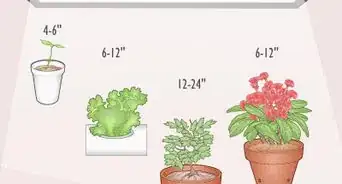
1Dumb cane and dracaena plants need different amounts of sunlight. For your dumb cane plants, find a spot in your home where your plants can get partial shade.[19] Try to find a spot in your home where your plant can get about 3-6 hours of sunlight each day without being exposed to the harsh, mid-day sun.[20] Dracaena plants do better in partial sunlight, like the edge of a sunny, south-facing window.[21]

Method 9
Method 9 of 9:Wait 2-3 months for your cuttings to grow.
-
1Cane cuttings grow pretty quickly, but you won’t see progress right away. Keep your potted cuttings in a sunny or partially sunny area, keeping the soil moist throughout the week. With regular watering, you should notice some growth progress in about 2-3 months![22]Advertisement

Community Q&A
-
QuestionCan you use soil for this?
 wikiHow Staff EditorThis answer was written by one of our trained team of researchers who validated it for accuracy and comprehensiveness.
Staff AnswerwikiHow Staff EditorStaff AnswerExperts actually suggest using a more specific potting mixture, like peat, sphagnum moss, perlite, sand, or vermiculite. -
QuestionWhen I make a cane cutting, can I root it by placing it in dirt?wikiHow Staff EditorThis answer was written by one of our trained team of researchers who validated it for accuracy and comprehensiveness.
Staff AnswerwikiHow Staff EditorStaff AnswerYes, you can! You can stick your cutting vertically into your potting mixture or nestle it horizontally on top. Cover your horizontal cuttings with your potting mix, and make sure any vertical cuttings are nestled at least 1 in (2.5 cm) into the soil. -
QuestionCan this propagation method work on woody stemmed dracaenas, such as Dracaena draco? If not, how would I go about it air layering?
 NinoxTop AnswererThe right method is close to this one. You need the top of the plant instead of the lower parts. The cutting must be only half-buried.







References
- ↑ https://www.purdue.edu/hla/sites/yardandgarden/extpub/new-plants-from-cuttings-text-only/
- ↑ http://www.ladybug.uconn.edu/FactSheets/dieffenbachia.php
- ↑ https://www.youtube.com/watch?v=IrWrskzb5oU&T=2m35s
- ↑ http://www.ladybug.uconn.edu/FactSheets/dieffenbachia.php
- ↑ https://plants.ces.ncsu.edu/plants/dracaena-fragrans/
- ↑ https://www.youtube.com/watch?v=IrWrskzb5oU&t=0m50s
- ↑ https://content.ces.ncsu.edu/plant-propagation-by-leaf-cane-and-root-cuttings-instructions-for-the-home-gardener
- ↑ https://www.youtube.com/watch?v=IrWrskzb5oU&t=1m52s
- ↑ https://www.youtube.com/watch?v=IrWrskzb5oU&t=0m47s
- ↑ https://extension.umaine.edu/gardening/manual/propagation/plant-propagation/
- ↑ https://pubmed.ncbi.nlm.nih.gov/30690985/
- ↑ https://aggie-horticulture.tamu.edu/plantanswers/misc/asexualpropagation.html
- ↑ https://pubmed.ncbi.nlm.nih.gov/23451487/
- ↑ https://www.purdue.edu/hla/sites/yardandgarden/extpub/new-plants-from-cuttings-text-only/
- ↑ https://www.youtube.com/watch?v=IrWrskzb5oU&T=2m55s
- ↑ https://www.youtube.com/watch?v=IrWrskzb5oU&T=2m51s
- ↑ http://www.ladybug.uconn.edu/FactSheets/dieffenbachia.php
- ↑ https://hgic.clemson.edu/factsheet/dracaena/
- ↑ https://gardeningsolutions.ifas.ufl.edu/plants/houseplants/dieffenbachia.html
- ↑ https://southernlivingplants.com/planting-care/a-gardeners-guide-to-sun-exposure/
- ↑ https://www.bhg.com/gardening/plant-dictionary/houseplant/dracaena/
- ↑ https://www.youtube.com/watch?v=IrWrskzb5oU&t=4m13s
About This Article