This article was co-authored by Andrea Rudominer, MD, MPH. Dr. Andrea Rudominer is a board certified Pediatrician and Integrative Medicine Doctor based in the San Francisco Bay Area. Dr. Rudominer has over 15 years of medical care experience and specializes in preventive health care, obesity, adolescent care, ADHD, and culturally competent care. Dr. Rudominer received her MD from the University of California, Davis, and completed a residency at the Lucile Packard Children's Hospital at Stanford University. Dr. Rudominer also has an MPH in Maternal Child Health from the University of California, Berkeley. She is a Member of the American Board of Pediatrics, a Fellow of the American Academy of Pediatrics, a Member and Delegate of the California Medical Association, and a Member of the Santa Clara County Medical Association.
There are 16 references cited in this article, which can be found at the bottom of the page.
This article has been viewed 152,621 times.
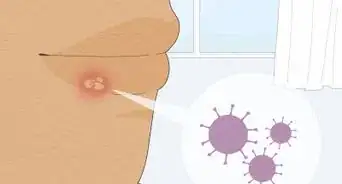
Cold sores (also called fever blisters), are caused by the herpes simplex virus.[1] They are painful blisters or lesions that commonly appear on the lips, nostrils, cheeks, chin, or inside of the mouth. Once contracted, there is no cure for the herpes virus; sufferers may have recurring cold sore outbreaks. The virus is easily spread to other places on your body and to other people, both when cold sores are present and when none are visible.

Steps
Method 1
Method 1 of 2:Preventing Sores from Spreading to Other Parts of Your Body
-
1Keep your fingers away from the cold sore(s). The herpes virus can spread to your fingers and cause a type of infection known as herpes whitlow. To prevent this, do not touch the cold sore with a bare finger, suck on your finger while you have a cold sore, or otherwise put your fingers into contact with the cold sore.[2] [3]
-
2Wash your hands frequently. Even if you take care not to touch your cold sore, you might touch it without realizing that you did. Washing your hands frequently will help keep the virus from spreading to other areas.[6]Advertisement
-
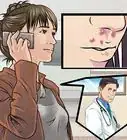
3Take medications to speed the healing process. Since the herpes virus is most contagious when cold sores appear, if you can make them go away, then you reduce the chances of spreading the virus elsewhere on your body.[7]
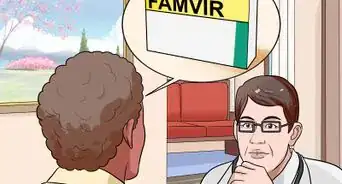
- Ask your doctor about what antiviral drugs (such as Acyclovir, Valacyclovir, Famciclovir, and Penciclovir) you can take to make the cold sores disappear sooner.
- Some antivirals are in pill form, while others are creams. For severe cases there are also injections.
- You can also take an over-the-counter cream (containing Docosanol) to shorten your cold sore outbreak.[8] [9] [10]
- If you use an antiviral cream, apply it to the cold sore while wearing a disposable glove and/or use a cotton swab. This will keep you from touching the cold sore and potentially spreading the virus.[11]
Advertisement


Method 2
Method 2 of 2:Preventing the Herpes Virus from Spreading to Others
-
1Keep in mind the risk of spreading the cold sore virus to others at all times. While the virus is most contagious when it causes painful cold sores to appear, it lies dormant in the body of an infected person at all times. This means that you can transmit the virus to others even if no cold sores are visible on your body.[12] [13]
-
2Wash your hands frequently. Even if you take care not to touch your cold sore, you might touch it without realizing that you did. Washing your hands frequently will help keep the virus from spreading to other people.[14]
-
3Do not share certain items with others. If you have a cold sore, you should not share with other people things like eating utensils, razors, towels, drinks, toothbrushes, lip balms, and other items that may come in contact with the cold sore or saliva. This includes secondary contact, as when your hand touches the cold sore and then the item.[15] [16]
-
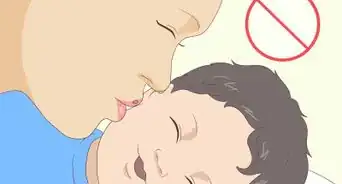
4Do not kiss anyone. The herpes virus can pass from your cold sore to another person through kissing, so to be safe you should refrain from kissing someone while you have a visible cold sore.[17]
-
5
-
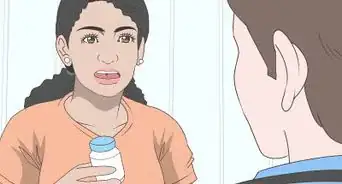
6Take medications to speed the healing process. Since the herpes virus is most contagious when cold sores appear, if you can make them go away, then you reduce the chances of spreading the virus to another person.[20]
- Ask your doctor about what antiviral drugs (such as Acyclovir, Valacyclovir, Famciclovir, and Penciclovir) you can take to make the cold sores disappear sooner.
- Some antivirals are in pill form, while others are creams. For severe cases there are also injections.
- You can also take an over-the-counter cream (containing Docosanol) to shorten your cold sore outbreak.[21] [22] [23]
- If you use an antiviral cream, apply it to the cold sore while wearing a disposable glove and/or use a cotton swab. This will keep you from touching the cold sore and potentially spreading the virus.[24]
Advertisement







References
- ↑ Andrea Rudominer, MD, MPH. Board Certified Pediatrician & Integrative Medicine Doctor. Expert Interview. 13 April 2020.
- ↑ http://www.mayoclinic.org/diseases-conditions/cold-sore/basics/definition/con-20021310
- ↑ http://www.uwhealth.org/health/topic/mini/cold-sores/hw31977.html
- ↑ http://www.uwhealth.org/health/topic/mini/cold-sores/hw31977.html#hw31988
- ↑ http://www.mayoclinic.org/diseases-conditions/cold-sore/basics/lifestyle-home-remedies/con-20021310
- ↑ http://www.uwhealth.org/health/topic/mini/cold-sores/hw31977.html
- ↑ https://www.mayoclinic.org/diseases-conditions/cold-sore/diagnosis-treatment/drc-20371023
- ↑ http://www.mayoclinic.org/diseases-conditions/cold-sore/basics/definition/con-20021310
- ↑ https://www.aad.org/dermatology-a-to-z/diseases-and-treatments/e---h/herpes-simplex/diagnosis-treatment
- ↑ http://www.nlm.nih.gov/medlineplus/ency/article/000606.htm
- ↑ http://www.uwhealth.org/health/topic/mini/cold-sores/hw31977.html#hw31988
- ↑ http://www.mayoclinic.org/diseases-conditions/cold-sore/basics/definition/con-20021310
- ↑ https://www.aad.org/dermatology-a-to-z/diseases-and-treatments/e---h/herpes-simplex
- ↑ https://www.betterhealth.vic.gov.au/health/conditionsandtreatments/cold-sores
- ↑ http://www.mayoclinic.org/diseases-conditions/cold-sore/basics/definition/con-20021310
- ↑ https://www.aad.org/dermatology-a-to-z/diseases-and-treatments/e---h/herpes-simplex/who-gets-causes
- ↑ http://www.mayoclinic.org/diseases-conditions/cold-sore/basics/definition/con-20021310
- ↑ https://www.betterhealth.vic.gov.au/health/conditionsandtreatments/cold-sores
- ↑ http://www.mayoclinic.org/diseases-conditions/cold-sore/basics/definition/con-20021310
- ↑ https://www.mayoclinic.org/diseases-conditions/cold-sore/symptoms-causes/syc-20371017
- ↑ http://www.mayoclinic.org/diseases-conditions/cold-sore/basics/definition/con-20021310
- ↑ https://www.aad.org/dermatology-a-to-z/diseases-and-treatments/e---h/herpes-simplex/diagnosis-treatment
- ↑ http://www.nlm.nih.gov/medlineplus/ency/article/000606.htm
- ↑ http://www.uwhealth.org/health/topic/mini/cold-sores/hw31977.html#hw31988
- ↑ http://www.uwhealth.org/health/topic/mini/cold-sores/hw31977.html
- ↑ http://www.mayoclinic.org/diseases-conditions/cold-sore/basics/risk-factors/con-20021310
- ↑ http://www.uofmchildrenshospital.org/healthlibrary/Article/89439










































Medical Disclaimer
The content of this article is not intended to be a substitute for professional medical advice, examination, diagnosis, or treatment. You should always contact your doctor or other qualified healthcare professional before starting, changing, or stopping any kind of health treatment.
Read More...