This article was co-authored by Geraldine Grace Johns and by wikiHow staff writer, Jessica Gibson. Geraldine Grace Johns is a Professional Ballerina and the Owner of Grace Ballet in New York and Los Angeles. Geraldine toured through New Zealand, Australia, Japan, and Korea as Jammes in Ken Hill's Original Phantom of the Opera. She has studied with the Royal Academy of Dance in London and taught for the Kudo School of Ballet in Yokohama. Geraldine also ran her own Royal Academy of Dance School in New Zealand before studying at the Neighborhood Playhouse School of the Theatre in New York City. Geraldine was a guest coach and Master Class teacher in Toronto for the Canadian Royal Academy of Dance's "Dance Challenge" in 2018, 2019, and 2020. She was also a guest coach and Master Class teacher for the USA Royal Academy of Dance Challenge in Long Beach, California in 2019 and 2020.
There are 9 references cited in this article, which can be found at the bottom of the page.
This article has been viewed 12,837 times.
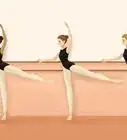
If you perform ballet, you're right to be concerned about knee injury. Knee injuries account for 14 to 20% of all ballet injuries.[1] Injuries are caused by a number of things: improper warm up or stretching, incorrect posture or form, and overworking of certain muscles. Fortunately, there are several ways to protect your knees so that you can enjoy ballet dancing for years.
Steps
Part 1
Part 1 of 2:Protecting Your Knees During Ballet
-
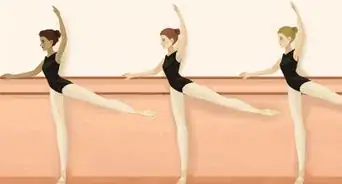
1Work with a professional. Find an instructor at a pre-professional ballet school that works with a professional ballet company. A great instructor can provide one-on-one help which can prevent injury and improve your poses.[2]
- Avoid simply relying on instruction from your peers or online lessons. You need to get proper feedback from a professional who's able to see if you're technique is correct.
-
2Practice on hardwood floors. Avoid dancing on hard floors like cement. Instead, the studio you use should have sprung wood (like harlequin) floors. This will help the floor absorb the shock of your movements. A good floor can prevent shin splints and other injuries.[3]
- Make sure the floor doesn't have too much rosin covering it in uneven patches. This can make it more likely for you to injure yourself.
-
3Warm up. Warming up exercises can loosen your muscles, making them less likely to tear or strain. Do exercises that get your blood pumping and really warm you up before you begin dancing. These will get you ready for more intense activity, which can improve your ballet dancing and prevent injury.[4]
- Do standing exercises for several minutes or try an aerobic exercise at a normal pace. Never push yourself too hard during a warm up.
-
4Do physical training. Exercise (physical training) is one of the best ways to reduce your risk of injury. While ballet is highly physical, most ballet dancers aren't active enough to improve their aerobic health. Work on a general fitness regimen throughout the week to reduce your risk of injury.[5]
- Be sure to avoid sports that are known for causing damage to the knees like basketball or tennis.
-
5Pay attention to pain. If you feel pain, this is your body telling you that something is wrong. Ask your instructor to watch you do the movement that caused you pain. Sometimes, you might just need technique correction which will stop the pain. But, if your instructor sees nothing wrong with your form, see a doctor.[6]
- If no specific move is causing you pain, follow the three day rule. If you feel pain for three days, tell your instructor.


Part 2
Part 2 of 2:Practicing Proper Technique
-
1Practice proper knee alignment. Your knees should always be in-line with your toes. If they're out of alignment, you'll put excess strain on the kneecaps and your lower leg muscles whether you're doing a plie or turnout. Stand with your knees soft and keep your spine elongated.
- Never lock your knees. This can hyperextend your knee, increasing mobility. But, it will also lead to knee injury and mis-alignment.
-
2Use your hips for good turnout. Research shows that using your knees spread your feet apart creates poor alignment and can lead to injury.[7] Instead, keep your muscles flexible. Lift your toes up and away from each other so that they're each at 90 degree angles. You should shift your weight not from your knees, but from your hips.[8] This will help your feet move apart naturally.
- You should never force your turnout. Using your knees instead of your hip muscles can put extra strain on your lower leg muscles and damage your knee.
-
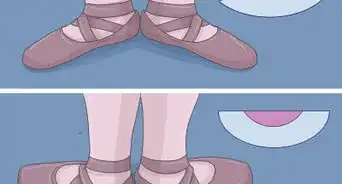
3Distribute weight throughout your feet. Foot hyperpronation ("rolling in") is a cause of knee injuries. When your feet roll in, the arches roll forward. Your tendons will try to compensate for this imbalance, leading to injury and inflammation (like tendonitis).[9] Instead, balance your weight throughout your foot.
- You should feel your weight at the heel, the big toe, and the little toe.[10]
-
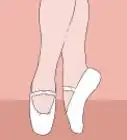
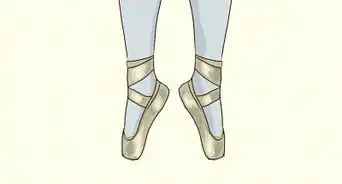
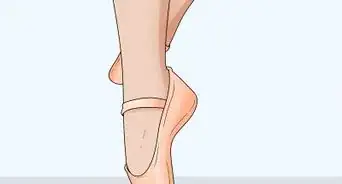
4Point your feet. Your foot should be pointed so that it creates a straight line extending from your calf. If you try to force your toes or point harder, you may actually make your foot sickle inward. Sickling breaks the imaginary line stretching from your calf so that it curves. It can also damage your muscles and form leading to injury.[11]
- You should keep your heel forward, not off to the side which can cause your foot to turn inward.[12]


Expert Q&A
-
QuestionHow do I stop my knee from hyperextending?
 Steve Horney PT, MPT, MTC, CSCSSteve Horney is a Licensed Physical Therapist and the Owner of Integrated Health Sciences, a New York City-based company that provides continuing education, health care products, and manual and movement physical therapy. Steve has over 15 years of academic and professional physical therapy training and specializes in the assessment and treatment of athletes with the goal of helping them become pain-free and less susceptible to injury. Steve is also a certified strength and conditioning specialist (CSCS) from the National Strength and Conditioning Association (NSCA). He received a BS in Health Science from Quinnipiac University in 2004 and a Masters of Physical Therapy (MPT) from Quinnipiac University in 2006. He then completed his Manual Therapy Certification (MTC) from the University of St. Augustine in 2014.
Licensed Physical TherapistDoing exercises that strengthen your hips, like squats, lunges, and bridges, can help prevent knee injuries.
Warnings
- If you do get injured, ice and use a brace or see a doctor. Continuing to dance could lead to further injury.Thanks!
References
- ↑ http://www.ncbi.nlm.nih.gov/pubmed/3064238
- ↑ http://www.ncbi.nlm.nih.gov/pmc/articles/PMC3871955/
- ↑ http://www.4dancers.org/2012/02/dance-wellness-causes-of-dance-injuries-risk-factors-part-i/
- ↑ Geraldine Grace Johns. Professional Ballerina & Ballet Instructor. Expert Interview. 11 November 2020.
- ↑ http://www.ncbi.nlm.nih.gov/pmc/articles/PMC3871955/
- ↑ http://www.danceadvantage.net/knee-deep/
- ↑ https://c.ymcdn.com/sites/www.iadms.org/resource/resmgr/imported/info/turnout_for_dancers_anatomy.pdf
- ↑ Geraldine Grace Johns. Professional Ballerina & Ballet Instructor. Expert Interview. 11 November 2020.
- ↑ http://dancemagazine.com/news/the_seven_deadly_sins/
About This Article