This article was co-authored by wikiHow Staff. Our trained team of editors and researchers validate articles for accuracy and comprehensiveness. wikiHow's Content Management Team carefully monitors the work from our editorial staff to ensure that each article is backed by trusted research and meets our high quality standards.
There are 14 references cited in this article, which can be found at the bottom of the page.
Learn more...
The rotten egg smell of hydrogen sulfide or H2S is unpleasant to begin with, but this gas is also legitimately dangerous if you shrug your shoulders and decide not to fix the problem. If you smell it at home, it's usually a plumbing issue, and not likely to do any real harm as long as you don't put off fixing it forever. In places with more concentrated hydrogen sulfide, like farm manure pits or some industrial workplaces, the gas is a much more serious risk. If you work anywhere near it, double check that your employer is doing everything they should to keep you safe.
Steps
Question 1
Question 1 of 7:What is hydrogen sulfide?
-
1Hydrogen sulfide is a gas produced by sewage, swamps, and manure. Also called H2S, this gas is heavier than air, so it can collect in low places like ditches and basements. If you smell rotten eggs in your water or air, this is probably hydrogen sulfide. Breathing it in over a long period of time could cause health problems, so it's a good idea to take some precautions if this happens.[1]
- The biggest risk from hydrogen sulfide happens on farms with manure storage areas, in sewage treatment plants, and in factories that use the gas for industrial processes. In these places, the gas can reach levels that cause serious harm and death in hours or even minutes. That doesn't mean that anyone who smells rotten eggs in their neighborhood is at risk of the same thing, since the gas is much less dangerous at low levels.[2]

Question 2
Question 2 of 7:How can I protect my home from hydrogen sulfide?
-
1Hire a plumber if your water smells like rotten eggs. This smell often means that hydrogen sulfide gas is coming from bacteria or pollution somewhere in your water supply. Have a plumber investigate. Depending on the cause, you might need to disinfect or replace part of the system (a water heater, water softener, pipes, or well), or install a filter for the groundwater.[3]
- Your sense of smell can narrow down the problem before the plumber gets there. Don't use the taps for a few hours, then smell the hot water to test your water heater, and the water from your water softener if you have one. If all your water (hot, cold, and unsoftened) smells bad but gets less smelly after a few minutes, the problem is probably in your pipes or well. If the smell sticks around, have your groundwater checked.[4]
-
2Close windows and stay inside when the air smells bad. Low levels of hydrogen sulfide sometimes leak into the air from factories or sewage treatment plants, or from natural sources like washed-up seaweed or sulfur springs.[5] This makes the air smell like rotten eggs, and while that doesn't mean it's immediately dangerous, it's not great to breathe that in day after day.[6] When that smell shows up, close the windows and spend most of your time indoors, or at least avoid exercising outdoors hard enough to cause heavier breathing.[7]
-
3Report air pollution to regulators. If you think a nearby business is polluting the air with hydrogen sulfide, you can make a complaint to a government agency for your state or country. Different regions organize this a bit differently, but typically you'd contact an environmental protection agency to report an industrial polluter, an agricultural department to report a farm, and/or the board of health to report a small business.[10]
- If you're not sure who to contact, start with the city council, the mayor's office, or another local government official.


Question 3
Question 3 of 7:What equipment do I need to protect myself from hydrogen sulfide in the workplace?
-
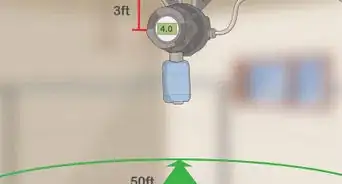
1Wear a gas monitor to alert you to danger. Clip the hydrogen sulfide monitor to your collar or breast pocket, so its sensor is near the air you're breathing. Make sure the sensor isn't covered. The monitor displays a digital readout of H2S concentration in parts per million, and sets off an alarm if it reaches dangerous levels.[11]
- You might need to set the alarm yourself. If the monitor has pre-set alarms, it is often one "low level" alarm at 10 ppm and a "high level" alarm at 15 ppm. Even a low level alarm should prompt you to leave the area within a few minutes for your safety.[12]
-
2Wear a specialized respirator around hydrogen sulfide. If you work with animal manure in enclosed spaces, or in an industrial workplace that uses H2S, you need a respirator with special cartridges designed to handle the gas. It's best to use a full-face respirator or safety goggles to protect your eyes as well as your lungs.[13]
- If your workplace has possible H2S concentrations of 100 parts per million or more (which can be lethal), you need a full face pressure breathing apparatus with its own air supply.[14]


Question 4
Question 4 of 7:How should workplaces be designed to limit hydrogen sulfide exposure?
-
1Use fire- and explosion-proof ventilation systems. Always keep ventilation and exhaust systems running in areas with hydrogen sulfide. Since the gas can catch fire and explode, the ventilation must be electrically grounded and spark-proof, and able to withstand an explosion. Make it out of corrosion-resistant materials and keep it separate from other ventilation systems.[15]
- Filter the hydrogen sulfide out of the air before venting it outside.[16]
-
2Test the air before and during work. Have a trained person use testing equipment to check the hydrogen sulfide levels before you begin. Check the readings often as you work, and consider installing sensors that set off alarms if the gas reaches dangerous levels.[17]
- Even though hydrogen sulfide smells like rotten eggs, at high concentrations it can shut down your sense of smell. Always rely on proper equipment in the workplace, never on your nose.[18]
-
3Train all workers and first aid responders. Anyone working near hydrogen sulfide needs to be trained to use testing equipment, use protective equipment, and understand what levels of the gas are dangerous and what symptoms they might cause. Design an escape plan for the worst-case scenario, and make sure all workers are trained to follow it. This includes medical responders who might need training and protective equipment.[19]
- Ideally, training should be done in-person, repeated annually, and given to everyone on the site, even one-time visitors to safer parts of the workplace.[20]


Question 5
Question 5 of 7:What are the symptoms of H2S exposure?
-
1Low-level exposure irritates the eyes, nose, and throat. If there's enough gas to notice its rotten egg smell, it can cause coughing and wheezing within fifteen minutes.[21]
-
2Long-term exposure can cause many health problems. Even at low levels you can't smell, H2S that sticks around long enough can cause headaches, nausea, and irritated eyes and throats. It may also damage your sense of smell, and could affect your muscle and blood health.[22] At higher levels (mostly found in workplaces), nerve damage is also a risk. This might cause muscle tremors, restlessness, memory loss, and personality changes.[23] At these high levels, it can also cause pregnant women to miscarry.[24]
-
3Major exposure can cause lethal lung and brain symptoms. Inhaling concentrated H2S gas causes breathing problems ranging from coughing to fluid in the lungs. It can also cause dizziness and excitement, or make the victim stagger around, collapse, fall unconscious, or die.[25] Depending on the concentration, this can happen right away or get steadily worse over several hours.[26]


Question 6
Question 6 of 7:What should I do if I am exposed to hydrogen sulfide?
-
1Get to clean air right away. If you think hydrogen sulfide might be making you cough or irritating your throat, leave the area right away and get to open air without any manure or other sources of the gas nearby. Once you are in a safe place, stop moving so your body can rest and focus on breathing.[29]
- If the gas irritated your eyes but not your lungs, hold your eyes open under lukewarm flowing water for 15 to 20 minutes.
-
2Call emergency services for any major symptoms. If you are having trouble breathing, feel dizzy, briefly fell unconscious, or have any other serious symptoms, call an ambulance. You could die if you are not given CPR or oxygen. Tell them that you were exposed to hydrogen sulfide, so they can protect themselves from gas that might still be on your skin.[30]
- If liquified gas freezes your skin or eyes, get medical help immediately. Flush eyes briefly, cover the skin or eyes with a sterile dressing, and don't drink alcohol, smoke, or try to warm the area.
-
3See a doctor if you're worried about long-term exposure. If you work near hydrogen sulfide, even at fairly low levels, you are at risk for health problems, including headaches, nausea, and possibly nerve damage or breathing problems. Although your doctor can't test you directly for hydrogen sulfide (since it doesn't stick around long in the body), they can track any symptoms you develop. You can ask specifically for tests of your sense of smell and your ability to exercise, since problems in these areas can be a sign of hydrogen sulfide damage.[31]
- The risk is usually much lower in homes that have hydrogen sulfide exposure, because the gas is so much less concentrated. That said, there's no clear-cut rule for what level of H2S is safe. Don't panic if you're getting headaches or irritated eyes at home, but do talk to a doctor.[32]


Question 7
Question 7 of 7:How long does hydrogen sulfide stay in your system?
-
1Hydrogen breaks down quickly in your body. Once the gas is inhaled, your body soon breaks it down and passes it harmlessly in your urine. If you keep getting headaches or irritated eyes, nose, or throat, then there's probably still hydrogen sulfide in the air you're breathing.[33]
- If you removed the source of the gas, it can still take up to three days for the lingering gas to break down in the air.[34]
- Severe exposure, or low-level exposure over a long period of time, can cause lasting damage to your body. Symptoms like newly developed asthma, muscle tremors, or difficulty thinking can stick around even after the gas is gone.[35]












References
- ↑ https://www.osha.gov/sites/default/files/publications/hydrogen_sulfide_fact.pdf
- ↑ https://ww2.health.wa.gov.au/Articles/F_I/Hydrogen-sulfide-and-public-health
- ↑ https://www.health.state.mn.us/communities/environment/water/wells/waterquality/hydrosulfide.html
- ↑ https://www.health.state.mn.us/communities/environment/water/wells/waterquality/hydrosulfide.html
- ↑ https://ww2.health.wa.gov.au/Articles/F_I/Hydrogen-sulfide-and-public-health
- ↑ https://ww2.health.wa.gov.au/Articles/F_I/Hydrogen-sulfide-and-public-health
- ↑ https://www.dph.illinois.gov/topics-services/environmental-health-protection/toxicology/indoor-air-quality-healthy-homes/hydrogen-sulfide-gas
- ↑ https://extension.psu.edu/use-personal-gas-monitors-to-avoid-exposure-to-toxic-hydrogen-sulfide
- ↑ https://ohsonline.com/articles/2007/10/human-health-effects-from-exposure-to-lowlevel-concentrations-of-hydrogen-sulfide.aspx
- ↑ https://www.mass.gov/guides/filing-environmental-complaints
- ↑ https://extension.psu.edu/use-personal-gas-monitors-to-avoid-exposure-to-toxic-hydrogen-sulfide
- ↑ https://extension.psu.edu/use-personal-gas-monitors-to-avoid-exposure-to-toxic-hydrogen-sulfide
- ↑ https://www.osha.gov/hydrogen-sulfide/evaluating-controlling-exposure
- ↑ https://www.osha.gov/hydrogen-sulfide/evaluating-controlling-exposure
- ↑ https://www.osha.gov/hydrogen-sulfide/evaluating-controlling-exposure
- ↑ https://www.ccohs.ca/oshanswers/chemicals/chem_profiles/hydrogen_sulfide.html
- ↑ https://www.osha.gov/hydrogen-sulfide/evaluating-controlling-exposure
- ↑ https://www.osha.gov/hydrogen-sulfide/evaluating-controlling-exposure
- ↑ https://www.osha.gov/hydrogen-sulfide/evaluating-controlling-exposure
- ↑ https://ehsdailyadvisor.blr.com/2019/11/5-common-myths-about-h2s-safety/
- ↑ https://ohsonline.com/articles/2007/10/human-health-effects-from-exposure-to-lowlevel-concentrations-of-hydrogen-sulfide.aspx
- ↑ https://ohsonline.com/articles/2007/10/human-health-effects-from-exposure-to-lowlevel-concentrations-of-hydrogen-sulfide.aspx
- ↑ https://www.ccohs.ca/oshanswers/chemicals/chem_profiles/hydrogen_sulfide.html
- ↑ https://pubmed.ncbi.nlm.nih.gov/9536160/
- ↑ https://www.ccohs.ca/oshanswers/chemicals/chem_profiles/hydrogen_sulfide.html
- ↑ https://fyi.extension.wisc.edu/agsafety/structures-and-storage/confined-spaces/manure-storagehandling/hydrogen-sulfide-health-effects/
- ↑ https://www.ccohs.ca/oshanswers/chemicals/chem_profiles/hydrogen_sulfide.html
- ↑ https://www.ccohs.ca/oshanswers/chemicals/chem_profiles/hydrogen_sulfide.html
- ↑ https://www.ccohs.ca/oshanswers/chemicals/chem_profiles/hydrogen_sulfide.html
- ↑ https://www.ccohs.ca/oshanswers/chemicals/chem_profiles/hydrogen_sulfide.html
- ↑ https://ohsonline.com/Articles/2007/10/Human-Health-Effects-from-Exposure-to-LowLevel-Concentrations-of-Hydrogen-Sulfide.aspx?Page=4
- ↑ https://ww2.health.wa.gov.au/Articles/F_I/Hydrogen-sulfide-and-public-health
- ↑ https://www.atsdr.cdc.gov/toxprofiles/tp114-c1.pdf
- ↑ https://ww2.health.wa.gov.au/Articles/F_I/Hydrogen-sulfide-and-public-health
- ↑ https://www.ccohs.ca/oshanswers/chemicals/chem_profiles/hydrogen_sulfide.html
- ↑ https://fyi.extension.wisc.edu/agsafety/structures-and-storage/confined-spaces/manure-storagehandling/hydrogen-sulfide-health-effects/














































Medical Disclaimer
The content of this article is not intended to be a substitute for professional medical advice, examination, diagnosis, or treatment. You should always contact your doctor or other qualified healthcare professional before starting, changing, or stopping any kind of health treatment.
Read More...