This article was co-authored by Ryan Corrigan, LVT, VTS-EVN. Ryan Corrigan is a Licensed Veterinary Technician in California. She received her Bachelor of Science in Veterinary Technology from Purdue University in 2010. She is also a Member of the Academy of Equine Veterinary Nursing Technicians since 2011.
There are 11 references cited in this article, which can be found at the bottom of the page.
This article has been viewed 3,555 times.
Heaves, also called recurrent airway obstruction, is a chronic, severe form of bronchitis that is caused by allergens in the air and airway inflammation.[1] It occurs when a horse breathes in particles, called allergens, that travel down to the lungs. The inflammation narrows the airways, trapping air in the lungs and making breathing difficult. Like treating heaves, preventing heaves is a lifelong commitment to reducing your horse’s exposure to allergens. The lifelong effort may sound daunting, but preventing heaves will allow your horse to live a happy and enjoyable life.
Steps
Part 1
Part 1 of 3:Preventing Heaves with Dietary Changes
-
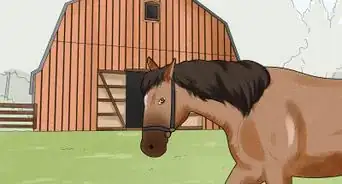
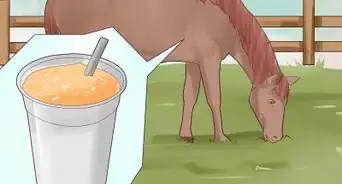
1Keep your horse out on pasture. Pasture time is key to preventing heaves in horses. The more time your horse spends out on pasture, the less he’ll be exposed to allergens inside his stable. In addition, he’ll get to eat plenty of grass, which is very healthy for him and won’t irritate his lungs.[2] Keep your horse out on pasture as much as possible—all day, if you can.
- Unfortunately, pasture time might increase the chances of heaves in some horses. If your horse has had pasture-associated heaves, keep him stabled until winter.[3]
-
2Don’t feed your horse from a round bale. Horses will often bury their faces directly in the round bale and then inhale the dust particles while they are eating. While you may be tempted to feed your horses this way because it is so easy, it is not good for your horse’s airways.Advertisement
-
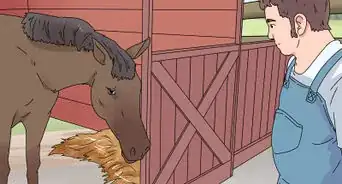
3Feed your horses from the floor to encourage mucus drainage. As a horse’s airways become irritated, the body will increase mucus production in the airways which further traps allergens and irritants. By feeding from the floor, gravity will help drain the mucus and keep your horse more comfortable.
-
4Do not feed your horse hay. Hay has a lot of dust and is a common culprit of heaves in horses. If you want to prevent heaves in your horse, take hay out of his diet, particularly round bale hay. Compared with other types of forage, round bale hay has higher amounts of dust, mold, and other allergens.[4] A horse will bury his nose in the bale and breathe in those allergens.[5]
- Even good-quality hay contains dust.[6]
- If you decide to feed your horse hay, soak it in water for up to 30 minutes to decrease its dust levels. Throw away any uneaten soaked hay, since it could develop mold when it dries out.[7]
- Rolled grains can also be dusty, so do not feed these to your horse.[8]
-
5Consider steaming your horse’s hay. If it is not practical to remove hay from your horse’s diet, you could steam it. A hay steamer heats up hay to a temperature (212 degrees F/100 degrees C) high enough to kill mold and fungus. Hay steamers produce water during the steaming process. Drain the water between uses and keep the steamer in a warm place during the winter so the water doesn’t freeze.[9]
- Discuss hay steaming with your veterinarian before investing in a hay steamer, as steaming can remove some vital nutrients from hay.
-
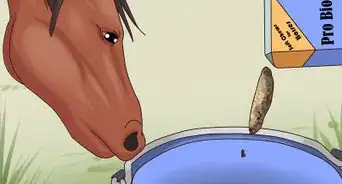
6Give your horse a complete pelleted feed in the winter. In winter, there won’t be much grass for your horse to eat. A commercially available pelleted feed is low in dust, which will help prevent heaves.[10] Your vet can recommend which pelleted feed to give your horse. A low-dust diet is important for preventing heaves.
- The term 'complete' indicates the feed contains all the required nutrients in the proper amounts.
- In the warmer months, you could also supplement the grass with the pelleted feed if your horse isn’t getting enough calories from pasture alone.[11]
-
7Include low-dust foods in your horse’s diet. Other than pelleted feed and grass, foods such as alfalfa cubes, alfalfa pellets, and silage are low in dust.[12] Alfalfa is a type of hay that horses really like. The cubed or pelleted forms of alfalfa are unlikely to cause heaves in horses.Advertisement


Part 2
Part 2 of 3:Reducing Allergens in Your Horse’s Environment
-
1Increase air flow in your horse’s stable. Adequate ventilation is essential to lowering the allergen count in your horse’s stable. An easy way to improve ventilation is to keep the stable windows and doors open as much as possible, even in cold weather.[13] If your horse gets cold, put a well-fitting blanket over him.[14] Other ventilation strategies are available:[15]
- Strategically place fans in the stable so they recirculate the air but do not blow dust particles back into the air. It may take some trial and error to determine where to place the fans.
- Install vents or windows in the roof so warm air can escape. Consider installing ridge vents, which run the length of a roof.
- If you are not comfortable doing the ventilation work yourself, work with a professional builder to improve the stable’s ventilation.
-
2Use low-dust bedding in your horse’s stall. In addition to ventilation, low-dust bedding will help keep allergens out of the air. Chopped paper and chopped cardboard are good low-dust beddings for horse stalls. Do not use straw bedding—it is very high in dust.[16]
- Rubber mats are another good bedding choice. Put just enough bedding in the stall on top of the rubber mat to absorb urine.
- If you have more than one horse, place low-dust bedding in all of the stalls.[17]
- Horses need much less bedding than most people believe. Reducing the amount of bedding also reduces the dust content circulating in the stall.
-
3Store hay away from your horse. Storing hay in the upper level of your stable may be convenient. However, that hay would be a constant source of allergens into the air, increasing the risk of heaves in your horse. It is very important not to store hay in the stable’s loft![18]
- Place the hay in a separate weatherproof building, such as a storage trailer.[19]
-
4Declutter the stable. Clutter can accumulate dust. Identify and remove unused items or items that don’t need to be stored in the stable. If needed items are collecting dust, wipe them down with a damp cloth to remove the dust.
- Be aware that removing the clutter will lessen only the visible dust.[20] There may still be dust and other particles lingering the air that you won’t be able to see.
-
5Moisten the arena footing. If you have an arena, your horse could kick up a lot of particles when exercising and training in the arena. If the arena footing is made of sand, dampen the sand to prevent it from flying into the air.[21] Alternatively, you could reduce dust by adding a special coated sand on top of the sand footing.[22]Advertisement


Part 3
Part 3 of 3:Cleaning Your Horse’s Stable and Stall
-
1Put your horse out on pasture. A clean stable is key to preventing heaves. Because cleaning can stir up a lot of dust and other air particles, it is best to keep your horse out on pasture during the cleaning process.[23]
-
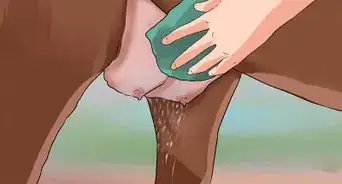
2Muck your horse’s stall every day. Mucking a horse stall involves removing feces and replacing the bedding. A pitchfork is useful for cleaning out the stall. If anything falls through the slats of the pitchfork, pick it up with a shovel. Damp spots on the stall floor indicate urine—clean up these spots with an absorbent deodorizer to remove the irritating smell of ammonia.[24]
- If you don’t see damp spots right away, inspect the entire stall for the scent of ammonia. Consider putting your head where your horse’s head would go.[25] You may be surprised where you end up smelling ammonia.
-
3
-
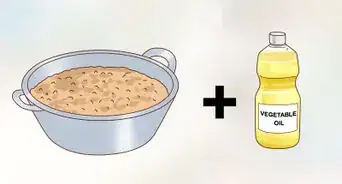
4Wait for at least an hour to bring your horse back in. Cleaning your horse’s stable, even with dampening the floor before sweeping, can put a lot of dust in the air. In fact, the cleaning process can increase the amount of airborne dust to 16 times above normal![29] It will take about an hour for all of the dust to settle back down to the floor, so keep your horse out on pasture for at least an hour after you’ve finished cleaning.[30]
-
5Consider whether the stall is adjacent to the arena. If the areas are connected, be sure to wet down the arena to reduce the amount of dust that is recirculated through the rest of the barn. You can do this by hand with a hose, or have a professional install an irrigation system above your indoor arena.Advertisement


Warnings
- Many particles in the air cannot be seen, but can still irritate a horse’s airways.[32]Thanks!
- Moldy hay can spontaneously burst into fire.Thanks!
- Silage can contain the botulinum toxin, which causes botulism. Before feeding silage to your horse, check your horse’s vaccination record to make sure he is vaccinated against botulism.[33]Thanks!

References
- ↑ http://www.veterinaryextension.colostate.edu/menu2/equine/treatingheaves-1.pdf
- ↑ http://www.merckvetmanual.com/mvm/respiratory_system/respiratory_diseases_of_horses/recurrent_airway_obstruction_in_horses.html
- ↑ http://edis.ifas.ufl.edu/vm142
- ↑ http://equusmagazine.com/article/horse-heaves-prevention-30165
- ↑ http://www.horsechannel.com/horse-news/2009/08/08/preventing-heaves.aspx
- ↑ https://www.extension.purdue.edu/extmedia/id/id-444-w.pdf
- ↑ https://www.dvm360.com/view/case-heaves-veterinarians-deal-with-recurrent-airway-obstruction-horses
- ↑ http://www.ca.uky.edu/agc/pubs/asc/asc172/asc172.pdf
- ↑ http://equusmagazine.com/article/horse-heaves-prevention-30165
- ↑ http://www.ca.uky.edu/agc/pubs/asc/asc172/asc172.pdf
- ↑ http://www.merckvetmanual.com/mvm/respiratory_system/respiratory_diseases_of_horses/recurrent_airway_obstruction_in_horses.html
- ↑ http://www.ca.uky.edu/agc/pubs/asc/asc172/asc172.pdf
- ↑ https://www.dvm360.com/view/case-heaves-veterinarians-deal-with-recurrent-airway-obstruction-horses
- ↑ https://extension.umn.edu/horse-care-and-management/caring-your-horse-winter
- ↑ https://www.extension.purdue.edu/extmedia/id/id-444-w.pdf
- ↑ http://www.ca.uky.edu/agc/pubs/asc/asc172/asc172.pdf
- ↑ http://equusmagazine.com/article/horse-heaves-prevention-30165
- ↑ http://www.ca.uky.edu/agc/pubs/asc/asc172/asc172.pdf
- ↑ https://www.extension.purdue.edu/extmedia/id/id-444-w.pdf
- ↑ https://www.extension.purdue.edu/extmedia/id/id-444-w.pdf
- ↑ http://www.horsechannel.com/horse-news/2009/08/08/preventing-heaves.aspx
- ↑ http://www.fivestarranch.com/articles/arena-footing.html#arena-footing
- ↑ https://www.dvm360.com/view/case-heaves-veterinarians-deal-with-recurrent-airway-obstruction-horses
- ↑ http://www.horsechannel.com/horse-exclusives/better-stall-cleaning.aspx
- ↑ http://equusmagazine.com/article/horse-heaves-prevention-30165
- ↑ https://www.dvm360.com/view/case-heaves-veterinarians-deal-with-recurrent-airway-obstruction-horses
- ↑ http://www.horsechannel.com/horse-news/2009/08/08/preventing-heaves.aspx
- ↑ http://www.ca.uky.edu/agc/pubs/asc/asc172/asc172.pdf
- ↑ https://www.extension.purdue.edu/extmedia/id/id-444-w.pdf
- ↑ http://www.ca.uky.edu/agc/pubs/asc/asc172/asc172.pdf
- ↑ https://www.extension.purdue.edu/extmedia/id/id-444-w.pdf
- ↑ https://www.extension.purdue.edu/extmedia/id/id-444-w.pdf
- ↑ http://www.ca.uky.edu/agc/pubs/asc/asc172/asc172.pdf
About This Article
To prevent heaves in your horse, keep it out on pasture as much as possible so it won’t be exposed to allergens inside the stable. While your horse is out on pasture, take some time to muck your horse’s stall and sweep, which will get rid of ammonia that can irritate its lungs. After you clean the stable, wait at least an hour before bringing your horse back inside so it doesn’t breathe in any dust that’s in the air. Besides keeping a clean stable, you should avoid feeding your horse round bale hay, since this type of hay has a lot of dust and mold which could be breathed in by your horse. If it’s not practical to take hay out of your horse’s diet, consider getting a hay steamer to kill mold and fungus on the hay before feeding time. To learn how to prevent heaves by choosing a new bedding, read more from our Veterinary co-author.