This article was medically reviewed by Tu Anh Vu, DMD. Dr. Tu Anh Vu is a board certified dentist who runs her private practice, Tu's Dental, in Brooklyn, New York. Dr. Vu helps adults and kids of all ages get over their anxiety with dental phobia. Dr. Vu has conducted research related to finding the cure for Kaposi Sarcoma cancer and has presented her research at the Hinman Meeting in Memphis. She received her undergraduate degree from Bryn Mawr College and a DMD from the University of Pennsylvania School of Dental Medicine.
There are 10 references cited in this article, which can be found at the bottom of the page.
This article has been viewed 30,756 times.
"Fuzzy Teeth" refers to buildup on teeth composed of food particles, plaque, and dead skin cells. If this film is not removed regularly, it can cause halitosis (bad breath) and gingivitis (gum disease) and lead to erosion of tooth enamel, cavities, and even tooth loss due to periodontitis.
Steps
Part 1
Part 1 of 3:Maintaining Oral Hygiene
-
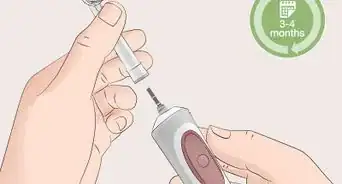
1Brush your teeth. Dentists recommend brushing twice daily for a total of two minutes each time. It's recommended that you imagine your mouth is divided into four quadrants — two upper, two lower — each of which is brushed for 30 seconds each. [1]
- Most electric toothbrushes are now pre-programmed with a timer to help you keep track of how long you've brushed each section and when to move to the next one.
-
2Remember to floss. Regular brushing can remove build up on the surface of your teeth, but what about the gaps between teeth? That's why flossing is important, preventing residual plaque from hardening into tartar or calculus.[2] In order to floss effective, follow these steps:
- Use enough floss. The American Dental association recommends 18 inches (45.7 cm). Wrap most of the length around the pointer or middle finger of one hand. Wrap of the rest around the index or middle finger of your other hand.
- Grasping the floss, use a seesawing motion to work the strand down between your teeth.
- When you reach the gum line, wrap the floss around the back of the tooth in a "C" shape.
- Pull the strand firmly against the tooth and, tugging back and forth between your fingers, rub the strand against your teeth until area near the gum line is free of plaque.
- Repeat with your other teeth, using fresh sections of the floss as needed.[3]
Advertisement -
3Use mouthwash. After brushing and flossing, what your mouth needs is a good rinse to wash away the residue of what you just cleaned off your teeth. Mouthwash is formulated to kill and reduce the number of bacteria that cause plaque and can help prevent gingivitis.[4]
-
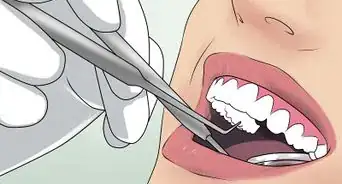
4Go to the dentist. Dentists recommend making a cleaning appointment every six months. This cleans up any plaque that was missed from your daily regimen. It also gives the dentist a chance to check your overall oral health and address any cavities or other problems.
-
5Get sealants. Sealants are a treatment that fills the crevices in molars with a composite compound, which has almost the same physical properties to your natural tooth structure. This means that even if your teeth do get fuzzy from time to time, it will cause less damage. Consult your dentist to see if you are a candidate for sealants. [5]Advertisement


Part 2
Part 2 of 3:Knowing What Not to Eat
-
1Avoid refined sugar. The bacteria that live in your mouth use sugar as a form of energy. When you eat sugary foods, their population explodes, more acid is generated in your mouth, and the rate of tooth decay increases dramatically.[6] The protective compounds you in saliva are overwhelmed by the fast growth in the acidic environment.
-
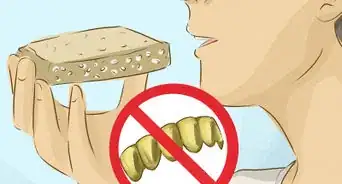
2Reduce starches. Starches like those found in breads, grains, and potatoes are a type of sugar and promote the same effect as refined sugars. Starches are also more prone to collect in the areas between your teeth.[7]
-
3Moderate consumption of oxalic acid. While oxalic acid doesn't actually harm teeth, eating food like spinach, beets, and parsley that contain high levels of oxalic acid will result in a fuzzy or chalky feeling on teeth.
-
4Balance your diet. Eat a variety of nutritious foods, including fruits and vegetables. Many vegetables — like celery, beans, and cabbage — actually have a neutralizing effect on the acids produced by the bacteria in plaque. This reduces the amount of fuzzy build up on your teeth.[8]
- Hard vegetables like carrots have a cleaning effect due to their fibrous texture and also increase antibacterial protection by stimulating the blood flow in the gums.
Advertisement


Part 3
Part 3 of 3:Understanding What Causes Fuzzy Teeth
-
1Avoid dry mouth. Your mouth naturally produces saliva to rinse your teeth free of bacteria-created acids. When you have dry mouth, it is because saliva production has been reduced. This increases the frequency of fuzzy teeth and promotes tooth decay.[9] Make sure you are drinking enough water every day (about eight 8-oz glasses) to avoid dry mouth. Factors that contribute to dry mouth are:
- Medication: Many medications list "dry mouth" as a side-effect.
- Smoking: Smoking dries out the mouth and requires increase saliva production to counteract the effects.
- Drinking alcohol: The dehydrating effect of alcohol reduces saliva production.
-
2Remove plaque. Plaque is the medical term for the combination of elements that coats our teeth between cleanings. It causes the irregular or fuzzy feeling on teeth and the reason that we brush, floss and rinse is to banish it from our mouths.[10]
-
3Know that there is no way to completely prevent fuzzy teeth. Mucopolysaccharides are a naturally occurring long-chain sugars that the body uses to make joint movements smooth and fluids more viscous. They are present in saliva to coat food, lubricating it for swallowing and digestion. Without them, digestion would take longer and we would be more prone to choking on food. Unfortunately, they are also why plaque adheres to your teeth, creating that fuzzy feeling.[11]Advertisement


Expert Q&A
-
QuestionHow do you reverse yellow teeth?
 Tu Anh Vu, DMDDr. Tu Anh Vu is a board certified dentist who runs her private practice, Tu's Dental, in Brooklyn, New York. Dr. Vu helps adults and kids of all ages get over their anxiety with dental phobia. Dr. Vu has conducted research related to finding the cure for Kaposi Sarcoma cancer and has presented her research at the Hinman Meeting in Memphis. She received her undergraduate degree from Bryn Mawr College and a DMD from the University of Pennsylvania School of Dental Medicine.
Board Certified DentistBrushing your teeth can help. Use a soft-bristle toothbrush and use the proper movements — up and down, not side to side, like you see in the movies. Use short strokes and hold your brush at a 45 degree angle. Brushing incorrectly can damage your enamel. -
QuestionHow do you motivate someone to brush their teeth every day?Tu Anh Vu, DMDDr. Tu Anh Vu is a board certified dentist who runs her private practice, Tu's Dental, in Brooklyn, New York. Dr. Vu helps adults and kids of all ages get over their anxiety with dental phobia. Dr. Vu has conducted research related to finding the cure for Kaposi Sarcoma cancer and has presented her research at the Hinman Meeting in Memphis. She received her undergraduate degree from Bryn Mawr College and a DMD from the University of Pennsylvania School of Dental Medicine.
Board Certified DentistThe best thing you can do is make it a habit. Encourage them to brush first thing in the morning and last thing at night before they go to bed. This will make brushing a part of their morning and evening routine, which will make them much less resistant to brushing. Another thing you can do to motivate them to brush for the right amount of time is to play a song while they brush so they do it for at least two minutes. This is a great way to make brushing fun for children!









References
- ↑ http://www.webmd.com/oral-health/healthy-teeth-14/brushing-teeth-mistakes
- ↑ http://www.mouthhealthy.org/en/az-topics/f/flossing
- ↑ http://www.webmd.com/oral-health/healthy-teeth-14/flossing-floss-sticks
- ↑ http://chealth.canoe.com/channel_section_details.asp?text_id=1018&channel_id=1029&relation_id=87429
- ↑ http://www.webmd.com/oral-health/guide/dental-sealants
- ↑ http://healthyteeth.org/what-about-sugar/
- ↑ http://www.livescience.com/2011-truth-tooth-decay.html
- ↑ http://www.webmd.com/oral-health/guide/plaque-and-your-teeth
- ↑ http://www.besthealthmag.ca/best-you/oral-health/why-is-my-mouth-always-dry














































Medical Disclaimer
The content of this article is not intended to be a substitute for professional medical advice, examination, diagnosis, or treatment. You should always contact your doctor or other qualified healthcare professional before starting, changing, or stopping any kind of health treatment.
Read More...