This article was co-authored by wikiHow Staff. Our trained team of editors and researchers validate articles for accuracy and comprehensiveness. wikiHow's Content Management Team carefully monitors the work from our editorial staff to ensure that each article is backed by trusted research and meets our high quality standards.
There are 7 references cited in this article, which can be found at the bottom of the page.
This article has been viewed 288,024 times.
Learn more...
When learning guitar, the D chord can be a great item to add to your repertoire. It is easy to learn, and can help you play your favorite songs in no time. This article will cover three different versions of D-chord.[1] All of these are D-major chords.
Steps
Method 1
Method 1 of 3:Playing an Open D (Common Fingering)
-
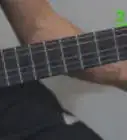
1Start on the 2nd fret of the guitar. An open D chord is bright, high-pitched, and expansive. It is one of the most commonly used chords, and works well with other common open chords like E, A, and G.[2]
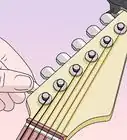
- Remember that frets count from the head down. If you're right-handed, the first fret is all the way to your left.[3]
-
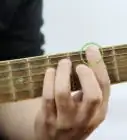
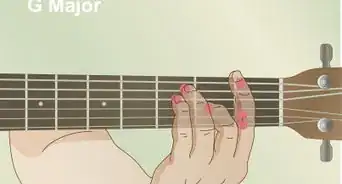
2Place your index finger on the 2nd fret, 3rd string. Remember that the strings count from the bottom up, so the thinnest string is the 1st and the thickest is the 6th. Place you index finger down on the 2nd fret, 3rd string.Advertisement
-
3Place your ring finger on the 3rd fret, 2nd string. Your two fingers will be diagonal to each other. [4]
-
4Put your middle finger on the 2rd fret of the 1st string. When you're done, you should have a triangle shape across the bottom three strings. This is your finished D chord!
-
5Strum every string except A and low E strings. Ignore the top two thickest strings on the guitar -- they are not used for the chord and will muck up the sound.
-
6Know that you can move this shape up and down the neck to make other chords. This simply three-fingered shape can be slide up and down the bottom three strings to make more chords. Practice playing moving up and down the neck, searching out other chords.
- Note: Your ring finger determines the root of the chord. If it is on a B, then the chord is a B.[5]
Advertisement


Method 2
Method 2 of 3:Playing a D-Major Barre Chord (A-Form)
-
1Go to the fifth fret of the guitar. This is a slightly "thicker," higher-pitched D chord. It is also much easier to get to when you're further down the neck, and easily transitions into other barre chords.
- If you already know it, this is simply an A-major barre chord located on the 5th fret, 5th string. This note is a D.[6]
-
2Bar the 5th fret with your index finger, getting all but the top string. Barre from the 1st to the 5th string with your index finger. Strum once to ensure that all of the strings are properly pressed down.
-
3Use your ring finger to barre the 2nd, 3rd, and 4th strings at the 7th fret. You can also place your pinkie on the 2nd string, seventh fret, your ring finger on the 3rd string, 7th fret and your middle finger on the 4th string, 7th fret. Most people find it easier to just barre the string, but you will get a cleaner sound with individual fingers.
- If you slid the entire thing up the neck, using open strings instead of a barred index finger, you'd have an open A chord.
-
4Leave the bottom string barred, or simply don't play it. The top and bottom strings are the least essential for your chord. If you can strum just the middle four strings, you'll have a better-sounding chord, but you can also strum the high-e string for a little more noise.
- Do not strum the top string.
Advertisement


Method 3
Method 3 of 3:Playing a D-Major Barre Chord (E-Form)
-
1Slide all the way down to the 10th fret. This is a very high and bright sounding D-chord, and isn't used too often unless you're playing all of your chords that far down the neck. Still, knowing how to form this chord is a lot of fun, and can give your songs a breath of fresh air when thrown in for a normal D.
- This chord is melodically identical to those before it, just at a different "octave."
-
2Barre the entire 10th fret with your index finger. This is simply an E-form barre chord,[7] meaning you form an E-major chord with your pinky, ring, and middle finger, then barre two frets up with the index. The result is the same shape as a normal E chord, just with barred notes instead of open notes.
-
3Place your ring finger on the 12th fret, 5th string. This note is an A. The first note, the one on the 10th fret, 6th string, is a D.
-
4Place your pinky on the 12th fret, 4th string. This is another D.
-
5Place your middle finger on the 11th fret, 3rd string. This note is an F#, and is needed for a full D chord.
-
6Leave the other strings barred, then strum all six at once. This chord uses every single string on the guitar, though you can stick just to the top ones for a thicker, slightly deeper chord.Advertisement


Community Q&A
-
QuestionHow do you go from the D chord to the E chord?
 Community AnswerFor a bar chord, it's a matter of sliding from the fifth fret to the second, and then putting your third finger on the G string, and your fourth on the B string.
 -
QuestionI tried doing the bar D chord for the 5th fret, but it only plays the 2 right up to the 5th string. I can't get my 6th string to make that clean sound. Any advice?
 Carly GallagherCommunity AnswerYou just need to push down on your fingertips as hard as you can to make a clean sound. It takes some practice.
Warnings
- Bar chords can be very hard to do at first, make sure you're doing it right to prevent any permanent injuries to your fingers; you're going to need them.Thanks!
- Don't get mad if you can't do it, try to try to try.Thanks!
- There are lots of other "D" chords, so beware which is which.Thanks!
Things You'll Need
- A guitar
- Two hands
- Practice
References
- ↑ https://www.jamplay.com/tools/guitar-chords/1-standard/4-d/85-major
- ↑ https://www.guitar-chord.org/articles/open-d-tuning.html
- ↑ https://www.guitarlessons.com/guitar-lessons/beginner-guitar-quick-start-series/fingers-frets-and-strings
- ↑ https://www.justinguitar.com/guitar-lessons/the-d-chord-bc-111
- ↑ https://takelessons.com/live/guitar/finger-placement-guitar-chords
- ↑ https://www.guitarforbeginners.com/barre_A.html
- ↑ https://www.guitarforbeginners.com/barre_E.html
About This Article

To play the D chord on a guitar, place your index finger on the third string from the bottom in the second fret. Place your ring finger in the third fret on the second string, so your index and ring fingers should be diagonal to each other. Place your middle finger in the second fret on the first string. Your fingers should make a triangle shape across the bottom 3 strings. Strum all of the strings except the top 2, the A and low E, to play the chord. If you want to learn how to play a D-major barre chord, keep reading the article!