X
wikiHow is a “wiki,” similar to Wikipedia, which means that many of our articles are co-written by multiple authors. To create this article, 11 people, some anonymous, worked to edit and improve it over time.
Learn more...
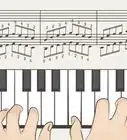
Arpeggios are notes of a chord played in succession, either ascending or descending. If you are practicing piano and want to learn the C Major arpeggio, this wikiHow will help.
Steps
Part 1
Part 1 of 4:Getting Started
Part 1
-
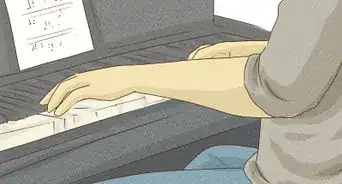
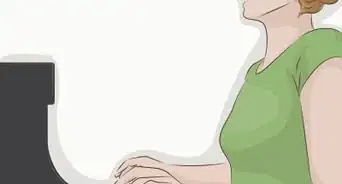
1Sit on the edge of the piano bench and stretch your arms out straight. If they hit the piano, move the bench back. This step is important, as if you are to close to the piano you will have bad position.
-
2Place your hands on the middle 'C' key on the piano. Curve your fingers and sit straight up. You want to have good posture when playing piano.
-
3Take a breath and double check your positioning before starting. It can be easy to rush into playing the arpeggio, but it is best to take your time before you start.


Part 2
Part 2 of 4:Learning the Notes and Timing on the Right Hand
Part 2
-
1Place your right hand (finger 1) on middle 'C'. Make sure each finger has a key. Fingers should not share piano keys, or be significantly spaced out for this arpeggio.
- If each finger does not line up with a key, re-position your hand.
-
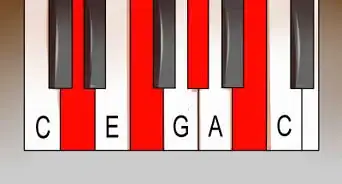
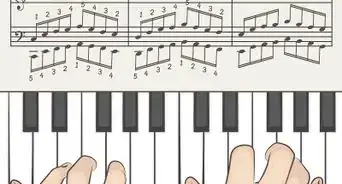
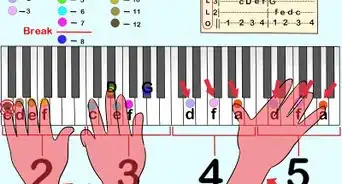
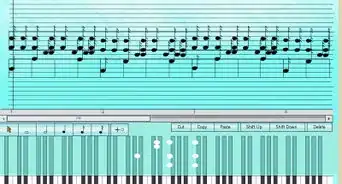
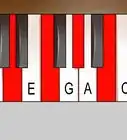
2Play the first 3 notes of the arpeggio (C, E, G) with fingers 1, 2 and 3. Then slide the thumb underneath to play the next 'C'.
-
3Play notes E, G and C with 2, 3 and 5.
-
4Come back down from the arpeggio. Repeat the succession backwards.
- If you are finding coming down from the arpeggio to be difficult, slow down! Set your metronome at a slow pace, and take your time. Arpeggios can be quite tricky, and they take awhile to get the hang out!
-
5Play whole notes when learning. To challenge yourself, play different rhythms like quarter notes, eighth notes, and half notes!


Part 3
Part 3 of 4:Learning the Notes and Timing on the Left Hand
Part 3
-
1Place your left hand on the 'C' below middle 'C'. Make sure each finger has a key.
-
2Play the first 3 notes of the arpeggio (C, E, G) with fingers 5, 3 and 2. Then use your thumb to play the next 'C'.
-
3Play notes E, G and C with 3, 2 and 1.
-
4Come back down from the arpeggio. Repeat the succession backwards.


Part 4
Part 4 of 4:Playing the Arpeggio Hands Together
Part 4
-
1Once you feel comfortable playing the arpeggio with both hands separately, you are ready to play the arpeggio with your hands together. Take it very slowly and try your best to play the correct fingering. If you slip up, don't worry - just take it again slowly. Playing arpeggios with your hands together can be quite challenging, so practice it over a couple of weeks. Remember, practice makes perfect, and you got this!