X
wikiHow is a “wiki,” similar to Wikipedia, which means that many of our articles are co-written by multiple authors. To create this article, volunteer authors worked to edit and improve it over time.
This article has been viewed 13,921 times.
Learn more...
The chromatic scale is both a peculiar and entertaining scale to learn. These instructions are designed to teach an intermediate piano player the proper technique and fingering pattern of the chromatic scale.
Steps
-
1Review the basics.
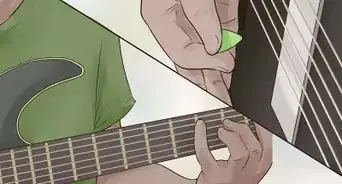
- Learn what numbers correspond with what fingers. The chromatic scale uses a unique fingering pattern. It differs from many other typical scale patterns in many ways, mainly because it only uses three of the five fingers.
- Remember the names of each note of the scale. The chromatic scale contains twelve pitches, each a semitone above or below another. "A semitone, also called a half step or a half tone, is the smallest musical interval commonly used in Western tonal music, and it is considered the most dissonant when sounded harmonically. It is defined as the interval between two adjacent notes in a 12-tone scale (e.g. from C to C♯)". It contains every tone between any one note and the same note an octave apart. We will start and end on C, but there is only one chromatic scale. No matter where you start, the fingering will be the same.
-
2Begin playing the scale.
- Play the first note (C) with your index finger (finger 1).
- Play the note a half step above the first (C#) with your middle finger (finger 3).
- As you play the C#, bring your thumb (finger 1) underneath your middle finger (finger 3).
Advertisement -
3Continue playing the scale.
- Repeat the motion of the first step, playing the next note (D) with your thumb (finger 1).
- Play half step above the first (Eb) with your middle finger (finger 3).
- As you play the Eb, bring your thumb (finger 1) underneath your middle finger (finger 3).
-
4Pay attention to the tricky part.
- Play the next note (E) with your thumb (finger 1).
- Play the next two (F, F#) with your index finger (finger 2) and middle finger (finger 3) in that order.
- As you play the F#, bring your thumb (finger 1) underneath your middle finger (finger 3).
-
5Continue playing the scale.
- Play the next note (G) with your thumb (finger 1).
- Play the next half step above the first (G#) with your middle finger (finger 3).
- As you play the G#, bring your thumb (finger 1) underneath your middle finger (finger 3).
-
6Continue playing the scale.
- Play the next note (A) with your thumb (finger 1).
- Play the next half step above the first (A#) with your middle finger (finger 3).
- As you play the A#, bring your thumb (finger 1) underneath your middle finger (finger 3).
-
7Finish the scale.
- One at a time, play the next note (B) with your thumb (finger 1) and then play the last note (C) with your index finger (finger 2).
Advertisement


Community Q&A
Did you know you can get answers researched by wikiHow Staff?
Unlock staff-researched answers by supporting wikiHow
-
QuestionWhat is the formula to find a scale?
 JayneCommunity AnswerA chromatic scale doesn't have a formula because it uses every note. For a Major scale, the formula is tone, tone, semitone, tone, tone, tone, semitone. For a Minor scale, the formula is tone, semitone, tone, tone, semitone, tone, tone (semitone = half step, tone = whole step).
 -
QuestionWhat is the formula?
 Joaquin BARBOSA VALDIVIACommunity AnswerJust increase the pitch in half steps; if you go from C4 to C5 including all notes in between, then you are playing the chromatic scale.







About This Article
Advertisement