This article was co-authored by Lauren Kurtz and by wikiHow staff writer, Danielle Blinka, MA, MPA. Lauren Kurtz is a Naturalist and Horticultural Specialist. Lauren has worked for Aurora, Colorado managing the Water-Wise Garden at Aurora Municipal Center for the Water Conservation Department. She earned a BA in Environmental and Sustainability Studies from Western Michigan University in 2014.
This article has been viewed 42,679 times.
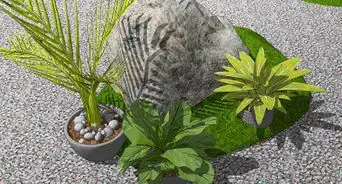
Rock gardens, or rockeries, recreate the beauty of wild plants growing amongst mountains or in the hard, arid soil of a desert area. Rock gardens can be planted in almost any location using low growing native plants to create natural-looking growth. Rock gardens feature hardy, drought-resistant plants that work well with Xeriscaping. With careful planning and time spent in your garden, you can create a rock garden oasis in your own yard.
Steps
Part 1
Part 1 of 3:Preparing a Location
-
1
-
2Avoid shade from trees and overhangs. On a day when you’re home, chart out where the shadows fall in your yard to make sure that your selected area does not fall under shade. You may find that during times you’re out of the house a large shadow covers your desired spot.[3]
- If you live in a region that gets very cold, you also want to avoid areas susceptible to frost. Frost can destroy your rock garden, so choose a spot in your yard that is least likely to freeze over.[4]
-
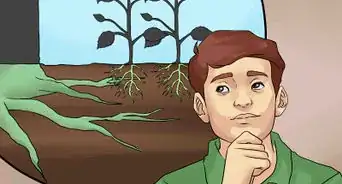
3Choose an area with good drainage. Rock gardens need to allow the water to drain off in order to thrive. The plants that work best for a rock garden are drought-resistant, so make sure that they won’t drown in poorly drained soil.[5]
- If you don’t find an area with good drainage, then you can build a raised bed.[6]
-
4
-
5Spread a base of broken rock or gravel. You should have about 6 inches (15 centimeters) of stone to support your rock garden. You will cover this stone with your topsoil, plants, and selected stones.[8]
-
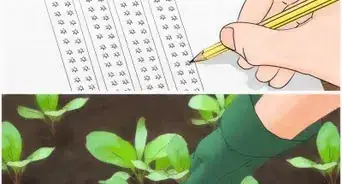
6Sketch out your plan. Include your rocks, the plants, and any shaded areas. If you are building a raised bed, factor that into your sketch.[9]
- You can choose complementary plants, such as all flowers, or a layered design, which would include different types of plants with varying sizes.[10]
- Great layering options include shrubs, flowers, mounded plants, and ground cover.
- Choosing different types of plants and rocks creates visual interest and more accurately portrays natural growth.[11]


Part 2
Part 2 of 3:Placing Your Stones
-
1Buy your stones. You can use any type of rock or stone, ranging from large boulders to gravel. For best results, choose a variety of sizes. Be sure to buy smaller rocks to support your large stones while also planning for stand-alone smaller rocks.[12]
-
2Outline your plot with sand. Use a light colored sand to recreate the designs from your sketch. The sand will help you place the heavier stones without risking having to move them.[15]
-
3Dig a small inset for the large rocks. Use a shovel or trowel to create a small indention in the ground. Go beyond your base level of rock or gravel and into the dirt below so that your large stones will be stable. You only need to remove a few inches of dirt to create a resting place for your stones.[16]
- The rock should fit in the ground about 1/3 of the way down. You can measure the rock if it helps you determine how deep to dig.
-
4Position small rocks near the inset. Before you move your large stones into place, put smaller stabilizing rocks near the indention you created. Some of the rocks may need to be moved into place after you place the larger rock.[17]
-
5Place your large rocks. Use a shovel or crowbar to move the large rocks in your chosen locations. After you have your large stone in place, reposition the smaller stabilizing rocks to help support the larger stones.[18]
-
6Position your remaining small stones. Based on the design you created, place the rest of your stones into your plot. Think about where you will be doing your planting.[19]
-
7Apply a top soil. Choose a top quality topsoil that meets the needs of the plants you’ve chosen. Your soil should cover at least one-third of the rock so that your stones will be stable in their positions. Keep the soil between your stones loose so that you can easily add your plants.[20]
-
8


Part 3
Part 3 of 3:Adding Vegetation
-
1Choose perennials. Perennials will return year after year, making your rock garden resilient to the changing seasons.[22]
- Popular perennials for rock gardens include rock cress, blanket flower, periwinkle, switchgrass, peonies, phlox, soapwort, coral bells, hardy hibiscus, oregano, and agave plants.
- If you really want the look of your favorite annuals, add them sparingly to your garden. Plan to replant those areas each year as the plants succumb to the seasons.
-
2Check your plant’s hardiness. Rock gardens usually include plants that can thrive in harsh conditions, such as alpine mountain environments. Make sure that the plants you want to include in your rock garden are strong enough to thrive.[23]
- Your rock garden should be low maintenance, so choose plants that are drought-resistant.[24]
- Use the USDA plant hardiness guide by visiting http://planthardiness.ars.usda.gov/phzmweb/interactivemap.aspx.
-
3Purchase your plants. Buying the plants at one time will help you visualize how they will look together, but it is possible to plant it in sections if you are working on a large plot.
-
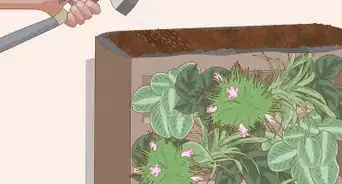
4Water the plants. Don’t remove the plants from their temporary pots. Use your garden hose, flower pail, or a cup to wet the dirt.[25]
- Once your rock garden is planted, how often you need to water your plants depends on your climate and plant choices. Because rock gardens are meant to be drought-resistant, you should not need to water them much after you initially establish the garden.[26]
-
5Position the plants before taking them out of the pots. Refer to your sketch and move the plants around until you are happy with the arrangement. Once you have your arrangement laid out, make sure that you aren’t creating a shady spot by putting a larger plant too close to a ground plant.[27]
-
6Allow space for plant growth. Overtime, your plants will grow in height and width. Plan for this growth as you do your planting so that your garden will flourish. Each plant should come with an informational card with the plant dimensions at maturity. If you did not receive this information, then look up your plant online.[28]
-
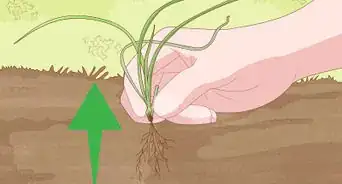
7Take the plants from the pots. Gently pull each plant out and shake the roots to untangle them to prepare the plant for transplant.[29]
-
8Place your plants under the topsoil and recover them with compost. Pat the soil down around the plant to keep it stable.[30]
-
9Apply gravel or grit on top of the topsoil. Finish your garden with a loose layer of gravel or grit. You can choose any small rock mixture that fits the aesthetic of your rock garden.[31]


Community Q&A
-
QuestionI want to do a rock garden under my deck, which is a large space without a lot of sun. Can this be done?
 Lauren KurtzLauren Kurtz is a Naturalist and Horticultural Specialist. Lauren has worked for Aurora, Colorado managing the Water-Wise Garden at Aurora Municipal Center for the Water Conservation Department. She earned a BA in Environmental and Sustainability Studies from Western Michigan University in 2014.
Professional GardenerPotentially. You will have to choose plants that grow well in shade or part shade.
Warnings
- Check with local authorities about collecting native plants. Some plants are considered a protected species.Thanks!
Things You'll Need
- Stones or rocks of various sizes
- Plants
- Gravel or grit
- Topsoil
- Compost
- Base rocks or stones
- Water

References
- ↑ https://www.rhs.org.uk/advice/profile?pid=837
- ↑ https://www.rhs.org.uk/advice/profile?pid=837
- ↑ https://www.rhs.org.uk/advice/profile?pid=837
- ↑ https://www.rhs.org.uk/advice/profile?pid=837
- ↑ https://www.rhs.org.uk/advice/profile?pid=837
- ↑ https://www.rhs.org.uk/advice/profile?pid=837
- ↑ https://www.rhs.org.uk/advice/profile?pid=837
- ↑ https://www.rhs.org.uk/advice/profile?pid=837
- ↑ https://www.rhs.org.uk/advice/profile?pid=837
- ↑ http://www.bhg.com/gardening/design/styles/rock-garden-designs/
- ↑ http://www.bhg.com/gardening/design/styles/rock-garden-designs/?slideId=368175fa-d3e5-437d-9494-9fbd78994521
- ↑ https://www.rhs.org.uk/advice/profile?pid=837
- ↑ https://www.rhs.org.uk/advice/profile?pid=837
- ↑ https://www.rhs.org.uk/advice/profile?pid=837
- ↑ https://www.rhs.org.uk/advice/profile?pid=837
- ↑ https://www.rhs.org.uk/advice/profile?pid=837
- ↑ https://www.rhs.org.uk/advice/profile?pid=837
- ↑ https://www.rhs.org.uk/advice/profile?pid=837
- ↑ https://www.rhs.org.uk/advice/profile?pid=837
- ↑ https://www.rhs.org.uk/advice/profile?pid=837
- ↑ https://www.rhs.org.uk/advice/profile?pid=837
- ↑ http://www.bhg.com/gardening/design/styles/rock-garden-designs/?slideId=fd7aeb2e-e839-4dd3-9f4c-63917976d98a
- ↑ http://www.bhg.com/gardening/design/styles/rock-garden-designs/
- ↑ http://www.bhg.com/gardening/design/styles/rock-garden-designs/?slideId=06052324-15ec-47b8-a6bc-3f70ec2429bd
- ↑ https://www.rhs.org.uk/advice/profile?pid=837
- ↑ http://www.finegardening.com/rock-garden-primer
- ↑ https://www.rhs.org.uk/advice/profile?pid=837
- ↑ https://www.rhs.org.uk/advice/profile?pid=837
- ↑ https://www.rhs.org.uk/advice/profile?pid=837
- ↑ https://www.rhs.org.uk/advice/profile?pid=837
- ↑ https://www.rhs.org.uk/advice/profile?pid=837
About This Article