This article was co-authored by wikiHow Staff. Our trained team of editors and researchers validate articles for accuracy and comprehensiveness. wikiHow's Content Management Team carefully monitors the work from our editorial staff to ensure that each article is backed by trusted research and meets our high quality standards.
This article has been viewed 17,928 times.
Learn more...
Parsnips are a root vegetable closely related to carrots. They thrive in temperate climates with lots of rainfall and are moderately easy to grow. Parsnips are healthy and sweet and you can enjoy them in a variety of recipes. They go especially well in soups and stews! Follow the steps on this list to plant your own parsnips for a tasty addition to your vegetable garden.
Steps
Method 1
Method 1 of 14:Timing
-
1Plant parsnips in mid-spring. Soil temperatures must be steadily above 50 °F (10 °C) to grow parsnips. Wait until March, April, or May, or whenever daily temperatures are between 50–70 °F (10–21 °C), to sow parsnip seeds. This is when the seeds germinate best.[1]
- Parsnip seeds don’t germinate as well if temperatures frequently exceed 80 °F (27 °C)

Method 2
Method 2 of 14:Sun
-
1Pick a site that receives 6+ hours of sun daily. Parsnips require full sun to grow and anything more than 6 hours of sun per day is considered full sun. Don’t choose a planting site that gets any less than that or the parsnip seeds won’t germinate.[2]

Method 3
Method 3 of 14:Soil type
-
1Provide deep, fertile, well-drained, sandy soil. Parsnips need light soil that’s rich in organic materials to flourish. If your garden has heavy soil, dig it up thoroughly to break up chunks of soil and clumps of organic material.[3]
- Avoid planting parsnips in clay or rocky soils.
- To test soil drainage, dig a hole 12 in (30 cm) deep and 8–12 in (20–30 cm) wide. Fill the hole with water and let it drain completely. Wait 12 hours, then fill it with water again and time how long it takes for the water to drain. If the soil is well-draining, the water should all be gone in 2-3 hours tops.

Method 4
Method 4 of 14:Nutrients
-
1Add up to 1 in (2.5 cm) of organic compost to the soil’s surface. Do a soil test to determine if the soil needs more nutrients. If so, add an even layer of compost no more than 1 in (2.5 cm) thick to the top of the soil. This acts as fertilizer to provide the parsnips with more nutrients.[4]
- The soil should have good levels of nitrogen, phosphorus, and potassium.
- Avoid adding clumps of fresh organic matter, such as manure, to the surface. This can cause misshapen roots. Make sure any compost you use is well broken up.

Method 5
Method 5 of 14:Soil pH
-
1Test the soil’s pH to check for a slightly acidic range of 6-7. Work peat moss into the top 2–3 in (5.1–7.6 cm) of soil to decrease the pH if it is not acidic enough. Or, work agricultural lime into the soil to increase the pH if it is too acidic.[5]

Method 6
Method 6 of 14:Planting depth
-
1Sow seeds 1⁄2–3⁄4 in (1.3–1.9 cm) deep. This is the ideal depth for germination. Push 2 or 3 seeds into the soil every 1 in (2.5 cm) or so to help ensure enough germination for a good stand of parsnips. Cover each seed hole up lightly with soil or compost.[6]
- Even the freshest parsnip seeds struggle to germinate, which is why it’s best to sow them somewhat thickly.
- Parsnip seeds older than 1 year won’t germinate.

Method 7
Method 7 of 14:Spacing
-
1Space rows 18–24 in (46–61 cm) apart. Give rows of parsnips plenty of room for root development. If you’re planting more than 1 row of parsnips, make sure to space them out evenly. Parsnip roots can grow up to 20 in (51 cm) long![7]
- You may choose to plant radishes along with parsnips to mark the rows and reduce surface crusting. Just be sure to pull the radishes out once the parsnips start coming up.

Method 8
Method 8 of 14:Weeding
-
1Pull out any weeds from the soil by hand. Keep the soil weed free while you wait for seedlings to grow. Check on the planting site regularly and gently remove any weeds that you see growing. Avoid hoeing or digging weeds up or you could hurt the parsnips.[8]
- Parsnips seeds take at least 3 weeks to germinate.
- Continue to weed once your parsnips come up, being careful not to crush or damage the foliage of the seedlings.

Method 9
Method 9 of 14:Watering
-
1Keep the soil evenly moist from the time of planting and onwards. Parsnips require consistent moisture from when they are germinating until harvest time. Water your plot of parsnips about once a week if there is no rainfall that week, or whenever the soil starts to dry out. Be careful not to let the soil dry out and crust over. [9]

Method 10
Method 10 of 14:Thinning
-
1Thin seedlings to 2–4 in (5.1–10.2 cm) apart. When the parsnips start sprouting, reduce crowding. Pull up and discard any seedlings that are within 2–4 in (5.1–10.2 cm) of their neighbor. The remaining parsnip will appreciate the extra room to grow![10]
- You can thin the seedlings by hand or using a hoe.

Method 11
Method 11 of 14:Mulching
-
1Apply 1–2 in (2.5–5.1 cm) of organic mulch to the beds in the summer. A light layer of mulch can help with moisture retention and reduce the number of weeds. Grass clippings, leaves, and straw are all good choices for mulching.[11]

Method 12
Method 12 of 14:Caterpillars
-
1Manually remove any caterpillars from the seedlings. Watch for swallowtail-butterfly caterpillars that like to feed on parsnips. If you see any caterpillars crawling on the foliage, pick them off by hand and discard them. This is typically all it takes to control them and keep your parsnips safe.[12]
- Swallowtail-butterfly caterpillars are green with black stripes and yellow spots.

Method 13
Method 13 of 14:Carrot flies
-
1Protect the plants from carrot flies with horticultural fleece or polythene. Carrot fly larvae cause parsnip roots to rot. To protect your plants from the flies laying their larvae, cover them with horticultural fleece. Or, put 2 ft (0.61 m) high barriers made of clear polythene around the plot to keep out the low-flying female carrot flies.[13]
- Once carrot fly larvae get into your parsnips and cause them to rot, there’s nothing you can do. Prevention is the only way to deal with this problem.

Method 14
Method 14 of 14:Harvesting
-
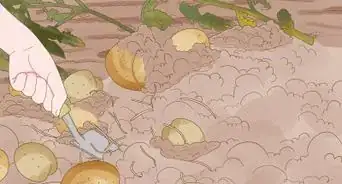
1Harvest the roots when they are 1 in (2.5 cm) in diameter. This is usually in late fall, or about 16 weeks after planting. Dig up the roots with a tilling spade, a shovel, or a spading fork. Note that parsnip foliage can cause skin irritation for some people, so wear gardening gloves and a long-sleeved top to be safe.[14]
- You can expect to harvest about 1 lb (0.45 kg) of parsnips per 1 ft (0.30 m) of planting row. Individual parsnip roots can weigh more than 1 lb (0.45 kg) each!
- If you don’t want to harvest all the parsnips in fall, you can cover the soil in mulch and overwinter them in the ground. Harvest them in the spring before the tops start to sprout.

Community Q&A
-
QuestionWhen are parsnips ready to pick?
 NinoxTop AnswererParsnips are ready to pick between 4 and 5 month after seeding. You can leave the plants in the ground after that; parsnips can sustain frost.
 -
QuestionHow far apart should I plant seedlings?NinoxTop AnswererFirst you plant the seeds close to each other. Then you thin the seedlings to leave 25 cm (10 in) between each plant.
-
QuestionWill parsnips grow over winter?
 Gavin DonnellyCommunity AnswerNo, but you can store them in the ground by mulching over them, then harvest them in the spring before they start to sprout again.
 -
QuestionWhen should I plant parsnips?Gavin DonnellyCommunity AnswerAnytime in spring when temperatures are higher than 50 degrees F. March, April, and May are usually all good times.

References
- ↑ https://research.wsulibs.wsu.edu/xmlui/bitstream/handle/2376/13128/FS314E.pdf?sequence=1&isAllowed=y
- ↑ https://research.wsulibs.wsu.edu/xmlui/bitstream/handle/2376/13128/FS314E.pdf?sequence=1&isAllowed=y
- ↑ https://digitalcommons.usu.edu/cgi/viewcontent.cgi?article=1288&context=extension_curall
- ↑ https://digitalcommons.usu.edu/cgi/viewcontent.cgi?article=1288&context=extension_curall
- ↑ https://extension.umn.edu/vegetables/growing-carrots-and-parsnips-home-gardens#soil-testing-and-fertilizer-190710
- ↑ https://web.extension.illinois.edu/veggies/parsnip.cfm
- ↑ https://web.extension.illinois.edu/veggies/parsnip.cfm
- ↑ https://www.rhs.org.uk/advice/grow-your-own/vegetables/parsnips
- ↑ https://www.rhs.org.uk/advice/grow-your-own/vegetables/parsnips
- ↑ https://web.extension.illinois.edu/veggies/parsnip.cfm
- ↑ https://research.wsulibs.wsu.edu/xmlui/bitstream/handle/2376/13128/FS314E.pdf?sequence=1&isAllowed=y
- ↑ https://web.extension.illinois.edu/veggies/parsnip.cfm
- ↑ https://www.rhs.org.uk/advice/grow-your-own/vegetables/parsnips
- ↑ https://www.canr.msu.edu/resources/how_to_grow_parsnips
About This Article