This article was co-authored by Lauren Kurtz. Lauren Kurtz is a Naturalist and Horticultural Specialist. Lauren has worked for Aurora, Colorado managing the Water-Wise Garden at Aurora Municipal Center for the Water Conservation Department. She earned a BA in Environmental and Sustainability Studies from Western Michigan University in 2014.
This article has been viewed 13,602 times.
Lily of the Valley is a plant with a white blossom that has a sweet scent. This plant thrives in hardiness zones 2 through 7. Even if you don’t live in the ideal climate, this plant can also be grown indoors. Once planted, Lily of the Valley is easy to grow and easy to maintain, which makes it ideal for bringing a touch of beauty into your home without too much extra effort.
Steps
Method 1
Method 1 of 3:Planting Lily of the Valley Outside
-
1Choose a shaded location where the soil drains well. Lily of the Valley does best in light to partial shade. Once you’ve found a shady location, test out the soil. Ideally, the soil should be well-drained. To test this, pour a cup of water onto one spot of the soil. If the water is still puddled after 5 to 6 hours, it isn’t well-drained. It is good soil, however, if the soil is only damp after that amount of time.[1]
- Soil can be improved by adding about 2 to 6 inches (5.1 to 15.2 cm) of organic matter, such as compost, peat moss, or ground bark, to the soil.
-
2Soak the pips in lukewarm water. This is not absolutely necessary, but it definitely helps “wake up” the pips, or bulbous roots, before planting. Take the bag your pips came in, add enough lukewarm water to the bag to saturate the pear, and leave it in the sink for a couple of hours. This will harden up the pips so that they are ideal for planting.[2]Advertisement
-
3Cut 1 inch (2.5 cm) of off the roots. Use a pair of scissors to snip off the last inch. This will encourage the roots to take in more moisture, which will encourage growth. Cut off the ends as soon as you take them out of the water and then plant them right away. The pips will dry out if you leave them out for too long.[3]
-
4Plant the pips 1.5 inches (3.8 cm) apart. Planting them this far apart should leave enough room so that your plants do not grow too close together. Plant them so that only the very top of the pip appears above the ground. Then, water the soil until it is thoroughly moistened.[4]
- Alternatively, you could also plant the pips in the fall before the soil freezes. For a fall planting, don't soak your pips.[5]
-
5Water the plant once a week. You only need to water the plants during the spring, summer, and fall. Only provide about 1 inch (2.5 cm) of water. If you receive rain that equals 1 inch (2.5 cm), you do not need to water your plants that week.[6]
- Lily of the Valley is a perennial. While it may not actively grow in the winter, you should still water it weekly.
-
6Leave the foliage in place after the growing season. Once the growing season is over, don’t remove the foliage on your Lily of the Valley. The foliage gathers sunlight, which provides strength for future plants. If you live in a location that stays moderately warm, your Lily of the Valley may stay in bloom all year long.[7]
- You can cut off yellow leaves in late winner.
Advertisement


Method 2
Method 2 of 3:Using a Pot for Your Plants
-
1Fill your chosen container with well-drained soil. You can choose to plant Lily of the Valley in a pot, barrel, tub, or urn. Make sure, however, that your chosen container has drainage holes. Then, fill the container all the way to the top with well-drained soil. Any type of commercial potting soil will work.[8]
- You can test to see if your soil is well-drained by pouring a cup of water into it and leaving it for 5 or 6 hours. The soil is not ideal if a puddle is still there. The soil is well-drained if the soil is only damp after that amount of time.
-
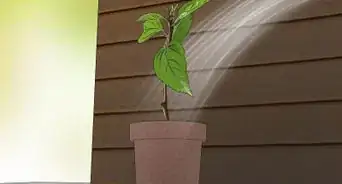
2Choose a lightly shaded location for your plant. Lily of the Valley does best in a partially shaded location. Locate a lightly shaded area in your home. Put the container there until you are ready to plant.[9]
-
3Snip off the end of the roots. Use scissors to cut 1 inch (2.5 cm) off of the ends of the roots. This will stimulate growth because the root can take in more moisture. Make sure to plant the pips right away after snipping the roots.[10]
- You can also stimulate growth by adding lukewarm water to the bag the pips came in, and leaving them in the sink for 2 hours. This will “wake” the pips up.
-
4Plant the pips 1.5 inches (3.8 cm) apart. Plant the pips in the pot about 1.5 inches (3.8 cm) apart. Once you plant them, only the very top of the pips should be sticking out. Soak the soil with water when you are done planting.[11]
-
5Water once a week during the spring, summer, and fall. Pour about 1 inch (2.5 cm) of water onto your plants. Keep in mind that if you live in a warm location or keep your home fairly warm all year long, your plant might bloom during every season. In this case, you would need to water your plants all year.[12]Advertisement


Method 3
Method 3 of 3:Keeping Lily of the Valley Healthy
-
1Divide the plants if they become overcrowded. If you notice that your blooms become sparse, check for overcrowding. You can tell they are overcrowded if the blooms are overlapping each other. Divide or thin the plants to solve this problem for the next season of growth.[13]
-
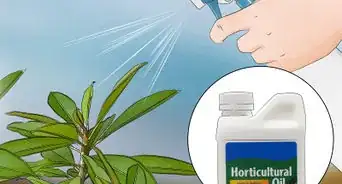
2Spray weevils with insecticide. If you notice notched leaves, this is a sign of weevils. The weevils do not seriously harm the plant, but it’s a good idea to kill off the weevils. You can do this by spraying an insecticide on both sides of the leaves 2 to 3 times every 7 to 10 days until there are no more weevils.[14]
-
3Attract snails and slugs with beer. Snails and slugs are attracted to moist soil, so you may notice them leaving ragged holes in the leaves of your plant. To stop this, set out a cup of beer. The snails and slugs are attracted to the yeast in beer, so they will climb into the cup and drown.[15]
-
4Use fungicide on severe fungal leaf spot. Brown spots on leaves indicate fungal rot. If you notice this on only a few leaves, simply picking off the leaves will solve the problem. A severe case of fungus will require spraying a sulfur-based fungicide on the leaves every 7 to 10 days until the problem has been solved.[16]
- Fungal rot may also be caused by excess moisture. To solve this problem, cut off the affected parts of the plant, add peat to soak up excess moisture, and reduce watering.
Advertisement
Community Q&A
-
QuestionI received a small amount of lily of the valley bulbs, but won’t be planting for a few days. Should the bulbs be refrigerated?
 NinoxTop AnswererYou don't have to refrigerate the bulbs, but put them in a shady place to avoid sprouts growing outside dirt.
Warnings
Things You’ll Need
- Well-drained soil
- Lily of the Valley pips
- Watering can
- Scissors
- Pot with drainage holes (or other container)
- Insecticide (optional)
- Fungicide (optional)
- Beer (optional)
- Peat or compost (optional)



References
- ↑ https://www.easytogrowbulbs.com/pages/lily-of-the-valley-planting-guide
- ↑ https://www.easytogrowbulbs.com/pages/lily-of-the-valley-planting-guide
- ↑ https://www.easytogrowbulbs.com/pages/lily-of-the-valley-planting-guide
- ↑ https://www.easytogrowbulbs.com/pages/lily-of-the-valley-planting-guide
- ↑ http://www.gardening.cornell.edu/homegardening/scene2835.html
- ↑ https://www.easytogrowbulbs.com/pages/lily-of-the-valley-planting-guide
- ↑ https://www.easytogrowbulbs.com/pages/lily-of-the-valley-planting-guide
- ↑ https://www.easytogrowbulbs.com/pages/lily-of-the-valley-planting-guide
- ↑ https://www.easytogrowbulbs.com/pages/lily-of-the-valley-planting-guide
- ↑ https://www.easytogrowbulbs.com/pages/lily-of-the-valley-planting-guide
- ↑ https://www.easytogrowbulbs.com/pages/lily-of-the-valley-planting-guide
- ↑ https://www.easytogrowbulbs.com/pages/lily-of-the-valley-planting-guide
- ↑ http://gardening.yardener.com/Problems-Of-Lily-Of-The-Valley
- ↑ http://gardening.yardener.com/Problems-Of-Lily-Of-The-Valley
- ↑ http://gardening.yardener.com/Problems-Of-Lily-Of-The-Valley
- ↑ http://gardening.yardener.com/Problems-Of-Lily-Of-The-Valley
- ↑ https://www.easytogrowbulbs.com/pages/lily-of-the-valley-planting-guide
- ↑ https://www.easytogrowbulbs.com/pages/lily-of-the-valley-planting-guide
- ↑ http://www.gardening.cornell.edu/homegardening/scene2835.html
- ↑ http://www.southernliving.com/home-garden/gardens/lily-of-the-valley
- ↑ http://www.southernliving.com/home-garden/gardens/lily-of-the-valley
About This Article