wikiHow is a “wiki,” similar to Wikipedia, which means that many of our articles are co-written by multiple authors. To create this article, 48 people, some anonymous, worked to edit and improve it over time.
wikiHow marks an article as reader-approved once it receives enough positive feedback. In this case, 100% of readers who voted found the article helpful, earning it our reader-approved status.
This article has been viewed 281,986 times.
Learn more...
Petting a cat can be more difficult than it sounds, especially if you are dealing with a high strung cat. A nervous, aggressive, or fearful cat may not know how to react to your affectionate advances, interpreting them as aggressive when they are really loving. Though you may want to pet, hug, or squeeze your beloved feline whenever the mood strikes you, instead you need to take the cat's temperament into consideration when you want to give it a little affection.
Steps
Method 1
Method 1 of 3:Making a Skittish Cat Comfortable
-
1Give a high strung cat places to hide and feel comfortable. While it may be tempting to force a nervous cat to come out of hiding, this will not build a better relationship with the cat. Instead, if you can tempt the cat out of hiding, you are putting the ball in the cat's court so to speak, basically having it make the decision to interact. If the cat has places it feels safe, then perhaps it will feel less stressed and it will make the cat feel more secure when it does venture out.[1]
- While you want to make sure the cat can hide itself a bit, you also need to make sure that there are no hazards around it. Be especially sure that the cat cannot escape!
-
2Give the cat some physical space from you. Don't force your affection onto a high strung cat. It can be totally frustrating to care for a cat that doesn't trust you or care to hang out with you, but you need to keep focused on developing your long-term relationship with the cat. Forcing the cat to do something it doesn't want to do will only make it more distrustful of you.[2]Advertisement
-
3Stimulate your cat's mind and body. Provide the cat with toys and equipment, such as a cat tower, that will make it happier and more fulfilled.[3] While a skittish cat may be a little afraid of you, it may overcome that fearfulness to play with you or to receive a treat. Contentment will only make it more likely that the cat will overcome its shyness and become comfortable with you.
-
4Understand that a skittish cat may never get totally comfortable in your presence. Some cats are naturally reserved or have experienced trauma that makes them fearful. While it's important to try to make your cat happy and content, it may not be able to overcome all neuroses. Make a concerted effort to socialize your cat but don't think of it as a personal failure if your cat doesn't want to snuggle with you all the time.
-
5Make sure that the cat sees that you are feeding it. Food is a powerful motivator for a cat, so if it knows that you are the source of its food it may be more inclined to show you affection. If the cat is severely high strung, feeding time may be the only time you can get near it. Hang out near the cat's food dish, making sure that you are far enough from the dish that the cat will actually eat but that your presence is acknowledged by the cat.Advertisement




Method 2
Method 2 of 3:Reading a Cat's Body Language
-
1Look for signs of fear in the cat. You don't want to increase the anxiety in a cat that is already stressed out. If a cat has its hair raised or is hissing at you, it's a good sign that the cat doesn't want to interact with you. At that point you can do one of two things, either walk away and let the cat have its space or you can try to win it over by offering a treat to it at a distance. You should not, however, try to win it over by forcing physical affection. This will only discourage trust and may result in the cat scratching or biting you.
- Remember that a cat will rely on the instinct of fight or flight when it feels at risk.[4] Whether it runs from you or fights you, it is doing it out of fear.
- You can also look at a cat's tail to judge its comfort level. A tail that is swishing may signal that the cat is fearful, while a straight up tail is more likely to signal that the cat is relaxed and comfortable with you.
-
2Understand that a cat may decide it doesn't want to be petted at any point. Stop petting the cat at any sign of displeasure.[5] A cat will usually warn you that it is getting overstimulated by a soft bite or growl.[6] If the cat you are petting does this, immediately quit petting it and give it some room.
-
3Look for signs the cat enjoys being petted. Purring is the clearest signal that your cat enjoys how you are petting it.[7] The cats body should be relaxed and it may be pressing into your hand for more pressure if it really likes the petting.
- Your cat may also direct your petting toward where it wants to be scratched. This is a good sign that it likes what's going on, the cat just wants it to happen in another location.
-
4Remember that just because a cat rubs up on you, doesn't mean it wants to be petted. A cat may even be purring and then decide that it is done with what you are doing. When petting a high strung cat, be prepared to stop petting him or her quickly, and be aware that you may get bitten or scratched. This may be the cost of trying to connect with a skittish cat.Advertisement


Method 3
Method 3 of 3:Petting a Cat Correctly
-
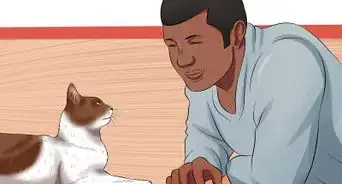
1Lure the cat toward you. Once you've located the cat, sit down on a nearby piece of furniture or on the floor but not too close to the cat. Try to be at the cat's elevation so you're not looming over it.[8] You can look in its direction but don't make eye contact. Call the cat's name. It will either respond by looking at you, turning an ear in your direction, pausing from current activity, or slowly getting up, stretching, and leaving the room, or it will not respond to you at all.
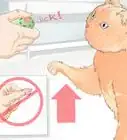
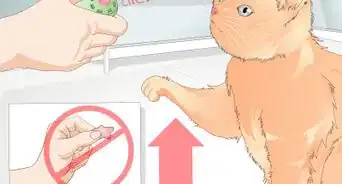
- If the cat acknowledges you, begin to pat your knee and call it again in a pleasing, gentle voice. You could even entice it to come to you with a treat.
-
2Allow the cat to sniff and rub up against you without attempting to pet it. A skittish cat needs to get used to your smell before it can become comfortable with you. If it comes up to you and rubs up against you, it's saying that you are its territory.[9] While a rub against your legs doesn't exactly mean that the cat loves you, it's a good first step toward the cat becoming comfortable with you.
- Once the cat has rubbed up against you a few times, put your hand out for it to smell. The cat may rub your hand with its cheek, at which time you can begin to gently find out where it likes to be petted.
-
3Make sure the cat sees you coming before you attempt to pet it. Don't surprise a high strung cat. While you might get closer to a skittish cat by sneaking up on it, you are not building trust with the cat. Instead, make sure that the cat sees you coming. If it agrees to let you pet it, you will know because it won't run away.[10]
-
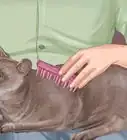
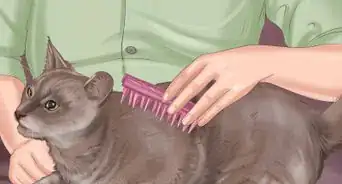
4Pet the cat in specific areas of its body. Begin by petting it on the back or under its chin. Also try scratching your cat between the shoulder blades or under its collar. These are spots it can't reach easily, and so cats generally love it.
- Gently stroke the cat in the direction of its fur growth, as many cats don't like their fur messed up by petting against the growth.
-
5Avoid petting sensitive areas. For instance, avoid petting a high strung cat's belly.[11] Although some cat's enjoy being petted on the belly, it's more likely that this will make a skittish cat go into defense mode. Some cats even take petting on the stomach as a clear invitation to playfully gnaw and scratch your hand.
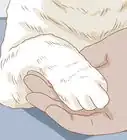
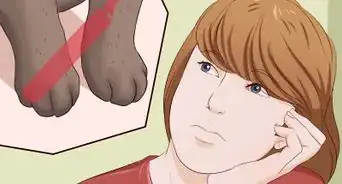
- Also, many cats don't like being touched on their paws.
- Some cats can bite without warning if you pet them too much. It is often safer to only pet the head, neck and under the chin if you are unsure.
-
6Be patient. Pet your new best friend gently and find out where and how the cat likes to be stroked or gently scratched. If your cat leaves, act like you are glad to be doing something very important.
-
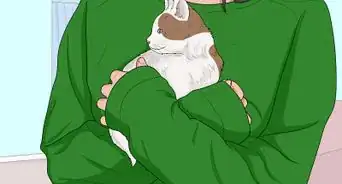
7Build up the length of time you pet the cat gradually. Don't expect a shy cat to put up with petting for a long period of time. Give him or her a few nice pets on the back and then willingly let the cat move away. This will begin the physical bonding process between both you and the cat, but it will also help to build the bond of trust as well.Advertisement


Expert Q&A
-
QuestionWhy is my cat high strung?
 Jennifer Van de KieftJennifer Van de Kieft is a Certified Advanced Feline Training & Behavior Professional, Fear Free Certified Animal Trainer, and the Owner of Cat Advocate LLC based in New York City. With four years of experience, she specializes in helping cat guardians address cat behavioral issues through positive reinforcement methods. Her specialties include inappropriate elimination, food insecurity and food aggression, and inter-cat aggression. In addition to Certifications in Feline Training and Behavior from the Animal Behavior Institute, Jennifer holds a BA from St. Francis College in Psychology and a JD from Cardozo School of Law.
Certified Advanced Feline Training & Behavior ProfessionalYour may not have gotten enough exercise and play to reduce their arousal. Play sessions throughout the day can help with this, along with clicker training. -
QuestionDo cats like being petted all the time?Jennifer Van de KieftJennifer Van de Kieft is a Certified Advanced Feline Training & Behavior Professional, Fear Free Certified Animal Trainer, and the Owner of Cat Advocate LLC based in New York City. With four years of experience, she specializes in helping cat guardians address cat behavioral issues through positive reinforcement methods. Her specialties include inappropriate elimination, food insecurity and food aggression, and inter-cat aggression. In addition to Certifications in Feline Training and Behavior from the Animal Behavior Institute, Jennifer holds a BA from St. Francis College in Psychology and a JD from Cardozo School of Law.
Certified Advanced Feline Training & Behavior ProfessionalNot necessarily! In general, cats tend to prefer lots of low-intensity interactions with you throughout the day, so less is more when it comes to petting a cat. -
QuestionHow do I start petting my cat?Jennifer Van de KieftJennifer Van de Kieft is a Certified Advanced Feline Training & Behavior Professional, Fear Free Certified Animal Trainer, and the Owner of Cat Advocate LLC based in New York City. With four years of experience, she specializes in helping cat guardians address cat behavioral issues through positive reinforcement methods. Her specialties include inappropriate elimination, food insecurity and food aggression, and inter-cat aggression. In addition to Certifications in Feline Training and Behavior from the Animal Behavior Institute, Jennifer holds a BA from St. Francis College in Psychology and a JD from Cardozo School of Law.
Certified Advanced Feline Training & Behavior ProfessionalGet consent first by offering your hand or fingers for your cat to smell. If they lean into your fingers, that's a good sign that they want to be pet. -
QuestionMy kitten is nice for five minutes then bites and scratches. What should I do?
 Pippa Elliott, MRCVSDr. Elliott, BVMS, MRCVS is a veterinarian with over 30 years of experience in veterinary surgery and companion animal practice. She graduated from the University of Glasgow in 1987 with a degree in veterinary medicine and surgery. She has worked at the same animal clinic in her hometown for over 20 years.
VeterinarianIt is a bizarre but well-recognized phenomena that some cats have a limited fuse when it comes to petting. They tolerate it for a time but then lash out unexpectedly. There is no simple answer other than to learn to read the tell-tale sign, such as a sideways glance or a flick of the tail, that indicates the cat has had enough and is about to strike out. When you see this, stop the petting and step away from the cat.
Warnings
- Sometimes cats nibble or paw your hand and forearm playfully. Stop petting the cat and move to a different room for at least 10 minutes. This should show the cat that nibbling or pawing is not a acceptable behavior.Thanks!
- If a cat does hook your hand with its claws, don't yank your hand back, you'll end up with one or more long ragged scratches on your skin. Allow the cat to pull your hand towards itself. Typically it might nibble on your hand a bit or unhook its claws once your hand is closer.Thanks!
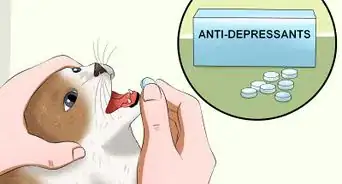
- It's possible your high-strung cat could have Feline Hyperesthesia Syndrome if it gets overly agitated by petting. If this is the case, petting and brushing cause pain instead of pleasure. There are various ways to help your cat including (but not limited to) clicker-training, more play time and activity, and medication.Thanks!
- Do not try to pet your cat while it is eating or using the litter pan, as it may become territorial and scratch you.Thanks!

References
- ↑ Jennifer Van de Kieft. Certified Advanced Feline Training & Behavior Professional. Expert Interview. 1 December 2021.
- ↑ Jennifer Van de Kieft. Certified Advanced Feline Training & Behavior Professional. Expert Interview. 1 December 2021.
- ↑ https://books.google.com/books?id=zZXdAwAAQBAJ&pg=PA274&lpg=PA274&dq=petting+a+nervous+cat&source=bl&ots=hXO5V_IzUD&sig=G30P2nHbbDVxkYPha8k8-7GpeSY&hl=en&sa=X&ved=0CEYQ6AEwBzgUahUKEwjo2tvK9JTGAhUONIgKHapIC0s#v=onepage&q=petting%20a%20nervous%20cat&f=false
- ↑ http://www.petmd.com/cat/conditions/behavioral/c_ct_fear_phobia_anxiety
- ↑ Jennifer Van de Kieft. Certified Advanced Feline Training & Behavior Professional. Expert Interview. 1 December 2021.
- ↑ http://www.humanesociety.org/animals/cats/tips/cat_communication.html
- ↑ http://www.drsfostersmith.com/pic/article.cfm?aid=892
- ↑ Jennifer Van de Kieft. Certified Advanced Feline Training & Behavior Professional. Expert Interview. 1 December 2021.
- ↑ http://www.humanesociety.org/animals/cats/tips/cat_communication.html
- ↑ Jennifer Van de Kieft. Certified Advanced Feline Training & Behavior Professional. Expert Interview. 1 December 2021.
- ↑ http://www.catbehaviorassociates.com/why-you-shouldnt-pet-your-cats-belly/
About This Article
To pet a high strung cat, start by sitting down on a piece of furniture or the floor so you're more on its level. Next, call the cat's name and gently pat your knee. If the cat comes and rubs itself against you, let it do so without trying to pet it so it can get used to your smell. Once the cat has rubbed up against you, begin gently petting the cat on its back or under its chin. You should also stroke the cat in the direction of its hair growth to avoid irritating it. For tips on how to create a relaxing environment for a high strung cat, keep reading!