This article was co-authored by Virginia Kelley, MA, a trusted member of wikiHow's volunteer community. Virginia Kelley is an artist and art teacher from New York with over 30 years of experience. She has both a Bachelor's and a Master's degree in Art Education from SUNY-Buffalo State and has taught art at the K-12 and college levels. For the last 20 years, she has focused her work and teaching on watercolor.
This article has been viewed 5,732 times.
Learn more...
Bunnies and springtime are good companions. Since the 1700s, rabbits have symbolized Easter and the tradition continues today. As surely as spring comes, so does the bunny, bearing baskets of colored eggs, chocolate, and other goodies. Celebrate spring with flowers popping out of the earth and a bunny stretching his legs to survey the scene. Your watercolor painting can do double duty by gracing your walls while stealing your heart.
Steps
Part 1
Part 1 of 2:Planning and Practicing
-
1Practice drawing the bunny. You can do so by starting with two circles, one large one for the body and a smaller one for the head, overlapping them slightly.
-
2Discover different ways to shade in your drawing.
- Crosshatching is simply criss-crossed lines. A series of repeated lines, close together creates a tone. Make gray tones by coloring with the side of your pencil, then blend it using your finger or a tissue to soften the lines.
- Stippling is making dots with the point of your pencil. Put them close together for a darker tone and further apart for lighter tones.
Advertisement -
3Look up drawings of bunnies to have a model to copy. Pay close attention to the way that the shades of gray define the bunny’s anatomy. Look closely to see where the darkest darks, lightest lights, and middle tones of shading occur on the body. Copy these tones on another sketch, using the stock photo as reference. By doing this, you can bring your figure to life giving it the appearance of roundness and depth. This will help you know where to put the shadows when you start to work on your painting.
-
4Practice various techniques for painting a rabbit. Keep in mind that the fur ought to be soft and fluffy. Practice painting bunnies using different, but commonly used watercolor painting techniques.
- Paint your picture on dry paper. Fill in the sketch of the rabbit. You will have loads of control. This is an easy and commonly used method.
- Add a wash of juicy, wet paint onto damp paper. Brush water over the rabbit figure and allow the water to sink in until the shine of it no longer appears on the paper. Then begin to paint the figure.
- Paint a rabbit shape in plain water, keeping the water inside the sketch, then paint colors onto the same shape outlined with the water. Let the water rise up off the surface so it can carry the colors around the shape. This is easy and fun - use whatever colors you wish. After a few minutes, pick up the paper and rock it gently to blend the colors.
- Try freehand sketching with the brush and work with no pencil lines to guide you. This is challenging, but fun and good practice.
- Go back to each sketch and add as many details as you want. Use a round, pointed brush or markers.
Advertisement


Part 2
Part 2 of 2:Creating Your Watercolor Painting
-
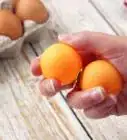
1Draw the figure of a bunny on watercolor paper. The preliminary work will give you new confidence and information about how the rabbit ought to look. Using your pencil, make your bunny the focus of the painting by making it at least as large as an orange and putting it on the center of your paper.
-
2Add an environment for the bunny. It can include grass, a flower bed, a single flower or two, a patch of weeds, a cabbage or carrot patch, colored eggs, a basket, or gardening accouterments such as a watering can and gardening tools.
-
3Sketch in a background. It can be simple or complex. You can include the sky, a fence, a starry night, a shed, a house, or even a rainbow. Use as few or as many lines as you need, but keep the drawing light. As you paint, the pencil lines will diminish and the color washes will take precedence.
-
4Paint the work. A light touch with your brush using well-diluted colors will ensure that your painting conveys a sense of freshness and embodies spring. Allow the piece to dry and give it another pass with soft, transparent colors if necessary to boost and clarify it. Allow it to dry again, thoroughly, using a hair dryer if necessary.
-
5Mat the piece in a white or pastel purchased mat. Remember that paintings are powerful, especially ones you make yourself. Put it in a frame under glass and enjoy it throughout the spring season. On sunny days, it will sparkle making you happy, and on gloomy days it will remind you to look forward to the days of wearing shorts, being outside in the open air, and lounging on the grass.Advertisement


Things You'll Need
- Watercolor paints; either dry ones in a pan or a set of tube colors
- Palette to put them on
- All purpose/watercolor brushes
- Pad or sheet of #140 watercolor paper cut to any size you wish for the actual painting; smaller pieces to practice painting colors and mixtures
- Sketch pad with paper thick enough to hold paint (for prelim color sketches.)
-
Water-soluble colored pencils if you wish
- 2 pencil and eraser




About This Article