This article was co-authored by Barry Zakar. Barry Zakar is a professional handyman and the founder of Little Red Truck Home Services based in the San Francisco Bay Area. With over ten years of experience, Barry specializes in a variety of carpentry projects. He is skilled at constructing decks, railings, fences, gates, and various pieces of furniture. Barry also holds his MBA from John F. Kennedy University.
This article has been viewed 97,168 times.
Wall art is a creative way to personalize your child's bedroom. Individuals who feel confident in their artistic abilities can get away with drawing and painting a picture free-hand, but those who want a little additional assistance can use stencils or projections to create a cleaner image. Stencils work especially well for simple designs, while projections often work better for detailed murals. Regardless of the method you use, you should choose a design and colors that suit your child's unique personality and tastes.
Steps
Method 1
Method 1 of 4:Deciding What to Paint
-
1Paint simple shapes in complimentary colors for a room belonging to an infant or young toddler. Think basic shapes, ABCs, and simple trees and flowers. Use either pastels or strong colors, but avoid bright, neon shades that may overwhelm your young child.
-
2Introduce animals into the design for older toddlers. Skip the pastels and neon shades, and stick with strong, eye-catching hues.
-
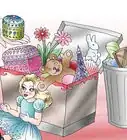
3Play to an older child's interests. Once your kid reaches school age, he or she will likely have his or her own interests and obsessions. Interests often include anything from animals to cityscapes and ballerinas to sports. Build a theme around your child's interests and paint wall art specifically tailored to those interests.
-
4Opt for simple, sophisticated designs once your child reaches the "tween" and "teen" stage. Images that use simple shapes and abstract designs will likely appeal to your maturing child more than specific pictures. Use muted colors or bright, funky shades depending on your child's personality.


Method 2
Method 2 of 4:Painting by Hand
-
1Sketch your idea on the wall using light pencil strokes. Use a blue pencil with an eraser. If you cannot find a blue pencil, use a regular pencil with an eraser, instead.
-
2Use painters tape to section your illustration off. Tape is especially useful if you want to create straight lines, and sectioning your illustration off will prevent you from accidentally getting the wrong color on the wrong portion of the illustration.
-
3Pour your paint onto a paint palette. Use acrylic paints and start with colors you know you will use to complete the first section instead of pouring out all the paint at once. This will prevent your paint from drying unnecessarily before use.
-
4Carefully fill in your picture with paint. Use a thin paintbrush to provide yourself with more control.
-
5Wait 24 hours for the first section of paint to dry.
-
6Apply an acrylic sealer to the paint. Remove your painting tape and allow the sealer to dry.
-
7Reapply painters tape to unveil another section of your illustration. Paint and seal the paint using the same method you used for the first section. Repeat as necessary until all sections are complete.


Method 3
Method 3 of 4:Painting with Stencils
-
1Find stencils that suit the theme of the room. You should search for large stencils, rather than smaller ones, in order to create a noticeable design that stands out as soon as you enter the room. It may be easiest to use stencils specifically made for use with wall paint, since they usually come in finished designs.
-
2Fix the stencil flat on the wall using blue painters tape. Painters tape is strong enough to hold the stencil in place but will not ruin the paint already on the wall.
-
3Pour your paint into a painting tray. You may use standard wall paint, but acrylic craft paint will likely be more cost-effective, especially if you plan on using multiple colors.
-
4Use a paint roller if your design only requires a single color. Coat the roller in your paint and roll the paint over the entire stencil until the entire design has been filled in.
-
5Use a paintbrush if applying multiple colors. A stubby stenciling brush works best and creates an "orange peel" finish, a slightly bumpy texture that mimics the texture of an orange peel.
-
6Allow the paint to dry for 24 hours.
-
7Apply an acrylic paint sealer if you used acrylic paint. Opt for a satin finish over a glossy one. Allow the sealer to dry, and air the room out before moving your child's belongings back into the room.


Method 4
Method 4 of 4:Painting by Projection
-
1Find a photograph or picture that you want to display on your child's wall. Search for images that consist of "coloring book" outlines for the best result. Full-color pictures can also work, but may be slightly more difficult to paint.
-
2Create a digital copy of the picture. If you found the image in a printed source, scan or transfer it into your computer. If you found it online, simply save a copy of the file to your computer.
-
3Rent a projector. You can ask your local library if they offer projector rentals, but more likely than not, you will need to find a store that specializes in renting audiovisual equipment.
-
4Print the image onto transparency paper. If you rented a projector that requires the use of transparencies, you need to transfer your image onto a transparency. You can purchase clear transparency paper for your home printer at most office supply stores.
- If you rent a projector that hooks up to your computer directly, you do not need to print out a transparency.
-
5Position the projector so that it transfers the image onto your selected space. Adjust the position and projection size as necessary until you feel satisfied with the way the image looks on the wall.
-
6Lightly trace the outline of the image using a blue pencil. Redraw every line you wish to duplicate on the mural.
-
7Turn the projector off. Check the image to make sure that you copied everything correctly. If not, turn the projector back on and finish filling in any details you missed.
-
8Spread the paint you need onto a paint palette. Use acrylic craft paint for the best results.
-
9Carefully paint inside the lines using a paintbrush. Choose a paintbrush that has an appropriate thickness for the size of the picture. A brush that is too small will cause the process to go slower and may increase streaking in the final picture. A brush that is too large may cause you to make more mistakes and paint outside the lines.
- Use multiple paintbrushes of varying sizes if needed, switching to a smaller paintbrush to complete smaller details.
-
10Let your paint dry for 24 hours after completing the mural.
-
11Seal the mural with acrylic paint sealer. Use a sealer with a satin finish instead of one with a glossy finish.
-
12Vacate the room until the sealer dries. Give the room a chance to air out before moving furniture back into it.


Warnings
- Avoid painting wall art on every wall and surface of the room. Too much of it can get remarkably overwhelming.Thanks!
Things You'll Need
- Acrylic craft paint
- Wall paint
- Paint palette
- Paint tin
- Painters tape
- Paintbrushes
- Paint roller
- Acrylic paint sealer
- Stencils
- Blue pencil
- Projector
- Transparency



-Step-14.webp)

References
- ↑ Barry Zakar. Handyman. Expert Interview. 16 July 2020.
About This Article