X
wikiHow is a “wiki,” similar to Wikipedia, which means that many of our articles are co-written by multiple authors. To create this article, 24 people, some anonymous, worked to edit and improve it over time.
wikiHow marks an article as reader-approved once it receives enough positive feedback. In this case, 94% of readers who voted found the article helpful, earning it our reader-approved status.
This article has been viewed 159,146 times.
Learn more...
It is not always necessary to have an ordained minister officiate at a funeral. In the event that you are asked to officiate at a funeral or a memorial service, here is a simple way to help family and friends gain a sense of closure.
Steps
-
1Talk to the family. Call the family and arrange to meet them, preferably in their home. Meeting them in public is OK in a bind, but if that's the arrangement, try not to meet more than two to three people. If a funeral home is taking care of other arrangements, the funeral directors may have space at the funeral home where you could meet. Invite the family to have other family members and close friends present if they wish, but be sensitive to their needs and to the space considerations.
-
2Discuss plans for the service. When you meet the family, let them know what you have in mind for the service. If they have their own ideas about what they want to see done or not done, make every effort to incorporate those ideas. However, don't leave them with a lot of open-ended questions about decisions that they need to make. You are there to help guide them, not to further complicate the process.Advertisement
-
3Take notes. Bring a notebook and be prepared to take many notes about the loved one that has passed away. Get as much information as you can so that you can present a story of the person's life from birth to death. Be sure to obtain the particulars such as birthday, school information, marriage, work history, children and grandchildren, and accomplishments. Pay special attention to the anecdotal memories that the family shares, especially stories that bring smiles. Ask them if there is music or any special readings that they would like to have incorporated into the service. Encourage them not to pick more than two or three songs, since those can be an emotional overload. Also let them know that you are available to read poems or letters that they've written in case they find that they can't share on the day of the service.
-
4Get family addresses and contact info. Thank the family and make arrangements to send a copy of your eulogy so that they can review it and make sure it is accurate. Obviously, sending a eulogy by e-mail is the easiest way to accomplish this, but delivering it in person or faxing it are other possibilities. Ask them if there's a gathering afterwards that they would like you to announce.
-
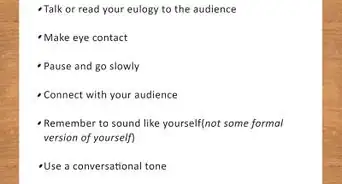
5Write a eulogy, using your notes. Make it positive in tone, but don't be afraid to mention less-than-happy things if they contributed to the person's life. Be sure that you read the eulogy aloud to measure the amount of time that it takes to deliver it and to make sure that you establish your rhythm. Two to three pages of written text should be sufficient.[1]
-
6Arrive early for the service. On the day of the service, arrive at least half an hour early with the final draft of the eulogy. Be available for any last minute words or arrangements that the family may have, but give them space to grieve. This can be a very trying day for them.
-
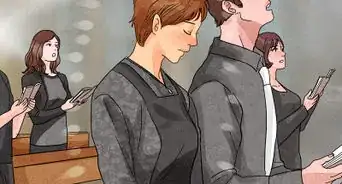
7Conduct the service. You may want to open with one of the pieces of music that they've chosen. Then, welcome the family and open with a word of prayer or remembrance. After the prayer, read the obituary as a way to acknowledge the family members that are included in it. Deliver the eulogy. After the eulogy, invite the friends and family to come forward and share their own thoughts. This is a perfect place to insert a song to give them time to think. If, after about half a minute, no one comes forward, then make some light comment about how difficult it can be to speak at a funeral, and finish by closing the service with prayer.[2]
-
8Stay afterwards. Make yourself available to the family and friends afterward, but unless you know the family personally, you may want to gracefully excuse yourself shortly after and give them space.Advertisement


Community Q&A
-
QuestionI heard there was a legal phrase that has to be said at funerals, is this true?
 Community AnswerNo, there is not. What the family wants is usually all that has to be said.
 -
QuestionPsalm 23 is a frequently spoken prayer at a funeral; what are a few more popular or frequently used prayers?
 Community AnswerThe Apostle's Creed, the Rosary, Glory Be, Hail Mary, Our Father, and the Sign of the Cross are good options.
Warnings
- Don't forget to get certified and licensed!Thanks!
Advertisement










References
About This Article
Advertisement