X
wikiHow is a “wiki,” similar to Wikipedia, which means that many of our articles are co-written by multiple authors. To create this article, volunteer authors worked to edit and improve it over time.
This article has been viewed 88,531 times.
Learn more...
If your automobile is rusty or you get in a collision and the damage isn't too extensive, you can patch the dings with a body repair product called Bondo. Learn to mix Bondo and save money, as Bondo, also called body putty, is considerably less expensive than a body shop. Applied correctly, Bondo repairs are durable and long-lasting.
Steps
-
1Cut a thick piece of cardboard about 6 by 6 inches (15.24 cm by 15.24 cm). Alternatively, you can mix it on particle board or buy an inexpensive pad of disposable plastic sheets to mix the Bondo.[1]
-
2Open the can and mix the Bondo with a stir stick if there is a layer of liquid on top. Use the stir stick to lift a golf ball-sized dollop of filler out of the can and reseal the can.[2]
- Mix a larger amount of Bondo and hardener if the area you need to patch is larger. Look at your project to estimate the amount of Bondo needed.
Advertisement -
3Add 1 line of hardener--also known as a catalyst or fixing agent--by squeezing it out of the tube across the top of the Bondo filler. (Bondo comes with a tube of hardener.)[3]
- If you add too much hardener, the mixture will gel too quickly. If you add too little, it increases the amount of time for it to cure, and if you don't add enough it will never cure. If you add 1 line of hardener across the top of the dollop of Bondo, it takes about 15 minutes to dry after applying. Add 2 lines and it takes about 5 minutes to dry. Experiment to get the right Bondo mixture.
-
4Use an ice cream novelty stick or a plastic spreader to quickly mix the two substances together. Do not whip them, but rather fold them to avoid introducing air bubbles.[4]
- Use hardener with dye in it so you can see when the mixture is mixed evenly. If there are no streaks in the filler or areas that are darker or lighter, it is mixed well.
Advertisement


Community Q&A
-
QuestionWhat's the right ratio of hardener to Bondo? For example, how much hardener should I mix in with two ounces of Bondo?
 Community AnswerMixing Bondo with the hardener is almost an art form. Start with two ounces of Bondo, squeeze out a few corn-kernel-sized drops of hardener, which is typically red in color, and begin to mix it into the Bondo. When the mixture turns a light red in color, you've got a good ratio.
 -
QuestionAt what temperature can I use Bondo?
 Community AnswerI wouldn't suggest using Bondo in temperatures below 60-65 degrees. If it's a sunny day and you can't work in the shade, then avoid temperatures higher than 85 degrees in the sun.
 -
QuestionWhy do you recommend mixing bondo on something that will soak up resins and solvents in the bondo and the catalyst?
 Uglymug18Community AnswerIt is not recommended. You will want to mix on a smooth almost pore free surface. You do not want to mix on something that will soak up any of the material.
 -
QuestionI forgot to add hardener. Can I remix and apply over the same area or do I need to remove? How would I remove it if it was applied to an iron gate?Uglymug18Community AnswerYou will have to remove the filler, if you reapply over top the bottom layer will not harden and will flake and break off. Simply scrape off the filler and clean with a rag. As long as you get most of it off a new layer with hardener can be applied.
-
QuestionCan I mix a whole tube of hardener in the can at once, and putty in holes?Uglymug18Community AnswerDefinitely not. The reaction takes place quickly and you will not be able to work with all of the filler before it hardens.
-
QuestionHow many types of Bondo are there?Uglymug18Community AnswerBondo is a name brand of body filler, there are many types of body filler on the market.
-
QuestionDoes body filler have a shelf life?
 Community AnswerYes, it does, but it depends on many factors, such as the temperature and humidity of the storage location.
 -
QuestionCan I apply fiberglass and cloth over a plastic car bumper for repair?Community AnswerYes, it will be good if you make a very strong structure on the inside/backside of the bumper, then place a single layer on the front.
Warnings
Things You'll Need
- Bondo and hardener
- Mixing surface
- Ice cream novelty stick or plastic spreader
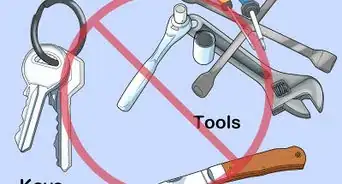
- Safety glasses



References
- ↑ https://www.youtube.com/watch?v=OpE2V3oZ9Ic
- ↑ https://makezine.com/projects/make-40/working-with-bondo/
- ↑ https://www.youtube.com/watch?v=OpE2V3oZ9Ic
- ↑ http://www.secondchancegarage.com/public/242.cfm
- ↑ https://multimedia.3m.com/mws/mediawebserver?mwsId=SSSSSuUn_zu8l00xM8tvN8t9nv70k17zHvu9lxtD7SSSSSS--
- ↑ https://makezine.com/projects/make-40/working-with-bondo/
- https://www.youtube.com/watch?v=hjvTmSAPNmE
- http://www.secondchancegarage.com/public/242.cfm
About This Article
Advertisement