wikiHow is a “wiki,” similar to Wikipedia, which means that many of our articles are co-written by multiple authors. To create this article, volunteer authors worked to edit and improve it over time.
Learn more...
Have you installed a TV antenna and wonder why it's not working as well as you thought? There are a few different tricks you can use to improve your antenna reception. This wikiHow article will teach you how to make a TV antenna work better.
Steps
Method 1
Method 1 of 9:Your external antenna may have fallen down or shifted.
-
1Since even a slight change in position or angle can have a big impact on your reception, make sure your external antenna (if you have any) has not been re-oriented by wind, rain, or storms.
- A directional antenna will most likely have bigger effects if it's fallen or shifted to another direction than a multi-directional antenna.
Method 2
Method 2 of 9:Your antenna may not be high enough.
Method 3
Method 3 of 9:Your flat (internal) antenna is in a bad location.
-
1Certain areas like skylights or on outside-facing walls seem to be the best places to put these antennae so they aren't covered up with dust or knickknacks.
- You can also use the FCC's website (https://www.fcc.gov/media/engineering/dtvmaps) to figure out which direction to point your antenna.
Method 4
Method 4 of 9:There are too many splitters set up.
Method 5
Method 5 of 9:Your TV's digital tuner could be broken, faulty, or going bad.
Method 6
Method 6 of 9:The station's frequency may have changed.
-
1Go to https://www.fcc.gov/media/engineering/dtvmaps and enter your address to find the stations broadcasting near you. Click the station's callsign (like WJKT or WBBJ-TV) and more information will expand down to reveal the station's RF channel and repacked channel (if there is one).
- Older TVs (like the 2008 Sony Bravia) need to tune to the station's RF channel while newer TVs will get the signal when you tune to the repacked channel.
- TV stations move locations, channels, and sometimes change their transmitter power, so it's a good idea to re-scan every once in a while.[1]
- You can rescan from your remote by pressing Menu > Settings > Channel Setup > Antenna/Air > Channel Search/Channel Scan. Not every TV will have the exact same menu, but it should be similar.[2]
Method 7
Method 7 of 9:The station's transmitter tower is using lower power.
-
1Sometimes a station might use lower power while they upgrade their equipment. Go to https://www.fcc.gov/media/television/tv-query and enter the station's callsign (call letters, like "WJKT") and hit the Enter or Return key on your keyboard.
- If you see "Special Temporary Authority" in red, the station is temporarily operating at reduced power.
Method 8
Method 8 of 9:The amplifier on your antenna is bad.
-
1A bad amplifier can cause choppy or glitchy reception on your TV. Try removing the amplifier from your antenna and use the antenna directly with your TV without the amplifier. If you get better reception, then you know your amplifier is bad.
- You'll know your antenna uses an amplifier if it requires power. If it doesn't, your antenna does not have an amplifier.
Method 9
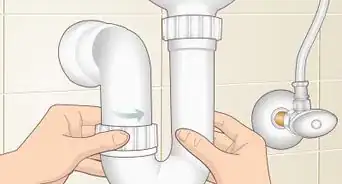
Method 9 of 9:Your cables are loose.

References
About This Article
1. Make sure your external antenna has not fallen down or shifted.
2. Elevate the antenna.
3. Unsplit any cables.
4. Check your TV's digital tuner.
5. Verify the frequency of the channel.
6. Change the location or elevation of your antenna.
7. Check if your transmitter tower is using lower power.
8. See if your amplifier is bad.
9. Tighten any loose cables.
10. Re-scan for channels.