This article was co-authored by wikiHow Staff. Our trained team of editors and researchers validate articles for accuracy and comprehensiveness. wikiHow's Content Management Team carefully monitors the work from our editorial staff to ensure that each article is backed by trusted research and meets our high quality standards.
This article has been viewed 13,924 times.
Learn more...
It is a popular belief that cats cannot learn to do simple obedience tricks such as sit or fetch. On the contrary, cats can be taught some simple tricks. They simply do not respond to the same training techniques used with dogs, which are the methods most people understand. Historically, dogs were bred to be social with humans whereas a cat’s relationship with humans was meant to be independent because they were kept to kill vermin.[1] Despite this history, cats can be taught to obey some simple commands, such as sit, if you follow some simple steps.
Steps
Part 1
Part 1 of 2:Getting Your Cat Ready
-
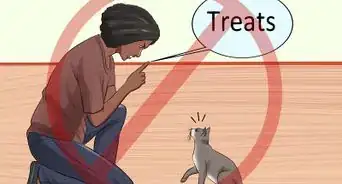
1Use the right treats. The key to training a cat to sit is to find the treat that he finds the tastiest. This will vary depending on the cat. It can range from small cubes of chicken to small flakes of canned tuna to commercially made treats. In general, cats love human foods high in protein the most.
-
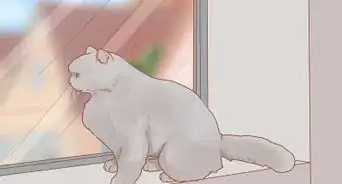
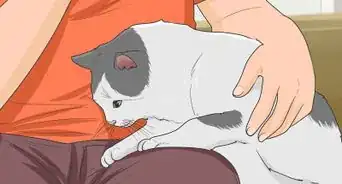
2Calm your cat. Before you can begin a training session, you need to burn off some of your hyper cat’s excess energy. Plan to spend 15 minutes playing rambunctious games with him to help him lose some of the energy. Try games such as chase, which can be done with a laser pointer, or keep away with a feather toy. You can also try going up or down the stairs inside your home dragging your cat’s favorite toy behind you. He will stalk and pounce on it and chase after you.[4]
- After your cat starts to slow down, he should be able to concentrate on a training session.[5]
Advertisement -
3Teach him his name. Before you can teach your cat to sit, your cat needs to know his name. To teach him to come when you call his name, you can use a training technique with treats.[6] Make sure to keep treats on you, either in a small plastic container or a zip topped bag. When your cat is in the same room as you, get his attention with a small treat in your hand. When he sees the treat, say his name as he comes over. When he gets to you, reward him with the treat.
- Do this until he is consistently coming to you when you say his name.
- Slowly phase out the treats. Replace it with praise and attention when he comes to his name.[7]
Advertisement




Part 2
Part 2 of 2:Training Your Cat
-
1Use treat training. Once you have tired your cat out and found the right treats, you can teach him to sit with treats.[8] Begin by sitting in front of your cat with a treat in your hand. He should be standing on all fours to best teach him to sit, so try to get him into this position if he doesn’t naturally do so. Let him see the treat in your hand, then hold the treat two or three inches above his head. Slowly move it back between his ears, rubbing it slightly against his head. In order to follow the treat, he will follow your hand and begin to sit.
- As he does, tell him “sit [his name].” Immediately after he does, say “good, sit” and give him the treat.
- This may take a few tries to get right. Make sure you aren’t holding the treat too far above his head at first either. This will cause him to jump up instead of leaning back, which can teach him the wrong thing.[9]
-
2Be patient. Your cat will not learn this overnight or after one try. It will probably take anywhere from seven to 14 training sessions until your cat understands that the motion above his head and the word “sit” means to sit down. With patience, persistence and consistency in training, your cat will soon be sitting like a pro.[10]
-
3Keep it short. Your cat will get distracted if you train too long, especially if he is hyper by nature. To this end, make sure you keep the training sessions short. Five to 10 minutes is long enough for kittens or hyper cats.
- Practicing for too long can make your cat aggravated, which may cause him to bite or scratch you.
- When you feed your cat treats, only feed him very small amounts as treats. A small sliver half the size of your pinkie finger thumbnail is plenty to give him. This way, he won’t fill up during your short training sessions and won’t over eat.[11]
-
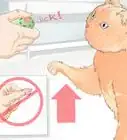
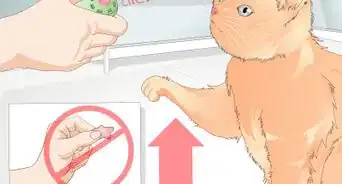
4Try clicker training. In addition to treat training, you can also try the clicker training method.[12] For this method, you need to buy a small hand held clicker, which you can get at pet stores or online. To start clicker training, you get your cat to associate the clicks with treats. To start this, produce a click and random and then give your cat a treat. He will start to realize that the click sound means a treat.
- Keep doing it until he understands. You’ll know he understands when you click and he starts looking at you or running to you for a treat. Once this happens, begin the treat training routine, which will be easier with the help of the clicker.[13]
- Clickers become a powerful tool for pet training. Your cat will know that once he hears a click, he is doing something right. So when you treat train, click the clicker the moment your cat sits, then give him a treat. He then associated the click with correct behavior, which will translate into sitting for your without the help of the clicker.[14]
-
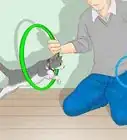
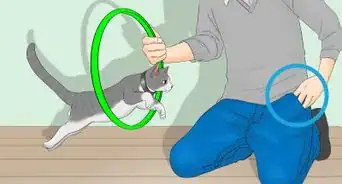
5Try more advanced tricks. Many hyper cats are simply bored cats. After you’ve taught him to sit, you can continue with other tricks. Do this by taking his clicker training to a higher level by training. You can do more elaborate things, such as teaching your cat to follow a target, such as a toy.
- You can also teach him to follow the target through an obstacle course such as cat tunnels and to jump over low lying obstacles.[15]
Advertisement


Expert Q&A
-
QuestionWhat is the easiest way to train a cat?
 Jennifer Van de KieftJennifer Van de Kieft is a Certified Advanced Feline Training & Behavior Professional, Fear Free Certified Animal Trainer, and the Owner of Cat Advocate LLC based in New York City. With four years of experience, she specializes in helping cat guardians address cat behavioral issues through positive reinforcement methods. Her specialties include inappropriate elimination, food insecurity and food aggression, and inter-cat aggression. In addition to Certifications in Feline Training and Behavior from the Animal Behavior Institute, Jennifer holds a BA from St. Francis College in Psychology and a JD from Cardozo School of Law.
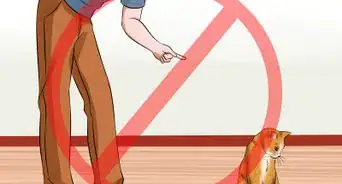
Certified Advanced Feline Training & Behavior ProfessionalUse cues instead of commands. A cue is a promise that if the behavior is performed well, a reward will be offered. A command, on the other hand, is a threat of correction if the required behavior isn't followed correctly. Positive reinforcement trainers use cues instead of commands, which work great with cats. -
QuestionHow do you relax an excited cat?Jennifer Van de KieftJennifer Van de Kieft is a Certified Advanced Feline Training & Behavior Professional, Fear Free Certified Animal Trainer, and the Owner of Cat Advocate LLC based in New York City. With four years of experience, she specializes in helping cat guardians address cat behavioral issues through positive reinforcement methods. Her specialties include inappropriate elimination, food insecurity and food aggression, and inter-cat aggression. In addition to Certifications in Feline Training and Behavior from the Animal Behavior Institute, Jennifer holds a BA from St. Francis College in Psychology and a JD from Cardozo School of Law.
Certified Advanced Feline Training & Behavior ProfessionalTake time to play with them throughout the day so they can get rid of their extra energy. -
QuestionWhy are cats difficult to train?
 Pippa Elliott, MRCVSDr. Elliott, BVMS, MRCVS is a veterinarian with over 30 years of experience in veterinary surgery and companion animal practice. She graduated from the University of Glasgow in 1987 with a degree in veterinary medicine and surgery. She has worked at the same animal clinic in her hometown for over 20 years.
VeterinarianThe trick to training cats is to find the treat they will work for. All cats have a food that will motivate them. As an owner, keep offering different tidbits until you find the one the cat really loves.

References
- ↑ https://www.aspca.org/pet-care/virtual-pet-behaviorist/cat-behavior/training-your-cat
- ↑ Whiteley, Ellen H. Understanding and Training Your Cat or Kitten. Sunstone Press, 2006
- ↑ https://www.aspca.org/pet-care/virtual-pet-behaviorist/cat-behavior/training-your-cat
- ↑ Jennifer Van de Kieft. Certified Advanced Feline Training & Behavior Professional. Expert Interview. 1 December 2021.
- ↑ http://www.perfectpaws.com/spring.html#.VjfzW27JJAM
- ↑ Jennifer Van de Kieft. Certified Advanced Feline Training & Behavior Professional. Expert Interview. 1 December 2021.
- ↑ Whiteley, Ellen H. Understanding and Training Your Cat or Kitten. Sunstone Press, 2006
- ↑ Jennifer Van de Kieft. Certified Advanced Feline Training & Behavior Professional. Expert Interview. 1 December 2021.
- ↑ https://www.aspca.org/pet-care/virtual-pet-behaviorist/cat-behavior/training-your-cat
- ↑ https://www.aspca.org/pet-care/virtual-pet-behaviorist/cat-behavior/training-your-cat
- ↑ https://www.aspca.org/pet-care/virtual-pet-behaviorist/cat-behavior/training-your-cat
- ↑ Jennifer Van de Kieft. Certified Advanced Feline Training & Behavior Professional. Expert Interview. 1 December 2021.
- ↑ https://www.aspca.org/pet-care/virtual-pet-behaviorist/cat-behavior/training-your-cat
- ↑ https://www.aspca.org/pet-care/virtual-pet-behaviorist/clicker-training-your-pet
- ↑ https://www.aspca.org/pet-care/virtual-pet-behaviorist/cat-behavior/training-your-cat
- ↑ https://www.aspca.org/pet-care/virtual-pet-behaviorist/cat-behavior/training-your-cat
About This Article

To make a hyper cat sit, start by playing with it for 10 to 15 minutes to help it burn off excess energy. Then, sit in front of your cat with a treat, such as a cube of chicken, and move it just above its head to force the cat to sit down. As your cat sits down, say “Sit,” and give it the treat. Repeat the exercise several times over a few days, since it may take 7 to 14 attempts for your cat to respond to your command. For tips from our Veterinary co-author on how to clicker train your cat, keep reading!