This article was co-authored by wikiHow staff writer, Eric McClure. Eric McClure is an editing fellow at wikiHow where he has been editing, researching, and creating content since 2019. A former educator and poet, his work has appeared in Carcinogenic Poetry, Shot Glass Journal, Prairie Margins, and The Rusty Nail. His digital chapbook, The Internet, was also published in TL;DR Magazine. He was the winner of the Paul Carroll award for outstanding achievement in creative writing in 2014, and he was a featured reader at the Poetry Foundation’s Open Door Reading Series in 2015. Eric holds a BA in English from the University of Illinois at Chicago, and an MEd in secondary education from DePaul University.
There are 22 references cited in this article, which can be found at the bottom of the page.
The wikiHow Culinary Team also followed the article's instructions and verified that they work.
This article has been viewed 22,673 times.
Learn more...
There are only a handful of signature, regional dishes out there that are as mysterious—and difficult to recreate—as New York-style pizza. The Big Apple is infamous for its thin-sliced pie, and many have tried and failed to replicate its distinctive flavors elsewhere. If you’re curious about what makes NY-style pie so unique, or you want to give it a shot yourself, you’re in the right place. Remember, even if you don’t duplicate that famous Brooklyn pizzeria’s signature pie perfectly, your results are going to be delicious!
Steps
Question 1
Question 1 of 8:What makes NY-style pizza?
-
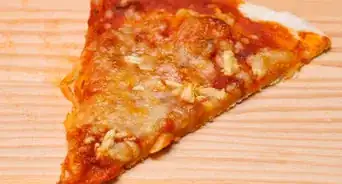
1NY-style pie needs to be thin and foldable. If your pizza is NY-style, then it’s roughly 1⁄4 in (0.64 cm) thick, with a slightly puffier crust around the edges of the pie where there’s no sauce. Each slice should be firm enough to hold up without toppings sliding off the crust, but soft enough that you can fold it like a taco to eat it with one hand. Pizza purists may throw some other requirements, but if it’s thin and foldable, it’s reasonable to call it NY-style pie.[1]
- Most pizza enthusiasts agree that NY-style pie must be cut in large triangles (8 slices is the gold standard).[2] Square-cut pies are common with Chicago’s tavern-style thin crust and Detroit-style pie, but they’ll gawk at a square-cut pizza in New York.[3]
- Purists will argue that NY-style pie must be big—roughly 16–18 inches (41–46 cm) in diameter. If you’re making it at home, you’ll have an easier time handling a smaller pie though, so don’t worry about it.
- Diehard pizza lovers will also argue that NY-style pizza can’t have more than 1-2 toppings on it, with the logic being that too many toppings ruins the integrity of the crust and makes it impossible to fold properly.
Advertisement

Question 2
Question 2 of 8:What is the difference between NY-style pizza and regular pizza?
-
1There is no such thing as “regular” pizza! A New Yorker will assume that NY-style pie is “regular,” while a Chicagoan is going to picture tavern-style thin crust when you ask where you can buy a regular pizza. However, if you live in a region that doesn’t have a signature style, you’ll probably picture pan pizza when someone talks about “regular pizza,” since pan pizza was popularized by fast food chains.[4]
- Pan pizza is thicker than NY-style pizza; it has a puffier, chewier crust, and you can’t really fold it like a NY-pie.[5] Sicilian-style pie and Detroit-style pizza are types of pan pizza.
- Other popular styles include deep dish and stuffed, which are much thicker than NY-style pie and often packed with tons of cheese and ingredients, and California-style pizza, which is defined by the toppings, not the dough (if it has a bunch of crazy toppings, it’s Cali-style).[6]

Question 3
Question 3 of 8:What kind of cheese does NY-style pizza use?
-
1Traditionally, you have to use dry, full-fat mozzarella. If you’re picturing a pre-packaged container full of that dusty shredded stuff, you might as well “fuh ged about it,” as a native New Yorker might say. You need a block of dried mozzarella, and you have to grate it yourself for best results. The best way to find dry, full-fat mozzarella is to swing by a deli and ask for them to cut you a block.[7] You’ll need roughly 4–8 ounces (110–230 g) of cheese per pizza depending on the size of the pie and how much cheese you like.
- Dry mozzarella is not that bright-white stuff you find in caprese salads. That’s fresh mozzarella. It’s popular on Neapolitan pizza, but it’s not for NY-style pie.
- If you really can’t get your hands on dry, full-fat mozzarella, your closest substitution is going to be low-moisture string cheese made from whole milk.[8]
- You cannot use pre-shredded cheese for pizza. It’s covered in cornstarch to prevent clumping, but that means it won’t melt right in the oven.[9]
-
2Grab some parmesan or pecorino if you’re going all out. Many of the highly-respected pizza joins in New York sprinkle in a thin layer of grated parmesan or pecorino underneath the mozzarella layer. This is optional, but if you’re putting in the effort to make a NY-style pizza at home, it’s worth picking up a block of some good parmesan or pecorino cheese. Don’t use that pre-packaged cheap stuff![10]
- NY-style pizza is more about the form than the ingredients. So long as your crust is up to the thin, foldable standards of the style, feel free to use whatever cheese you’d like.[11]
Advertisement


Question 4
Question 4 of 8:How do you make the dough for NY-style pizza?
-
1Start by making the dough a day before you want to eat. Pour 2.5 cups (590 mL) of warm water in a mixing bowl and add 0.5-1 tbsp (6-12 g) of sugar. Add 1 tsp (3 g) of dry activated yeast and mix. Then, add 1–2 tablespoons (15–30 mL) of olive oil, 1 tbsp (17 g) of salt, and 5 cups (600 g) of bread or all-purpose flour. Mix everything together until it’s uniform and knead it by hand. Once the dough can be stretched without tearing it, coat 4 containers with a little bit of olive oil and separate your dough into 4 balls. Set a ball in each container, cover it, and set it in your fridge for 24 hours.[12]
- This will make four 12 in (30 cm) pizzas. You can split the recipe in half to make 2 pies if you’d like.
- If the dough starts sticking to your hands while you’re kneading it, sprinkle a little more flour in. The dough should have a semi-sticky texture, but it shouldn’t adhere to your skin.
- The yeast will be good in your fridge for up to 7 days. You can always make 1-2 pies now and see how they turn out. This way, you can refine your process and make adjustments before baking the remaining dough later in the week!
Question 5
Question 5 of 8:How do I make the sauce for NY-style pizza?
-
1Mix the sauce or use the prepackaged stuff. If you aren’t a sauce aficionado, you can use any premade red sauce you’d like. Otherwise, mix 4-parts canned tomatoes with 1-part tomato paste. Add more canned tomatoes or paste based on your preferences after a taste test. From there, you have options. For a traditional NY pie, add a pinch of sugar, a spoonful or two of olive oil, and 2-3 tbsp (g) of dried oregano and mix.[13]
- For more spice options, feel free to add premixed Italian seasoning, garlic powder, onion powder, black pepper, or red pepper flakes based on your personal tastes. You have more freedom here than you do with the crust, so get creative!
Advertisement
Question 6
Question 6 of 8:How do I bake it after the dough and sauce is ready?
-
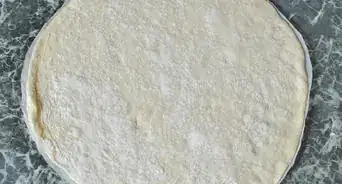
1Grate your cheese and preheat your pizza stone or slab. Throw a pizza stone or slab in the oven and preheat the oven to the highest temperature available (usually 500 °F (260 °C)).[14] Grate your cheese by hand (the amount is up to you). Take a dough ball out of the fridge and stretch it out by hand. Pinch a 1–2 in (2.5–5.1 cm) rim around the edge of the dough to make the edges of the crust, and stretch the dough out from the middle without compressing the edges.[15]
- You can use a baking sheet if you don’t have a stone or slab, but the pizza really won’t turn out as good. The stone helps heat the crust from underneath, which gives it a better texture.
- Hand-tossing is a traditional way to shape the dough, but it’s difficult, risky, and really only designed to save time. Hand-stretching is fine.
- The pinched crust around the edges is absolutely essential for true NY-style pie. If you compress or squeeze the edges, the dough won’t puff up around the rim, which will make it difficult to fold.
-
2Add your toppings and bake the pizza for 4-5 minutes. Grab a wood cutting board and cover it in a light layer of flour. Spread your sauce out on top with the back of a spoon; the amount of sauce is up to you. Sprinkle your cheese evenly on top of the sauce and transfer it to the oven. The pizza is ready when the cheese is melted and starting to brown (this shouldn’t take more than 4-5 minutes). Let it cool for 2-3 minutes on a wire rack before cutting and serving![16]
- The flour on the cutting board will keep the dough from sticking to it.
- Feel free to add any toppings you’d like. Traditional NY-style pizza isn’t particularly diverse in the toppings department but you’re cooking at home, so who cares what those pizza snobs think?
Advertisement
Question 7
Question 7 of 8:What is the secret to New York pizza?
-
1You have to make the dough with care, and the details are important. It’s hard to replicate the classic NY-style crust at home, since there are so many ingredients and variables.[17] On top of that, the pizza stone is essential for the classic New York pie, and you may not have one.[18]
- If you make a lot of pizza at home, picking up a pizza stone is a worthwhile investment!
-
2It’s unlikely your oven gets hot enough to replicate NY pizza. Most NY pizzerias bake their pies at 525–575 °F (274–302 °C). However, your home oven likely only goes up to 500 °F (260 °C). If you can bake your pizza at a higher temperature, do it![19] While your results will still be delicious at 500 °F (260 °C), your pizza may not feel like a true NY-style pie.[20]
- If you want to improve your home-style NY pizza, try letting the pizza stone heat for an additional 1-2 hours in the oven after the buzzer goes off to let you know the oven is preheated. This will give the stone more time to absorb heat, which can improve the texture of the crust.[21]
Advertisement


Question 8
Question 8 of 8:What is so special about NY-style pizza?
-
1It comes down to the old ovens and the zealotry for pizza. For one, New Yorkers take their pizza seriously. This means that there’s relatively little deviation from tradition, and after hundreds of years, they’ve perfected their methods. On top of that, famous New York pizzerias have been using the same ovens for decades, and ingredients vaporize in the oven with every cook. This gives a lot of New York pies a certain texture and flavor that can’t be replicated![22]
- Think about it like this—if you cooked chicken tikka masala in the same pot every day for a year, and then you used that same pot to make chili, what would that chili taste like? Chicken tikka masala! That’s basically what’s going on with New York pizza ovens. Each pie takes on just a mere touch of the pies that came before it, and that can’t be reproduced at home unfortunately.[23]
-
2It’s a myth that New York tap water makes a difference. You’ll hear from time-to-time that New York pizza is unique because the city’s tap water has certain minerals in it. Some pizza shops even import their water from New York for this reason! However, there’s no evidence that this the case, and it’s a disservice to the skilled chefs of the Big Apple to give all of the love to the tap water.[24]Advertisement




References
- ↑ https://www.latimes.com/food/la-fo-newyorkpizza25-2009mar25-story.html
- ↑ https://ny.eater.com/2015/8/7/9050099/new-york-pizza-styles-best-slice
- ↑ https://www.nytimes.com/2017/09/14/nyregion/new-york-today-history-of-nyc-pizza.html
- ↑ https://firstwefeast.com/features/pizza-style-taxonomy/pan
- ↑ https://www.chowhound.com/food-news/189395/what-is-the-difference-between-pan-stuffed-and-deep-dish-pizza/
- ↑ https://www.thrillist.com/eat/nation/best-pizza-styles
- ↑ https://slice.seriouseats.com/2010/10/the-pizza-lab-how-to-make-great-new-york-style-pizza.html
- ↑ https://youtu.be/lzAk5wAImFQ?t=235
- ↑ https://slice.seriouseats.com/2010/10/the-pizza-lab-how-to-make-great-new-york-style-pizza.html
- ↑ https://youtu.be/lzAk5wAImFQ?t=261
- ↑ https://feelingfoodish.com/the-best-new-york-style-pizza-dough/#
- ↑ https://youtu.be/SDpCzJw2xm4?t=36
- ↑ https://youtu.be/lzAk5wAImFQ?t=139
- ↑ https://www.seriouseats.com/recipes/2010/10/new-york-style-pizza.html
- ↑ https://youtu.be/lzAk5wAImFQ?t=189
- ↑ https://youtu.be/lzAk5wAImFQ?t=300
- ↑ https://feelingfoodish.com/the-best-new-york-style-pizza-dough/
- ↑ https://www.popularmechanics.com/home/a10608/tested-does-a-pizza-stone-really-make-a-better-crust-16859308/
- ↑ https://www.fornobravo.com/pizzaquest/its-the-heat-or-is-it/
- ↑ https://youtu.be/lzAk5wAImFQ?t=207
- ↑ https://youtu.be/lzAk5wAImFQ?t=207
- ↑ https://www.wired.com/2008/04/ps-pizzasci/
- ↑ https://www.wired.com/2008/04/ps-pizzasci/
- ↑ https://www.foodrepublic.com/2016/12/06/new-york-pizza-theories-why-do-the-citys-pies-reign-supreme/
- ↑ https://www.nytimes.com/2017/09/14/nyregion/new-york-today-history-of-nyc-pizza.html
- ↑ https://www.bbc.com/news/magazine-33542392
- ↑ https://www.nytimes.com/2017/09/14/nyregion/new-york-today-history-of-nyc-pizza.html
About This Article