This article was co-authored by wikiHow staff writer, Danielle Blinka, MA, MPA. Danielle Blinka is a Writer, Editor, Podcaster, Improv Performer, and Artist currently living in Houston, TX. She also has experience teaching English and writing to others. Danielle holds a Bachelor of Arts in English, Bachelor of Arts in Political Science, Master of Arts in English with a concentration in writing, and Master of Public Administration from Lamar University.
There are 7 references cited in this article, which can be found at the bottom of the page.
This article has been viewed 10,319 times.
Learn more...
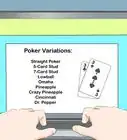
There’s nothing like the rush of winning a big pot in a game of poker. If you enjoy the game, you might be hoping to turn it into an income stream. Playing professional poker is more challenging than it looks on TV, but you might be able to make some cash off your poker hobby. While you likely won’t be going pro right away, you can use a few common strategies to make more money off the game.
Steps
Method 1
Method 1 of 4:Using Proven Strategies
-
1Play your hand every time you have a pair or better. Poker is a unique game because it involves both luck and skill. As a general rule, it’s best to play your hand if you have any good cards, even if it’s a relatively weak hand. This way it’s harder for players to figure out your “tell,” and it shows you’re confident in yourself.[1]
- For example, go ahead and place a bet if you have a pair of 2s, even though it’s a very weak hand. You still have a chance at winning, and your hand could get better on the flop or draw.
- If you only play good hands, you’ll never win because everyone will know your hand is good when you start placing bets.
-
2Bet the same amount pre-flop on each hand you play. Texas Hold’em is the most popular poker game, and you’ll usually receive 2 initial cards before the first bet. When you’re new to the game, it’s tempting to bet more on a good hand and less on a weak hand. However, the other players will recognize this pattern, so they’re likely to fold early when you have a strong hand. Always make the same bet on the first round so they don’t know if your cards are good.[2]
- For instance, people will likely notice if you usually bet $5 to $10 pre-flop but suddenly plop down a $25 bet. Chances are, they’ll fold early because they know your cards are good.
- It’s okay to bet more in later rounds if you’re confident in your cards.
Advertisement -
3Bluff if you think your opponent has a weak hand. “Bluffing” means pretending like you have great cards when really your hand is weak. It’s risky because you can lose a lot of money if the other person calls your bluff and takes the hand all the way to showdown, which is when you reveal your hand to see who wins. Wait until you feel like you can get a good read on the other players before you start bluffing. If you think the other person has a weak hand, pretend like you’re holding something special to see if you can make them fold.[3]
- Let’s say you notice that another player is acting nervous or is suddenly betting less than they were early on. This might be a sign their cards are weak. In response, you might place a big bet and act really confident and excited about your hand.
- Don’t bluff very often if you’re not good at faking a strong hand. If your opponent realizes you’re bluffing, they might call you on it.
-
4Adapt your strategy to fit the other players in the game. As you get better at poker, it’ll get easier to figure out other players’ strategies and tells. Study the other players to see which hands they take to the final showdown, how they react to their cards, and how aggressively they’re playing. Try to change up your game play to take advantage of their weaknesses. Once you can do this, you’ll be able to start making real money playing poker.[4]
- If someone has a tell, watch for it on each hand to see if you can gauge what kind of cards they have.
- If a player only bets big on good cards, you’ll know to fold early when they make big bets.
- If a person takes every hand to a showdown, you can start paying attention to their mannerisms and betting amounts to see what their cards might be like. You’ll also know not to bluff them because they’ll always go to the showdown.
-
5Practice bankroll management to control your losses. Bankroll management means keeping track of how much money you have to play poker and adjusting your bets accordingly. Keep a daily tally of how much money you have in your reserves so you know what types of stakes you should choose. If your bankroll is high, it’s okay to take some risks, but you might want to choose a low-stakes game if you’re running low on cash.[5]
- If you play online poker, you can play very low stakes games, with stakes as low as $0.01.
- At a casino, you might have fewer options. However, different tables should offer different stakes. You might decide to switch to a game with $5 or $10 stakes if you’re low in cash.
-
6Quit playing while you’re ahead. Winning any sum of cash is thrilling, so you may be tempted to keep playing after a winning streak. However, everyone loses eventually, so try not to get caught up in the moment. Pull out of the game while you’re still up.[6]
- Decide ahead of time how much money is considered a “win” to you. For example, you might immediately stop playing if you find yourself up by a certain amount, like $250.
- Keep in mind that you can’t drop out of a tournament, as they’re winner-take-all.
Advertisement


Method 2
Method 2 of 4:Increasing Success at Online Poker
-
1Play online poker if you want a game that fits your schedule. Online poker is super convenient because you can play it anywhere with Internet access. You have multiple options for online poker, so try out different sites to see which one you like best. Once you pick a site, you can play at 1 digital “table” or multiple “tables,” depending on your preference.[7]
- One benefit of online poker is that you have more opportunities to win if you play at several “tables” at one time. However, this requires extra concentration since you’ll need to pay attention to what’s happening at each table.
- Read the terms and conditions on each website carefully so you know how the site makes money. For instance, the site will likely get a percentage of each pot.
-
2Choose a site that offers a bonus or “rakeback” program for loyal users. Websites make money by taking a small amount of each winning pot, which is called the “rake.” However, many sites will refund parts of the “rake” to players who use the site often. Similarly, you may also get a bonus for being a loyal customer. Stick to sites that offer these financial rewards to help pad your winnings.[8]
- Most professional players take advantage of these types of bonuses to increase their winnings. This way, you might be able to make money even on days you’ve lost hands.
-
3Look for players that complain and use emojis in the chat. Online poker draws a lot of recreational players who just enjoy playing. Typically, these players lose more often and are great opponents for someone like you who’s out to make money. You’ll likely notice these players using the chat function to talk about life, complain about their losses, and shoot the breeze. Seek out these players because you’ll probably win more often against them.[9]
- For example, they might send you messages like, “I keep getting bad hands,” or “Wow :) :) good hand.”
- There’s no guarantee that these players will be amateurs.
-
4Stay at “tables” where players bet the minimum and always go to showdown. Beginner players usually don’t strategize as well as experienced players, so they’ll play every hand the same. Typically, they’ll be too afraid to make bets that are higher than the minimum, and they may be unsure of when to fold their hand. Watch for tables where players are making these novice moves because they might be more profitable for you.[10]
- You only need 1 amateur player at the “table” to make money.
Advertisement
Method 3
Method 3 of 4:Playing Poker in-Person
-
1Stick to in-person games with your friends if you’re a beginner. While you might get lucky, you’re more likely to lose if you’re a beginner playing against seasoned players. However, chances are most of your friends aren’t card sharks. Schedule a poker game night and invite your friends so you can get more practice and hopefully win some cash. You might also allow your friends a “plus one” if you want to attract more players.[11]
- You might not win a lot of cash when you’re playing a friendly game, but it’s great for building your experience. Hopefully, you’ll also come away with a little extra money.
-
2Join a cash game at a casino once you’re more experienced. Cash games are great for players at any level because you can come and go as you please. You can find cash games at casinos and game rooms. Cash games typically have “blinds,” which are the required starting bet that each player must put into the pot before a hand. Look for games with low blinds to help manage your losses.[12]
- For instance, the blind may be $5, $10, $50, or even higher. You’ll need to put this amount in the pot before you’re given any cards.
- In a cash game, you can usually sit out a round or leave the game early if you like. You’ll be able to keep any chips you still have.
- You'll likely get to watch other players as an observer during a cash game, so you might be able to learn something.
- If you’re playing at a casino, the house takes in a “rake” on every hand, which is a percentage of the winnings. Each casino sets its own rake percentage. Take that into account when calculating the pot.
-
3Play against beginners if you can. You’re more likely to win games against beginners, especially if you have a lot of experience. Since you’re trying to make money, invite people who are amateurs or recreational players to join your game. If you’re playing in a casino or online game, look for players who seem inexperienced.[13]
- Signs of an inexperienced player include things like showing too much emotion, placing bets on every hand, checking or folding a lot, and taking a lot of bad hands to the showdown, which is when everyone who’s still in the game reveals their hand.
-
4Look for players who bet often and chase pots. Aggressive betters are more likely to lose money, especially if they bet the same way on every hand. This can even be a sign that they’re inexperienced. When you have a choice on which table to join, pick a table with a player who bets recklessly.[14]
- You may not be able to bluff as often when playing with someone who takes every hand to the end. However, it’ll increase your chances of making big bucks when you have a great hand, since you know the other person will chase the pot.
-
5Avoid tournaments unless you’re okay with losing all of your chips. Poker tournaments can be fun, but they’re also a big financial risk. Tournaments are designed as a winner-take-all game, so very few players will take home cash. If your goal is making money, wait until you’re winning more than you lose before you sign up for a tournament. Then, look for tournaments at a local casino or game room.[15]
- In a poker tournament, you typically can’t leave the game or sit out a round. If you choose to walk away, you forfeit all of your chips. You’re less likely to earn money from a tournament if you’re a beginning player, since only the winners walk away with cash.
Advertisement


Method 4
Method 4 of 4:Developing Your Poker Skills
-
1Learn the rules of the game. It’ll be hard to know when to bet, bluff, or fold if you don’t know how to play poker. Start by learning the winning hands in poker. Then, play a few games with friends to familiarize yourself with betting, checking, and folding a hand.[16]
- Your “hand” is the cards you’ve been dealt this round.
- The “ante” or “blind” in poker is a mandatory first bet that everyone who’s playing a hand must put in the pot before the cards are dealt.
- “Betting” means that you’re adding money to the pot and staying in the game. If you place a bet, other players must match or exceed your bet to stay in the game. You can say “check” if you don’t want to place a bet and no other players have already bet in the round.
- “Folding” means that you aren’t confident in your hand and are dropping out of a round. If you fold, you lose any money you already put into the pot.
-
2Play a lot of practice games to help you get better. As the old saying goes, “Practice makes perfect.” While your poker game can never truly be “perfect,” playing often will help you improve your game play. Arrange poker nights with friends, family, and coworkers so you can get more experience. Additionally, try playing online poker to build your skills.[17]
- Ask your friends or family members to invite people they know to your games so you encounter more players.
- You might set up a regularly scheduled poker night that occurs weekly, biweekly, or monthly, depending on your schedule.
-
3Study how professional poker players play. Like with sports, you can learn a lot about game play by observing other players. Watch programs like World Series of Poker, High Stakes Poker, and Poker After Dark to see how the professionals do it. Additionally, look for clips and video tutorials featuring your favorite players online. Take notes on the strategies they use to win.[18]
- Pay attention how the players act when they have a good hand versus a bad hand. Notice if they have any “tells,” which signal whether or not their hand is good.
- Notice when your favorite players decide to bet, bluff, or fold.
-
4Practice managing your emotions while you’re playing poker. Displaying emotions during a poker game works against you because other people will be able to guess if your cards are good or bad. Additionally, getting emotional may make you place reckless bets. Find stress relievers that help you stay calm and collected under pressure. Practice using these techniques so they become second nature to you.[19]
- For example, you might try counting to 10 to help you calm down. You could also try visualizing yourself in your happy place.
- This is called “controlling your tilt.”
Advertisement
Warnings
- Poker is a risky game, so only bet money you’re willing to lose. Experts say only the top 5% of players consistently make money playing poker.[21]Thanks!






References
- ↑ https://beastsofpoker.com/make-money-playing-poker/
- ↑ https://beastsofpoker.com/make-money-playing-poker/
- ↑ https://www.youtube.com/watch?v=VWNoD2m7kEM&feature=youtu.be&t=33
- ↑ https://slate.com/human-interest/2014/02/what-is-it-like-to-earn-a-living-by-playing-poker.html
- ↑ https://www.oddsshark.com/poker/basics/poker-101-do-people-actually-make-money-playing-online-poker
- ↑ https://slate.com/human-interest/2014/02/what-is-it-like-to-earn-a-living-by-playing-poker.html
- ↑ https://slate.com/human-interest/2014/02/what-is-it-like-to-earn-a-living-by-playing-poker.html
- ↑ https://www.oddsshark.com/poker/basics/poker-101-do-people-actually-make-money-playing-online-poker
- ↑ https://beastsofpoker.com/make-money-playing-poker/
- ↑ https://beastsofpoker.com/make-money-playing-poker/
- ↑ https://beastsofpoker.com/make-money-playing-poker/
- ↑ https://www.vox.com/the-goods/2019/4/30/18518010/online-poker-microstakes-expert-blackrain79
- ↑ https://www.oddsshark.com/poker/basics/poker-101-do-people-actually-make-money-playing-online-poker
- ↑ https://www.vox.com/the-goods/2019/4/30/18518010/online-poker-microstakes-expert-blackrain79
- ↑ https://www.pokernews.com/strategy/10-multi-table-tournament-tips-how-play-early-levels-25930.htm
- ↑ https://www.vox.com/the-goods/2019/4/30/18518010/online-poker-microstakes-expert-blackrain79
- ↑ https://slate.com/human-interest/2014/02/what-is-it-like-to-earn-a-living-by-playing-poker.html
- ↑ https://www.cardplayer.com/poker-news/24770-poker-strategy-with-jonathan-little-how-to-improve-your-poker-skills
- ↑ https://www.vox.com/the-goods/2019/4/30/18518010/online-poker-microstakes-expert-blackrain79
- ↑ https://slate.com/human-interest/2014/02/what-is-it-like-to-earn-a-living-by-playing-poker.html
- ↑ https://www.oddsshark.com/poker/basics/poker-101-do-people-actually-make-money-playing-online-poker
About This Article