This article was co-authored by wikiHow staff writer, Jessica Gibson. Jessica Gibson is a Writer and Editor who's been with wikiHow since 2014. After completing a year of art studies at the Emily Carr University in Vancouver, she graduated from Columbia College with a BA in History. Jessica also completed an MA in History from The University of Oregon in 2013.
There are 7 references cited in this article, which can be found at the bottom of the page.
This article has been viewed 7,526 times.
Learn more...
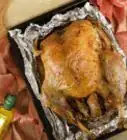
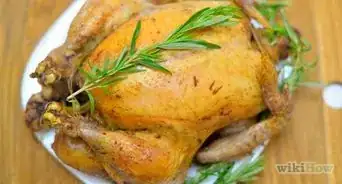
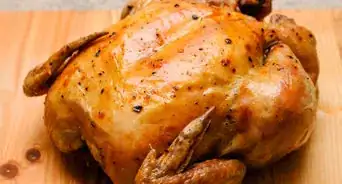
If you're looking to switch up your holiday table, try making a lemon pepper turkey. The bright flavor of the lemon and spice from the pepper cut through rich foods and make for a welcome change. Season the turkey with lemon zest and cracked peppercorns before filling the cavity with onion, lemon, celery, and thyme. Then roast the turkey until the skin is crisp and the meat is tender.
Ingredients
- 1 12 to 14 lb (5.4 to 6.4 kg) turkey, thawed if frozen
- 4 lemons
- 2 tablespoons (14 g) of coarsely cracked black peppercorns
- Kosher salt
- 1 onion
- 2 stalks of celery
- 3 sprigs of fresh thyme
- 8 tablespoons (113 g) of butter
Makes 1 whole turkey
Steps
Part 1
Part 1 of 2:Seasoning the Turkey
-
1Leave the turkey at room temperature for 30 minutes. If you're using a 12 to 14 lb (5.4 to 6.4 kg) turkey that was frozen, thaw it before setting it out at room temperature for half an hour. You should also remove the neck or giblets from the turkey's cavity.[1]
- Save the neck and giblets to make turkey gravy or stock.
-
2Zest 4 lemons and mix the zest with salt and peppercorns. Use a microplane or cocktail zester to finely grate the zest from 4 lemons. Put the zest into a bowl and stir in 2 tablespoons (14 g) of coarsely cracked black peppercorns along with 1 tablespoon (18 g) of kosher salt. Stir until the spice rub is combined.[2]
- Use organic lemons which haven't been sprayed with pesticides or coated in wax.
Advertisement -
3Pat the turkey dry and season it with the lemon pepper rub. Take a paper towel and pat the entire surface of the turkey until it's dry. Throw away the paper towel and then sprinkle 1/4 of the lemon pepper rub inside the turkey's cavity. Rub the remaining 3/4 of the rub over the outside of the turkey.[3]
- Use your fingers to rub the lemon pepper mixture into the turkey's skin, so it absorbs the flavor.
-
4Fill the cavity with onion, celery, thyme sprigs, and 1 of the lemons. Cut 1 onion into 4 equal-sized pieces and chop 2 stalks of celery into 2 in (5.1 cm) chunks. Put them into the turkey's cavity along with 1 of the lemons that you've cut into 4 pieces and 3 sprigs of fresh thyme.[4]
Tip: To give the turkey a garlic flavor, add 2 heads of garlic that you've cut in half crosswise.
-
5Tie the turkey legs and set the turkey on the rack of a roasting pan. Hold the legs together and wrap them in place using kitchen twine. Set the turkey on a rack that you can lower into a large roasting pan. Then take the tips of the wings and tuck them under the shoulder of the turkey.[5]Advertisement


Part 2
Part 2 of 2:Roasting and Serving the Turkey
-
1Adjust the oven rack and preheat the oven to 350 °F (177 °C). Depending on the size of your oven, you'll probably need to remove 2 or 3 oven racks. Then position a rack on the lowest setting. This way you'll have space to fit the turkey in the oven.[6]
- Set the spare oven racks aside.
-
2Melt the butter in a skillet and stir in the juice of 2 lemons. Put 8 tablespoons (113 g) of unsalted butter into a skillet and melt it over low heat. While the butter melts, juice 2 of the lemons. Then turn off the burner and stir in the juice.[7]
- You'll need about 1⁄4 cup (59 ml) of juice from the lemons.
-
3Brush the lemon butter over the turkey and put it in the oven. Dip a basting brush in the lemon butter and brush it over the surface of the turkey. Ensure that you cover all of the skin with the mixture.[8]
- The lemon butter will flavor the turkey and prevent it from drying out as it roasts.
-
4Roast the turkey for 1 hour and baste it with the lemon butter. Put the roasting pan with the turkey into the preheated oven and bake the turkey for 1 hour. Then open the oven door and carefully use a turkey baster to squirt the pan juices over the turkey's skin.[9]
- If you don't have a turkey baster, dip a clean basting brush into the pan juices and brush them over the turkey. It's important to wash the brush you used earlier to prevent cross contamination.
-
5Cook the turkey for 2 more hours or until it reaches 165 °F (74 °C). Continue to roast the turkey and coat it with pan juices every 30 minutes until the turkey skin turns golden brown. Instead of relying on the pop-up thermometers that are in some turkeys, insert your own instant-read meat thermometer into the thickest part of the thigh. It should reach 165 °F (74 °C) once the turkey is finished cooking.[10]
Did You Know? Pop-up thermometers aren't as accurate as thermometers that you insert yourself. Some have been shown to pop up before the turkeys reached a food-safe temperature, which is why it's important to always check the temperature yourself.
-
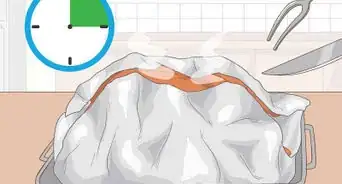
6Remove the turkey and rest it for 30 minutes. Turn off the oven and take the roasting pan out. Carefully transfer the turkey to a cutting board and loosely cover the turkey with aluminum foil. Leave the turkey to rest for 30 minutes, so the juices redistribute within the meat and the turkey finishes cooking.[11]
- If you're having trouble lifting the turkey, ask someone to help you.
- You can pour the pan juices through a strainer and use them to make gravy.
-
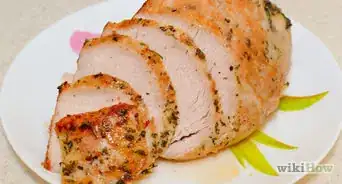
7Carve the turkey and serve it warm. Use a sharp knife to carefully cut off the thighs and legs. Set them on a serving platter and slice through the breast meat. Arrange the slices on the platter and cut off the wing pieces. Place them on the platter and serve the turkey with your favorite sides, such as mashed potatoes or brussels sprouts.[12]
- Refrigerate the leftover turkey in an airtight container for up to 3 to 4 days.
-
8Finished.Advertisement


Things You'll Need
- Knife and cutting board
- Roasting pan with a rack
- Instant-read meat thermometer
- Kitchen twine
- Skillet
- Turkey baster
- Basting brush
- Aluminum foil

References
- ↑ https://www.foodnetwork.com/recipes/food-network-kitchen/lemon-pepper-turkey-with-bacon-gravy-3364277
- ↑ https://www.foodnetwork.com/recipes/food-network-kitchen/lemon-pepper-turkey-with-bacon-gravy-3364277
- ↑ https://www.foodnetwork.com/recipes/food-network-kitchen/lemon-pepper-turkey-with-bacon-gravy-3364277
- ↑ https://www.foodandwine.com/recipes/lemon-pepper-roast-turkey
- ↑ https://www.epicurious.com/expert-advice/how-to-truss-thanksgiving-turkey-easy-way-article
- ↑ https://www.foodnetwork.com/recipes/food-network-kitchen/lemon-pepper-turkey-with-bacon-gravy-3364277
- ↑ https://www.foodnetwork.com/recipes/food-network-kitchen/lemon-pepper-turkey-with-bacon-gravy-3364277
- ↑ https://www.foodnetwork.com/recipes/food-network-kitchen/lemon-pepper-turkey-with-bacon-gravy-3364277
- ↑ http://www.kittycooks.com/how-to-use-a-turkey-baster.html
- ↑ https://www.consumerreports.org/meat-thermometers/meat-thermometer-or-pop-up-timer-for-turkey/
- ↑ https://www.foodnetwork.com/recipes/food-network-kitchen/lemon-pepper-turkey-with-bacon-gravy-3364277
- ↑ https://www.thekitchn.com/turkey-carving-for-beginners-251014
- ↑ https://www.foodandwine.com/recipes/lemon-pepper-roast-turkey
- ↑ https://www.tasteofhome.com/recipes/lemon-herb-roasted-turkey/
About This Article