wikiHow is a “wiki,” similar to Wikipedia, which means that many of our articles are co-written by multiple authors. To create this article, volunteer authors worked to edit and improve it over time.
This article has been viewed 106,157 times.
Learn more...
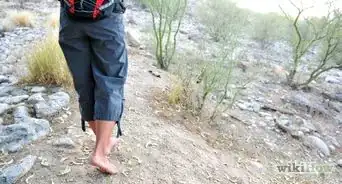
Minimalist running is the idea that human feet are very well adapted to supporting weight and running. Studies show that runners use 4% less energy when they run barefoot.[1] International athletes (like Zola Budd-Pieterse from South Africa and the late Abebe Bikila from Ethiopia) have successfully competed barefoot. Some studies even suggest that running barefoot might also result in fewer injuries![2] If you are interested in starting out in barefoot running and want transition footwear, or if you're already minimalist running or looking to extending your outdoor running season, then these might be the shoes for you.
Steps
-
1Gather the materials listed below.
-
2Cut the leather down the middle so that you have one rectangle for one foot and one for the other.Advertisement
-
3Put on your socks if you don't have them on already.
-
4Apply Shoe Goo as evenly as possible to the rough side of one of the leather rectangles. Put newspapers down first to protect the surface beneath.
-
5Quickly stand on the rectangle squarely with one foot.
-
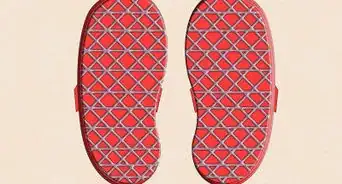
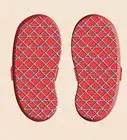
6Using your hands, press and hold the leather sole onto the contours of your foot. You may alternatively stand on a pillow covered in paper, a bag of beans, foam, or anything else you can think of to form the sole to your foot.
-
7Repeat the process for the other foot.
-
8Wait until the glue sets, usually about 24 hours.
-
9Trim the edges of the leather to round it into more of a sole shape.
-
10With your foot in your new shoe/sock, glue down any little flaps and edges. To prevent pleating, you can cut small triangles out to fit the sole up the heel and around the toes.
-
11Let the glue cure. You may waterproof the soles at this time, if you wish.
-
12Run.Advertisement


Warnings
- This will not make you good at running barefoot.Thanks!
- Follow all directions and precautions associated with adhesives and waterproofing agents.Thanks!
- This shoe will not protect you from all the dangers of barefoot running.Thanks!
- Be careful when beginning minimalist running. Modern shoes are carefully designed to support your foot. As a result of wearing these shoes constantly, the muscles that you use for stability may not be strong enough to keep you from getting injured when running barefoot.Thanks!
- While the human body may be well adapted to running barefoot, it is not well adapted to running on asphalt. If you decide to run on a hard surface without shoes for support, keep in mind the long-term effects that it will have on the health of your joints.Thanks!
Things You'll Need
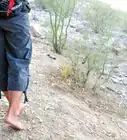
- Use a thick wool-blend or synthetic fiber pair of socks (cotton is not recommended). They should be fairly snug fitting so your feet don't slide around too much. Too much slack may be uncomfortable and possibly unsafe.In the pictures show a pair of very tight fitting military surplus wool-blend socks.
- A patch of leather. Be sure it is large enough for you to stand on with no part of your feet on the floor. Ideally, it would be larger than that, so that it can wrap around your feet a little. Also, make sure at least one side of the leather is rough.
- A tube of Shoe Goo shoe adhesive and sealant.
- scissors
- (optional) Leather waterproofing and conditioner. You can find this for treating leather boots and shoes.