This article was co-authored by Ben Whitehair and by wikiHow staff writer, Jessica Gibson. Ben Whitehair is a Social Media Expert, Acting Coach, and the Chief Information Officer (CIO) of TSMA Consulting. With over a decade of experience in the social media space, he specializes in leveraging social media for business and building relationships. He also focuses on social media’s impact on the entertainment industry. Ben graduated summa cum laude from The University of Colorado at Boulder with BAs in Theatre and Political Science as well as a Leadership Certificate. In addition to his work as CIO, Ben is a certified business and mindset coach and National Board Member of SAG-AFTRA. He is also a successful entrepreneur as the Co-Founder of Working.Actor, the premier business academy and coaching community for actors.
There are 8 references cited in this article, which can be found at the bottom of the page.
This article has been viewed 231,857 times.
People always talk about how hard it is to cry on cue, but laughing can be tricky, too! Fortunately, there are lots of little tricks for delivering a believable, natural laugh. These are really helpful for actors, but you can even pick up tips that may come in handy during socially awkward situations. It all comes down to getting in a funny frame of mind—then the laughs will follow.
Steps
Method 1
Method 1 of 8:Think of things that make you laugh.
-
1Find something that's funny so you're in a lighthearted mindset. Maybe someone told a funny joke, you're recalling a scene from a hilarious movie, or something just struck you as silly and made you laugh. You could even watch great performances by funny actors for inspiration. Isolate the moment that you found funny so you can remember it on cue.[1]
- You may think of an embarrassing memory that's become funny over time or remember a really funny line of a movie you watched recently.

Method 2
Method 2 of 8:Identify different types of laughter.
-
1People laugh differently depending on the situation. Think about it—you might have a deep, belly laugh if a friend's telling a really funny story or you might chuckle a little at something that's kind of amusing. These are different laughs for different settings and figuring out which to use can make your performance more effective. You may want to make notes on the script about how the laughter sounds.[2]
- For example, if you're playing a character that's surprised by something funny, you might have a lighter, higher chuckle. If your character is trying to hold back from laughing, it may be a deep, bubbly laugh that escapes.
- Not sure where to start? Study yourself, a close friend, or a character in a funny movie, and pay attention to all of the laughing styles you hear.

Method 3
Method 3 of 8:Study your character's personality.
-
1Immerse yourself in the situation so you find it easier to laugh. Imagine how your character would respond to the scene around you.[3] This makes your laugh more believable because it fits the scene. For instance, if your character is being sarcastic, you may give a short, slow laugh. If your character is genuinely happy and joyful, you might give a big, goofy chuckle that doesn't stop for a minute.[4]
- Getting into character may mean that you spend extra time reading the script so you understand your character's personality and what they find humorous. For instance, if they're nervous, they may give a short, strained laugh.
- Not an actor? No problem—if you're trying to laugh at the end of a friend's joke, just follow the joke a little more closely. This can help you cue in on when to laugh and you might even find something truly funny in the joke.

Method 4
Method 4 of 8:Make deep laughing sounds from your gut.
-
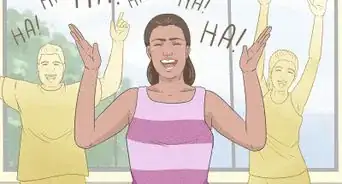
1Trick your body into naturally laughing by going, "huh, huh, huh." If you have a hard time getting into a funny state of mind, focus on the physical aspect of laughing. Say, "huh," or "ha," while you draw in your stomach. Repeat this, going faster until you're saying "huh-huh-huh," and it turns into realistic-sounding laughter. With a little practice, this is a great way to start laughing on cue.[5]
- This is a great laugh to use if your character will be laughing along with others. Once you get started, it's really easy for your body to take over with natural laughter.

Method 5
Method 5 of 8:Take a few deep breaths while you're laughing.
-
1You can probably spot fake laughter—it doesn't sound natural. This is because real laughter uses your lungs and emotions to produce a totally unique sound. To trigger this realistic-sounding laugh, breathe in deeply and let out the air while you're laughing. You'll soon be laughing with your whole body so it's more natural than just making the sound with your vocal cords.[6]
- Keep your body loose so it's easy for your lungs to expand and your muscles to relax.
- Use this breathy laugh for scenes when your character might be reacting to something funny that someone said or did.
- You've probably seen someone laugh so hard that they've struggled to breathe. While you don't have to gasp while you laugh, the extra breaths do make it look like you're truly laughing.

Method 6
Method 6 of 8:Give an authentic smile.
-
1You may have a good fake laugh, but make it more realistic with a smile. Instead of smiling like you're posing for a picture, remember a time when you were really happy or pretend to be joyful during your scene. When you smile, let it spread across your face up to your eyes so you look truly happy. Then, your laugh will seem totally natural.[7]

Method 7
Method 7 of 8:Make gestures while you laugh.
-
1You might cover your mouth with your hand or pat your chest. These little gestures can make your laughter seem more authentic than if you just stand up straight and laugh on cue. You can pick up on even more movements by watching people in a crowd.[8]
- For instance, some people find that raising your eyebrows while smiling can help trigger laughter.
- Your script might include physical movements that you should do while laughing.

Method 8
Method 8 of 8:Practice making yourself laugh.
-
1You use a lot of muscles when you laugh so give them a workout! The more you practice laughing on command, the easier it will be since your body will be used to it. You'll also feel more confident as you practice, which will make the laughter seem more authentic.[9] [10]
- It can help to practice in front of a mirror so you can see if you're smiling and appearing genuine.

Expert Q&A
-
QuestionHow can I laugh on cue during a play?
 Ben WhitehairBen Whitehair is a Social Media Expert, Acting Coach, and the Chief Information Officer (CIO) of TSMA Consulting. With over a decade of experience in the social media space, he specializes in leveraging social media for business and building relationships. He also focuses on social media’s impact on the entertainment industry. Ben graduated summa cum laude from The University of Colorado at Boulder with BAs in Theatre and Political Science as well as a Leadership Certificate. In addition to his work as CIO, Ben is a certified business and mindset coach and National Board Member of SAG-AFTRA. He is also a successful entrepreneur as the Co-Founder of Working.Actor, the premier business academy and coaching community for actors.
Acting CoachThe more you're actually embedded in the character and the story, the easier it will be. Focus more on communicating with the other person than the final effect. I find that building a connection with whomever I'm in the scene with helps because then I'm having a genuine human connection. -
QuestionHow can I practice laughing on cue by myself?Ben WhitehairBen Whitehair is a Social Media Expert, Acting Coach, and the Chief Information Officer (CIO) of TSMA Consulting. With over a decade of experience in the social media space, he specializes in leveraging social media for business and building relationships. He also focuses on social media’s impact on the entertainment industry. Ben graduated summa cum laude from The University of Colorado at Boulder with BAs in Theatre and Political Science as well as a Leadership Certificate. In addition to his work as CIO, Ben is a certified business and mindset coach and National Board Member of SAG-AFTRA. He is also a successful entrepreneur as the Co-Founder of Working.Actor, the premier business academy and coaching community for actors.
Acting CoachOne thing you can do is film yourself. Set up a tripod and an iPhone, and film a scene that you've seen someone else do and try to do it exactly how they did. Then watch yourself on camera. You'll learn a lot by watching yourself, and you'll often see things that you didn't realize you were doing.










References
- ↑ https://www.backstage.com/magazine/article/top-tips-becoming-successful-comedy-actor-63688/
- ↑ https://youtu.be/f9Fuh3yLw0A?t=86
- ↑ Ben Whitehair. Social Media Expert. Expert Interview. 3 June 2021.
- ↑ https://www.backstage.com/magazine/article/top-tips-becoming-successful-comedy-actor-63688/
- ↑ https://variety.com/video/allison-janney-talks-using-a-technical-method-to-laugh-on-cue/
- ↑ https://www.npr.org/2014/05/08/310794138/how-to-tell-when-a-laugh-is-real-the-answer-is-in-a-breath
- ↑ https://youtu.be/_nyUGxRTWn0?t=427
- ↑ https://youtu.be/_nyUGxRTWn0?t=392
- ↑ https://castingfrontier.com/tips-laugh-cue/
- ↑ Ben Whitehair. Social Media Expert. Expert Interview. 3 June 2021.
About This Article

To laugh naturally on cue, you need to find the right trigger that will help you laugh genuinely. Actively look for things that make you laugh and think about what’s funny in day-to-day situations you find yourself in. For example, your name on your coffee order might be spelt completely wrong! It can also help if you memorize different jokes and references. Watch standup routines and comedies to expose yourself to a wide variety of humor. This gives you a better range of possible triggers that may help you if you have trouble laughing on cue. To perform a great natural laugh on cue, do plenty of practice at home. Stand in front of the mirror, use your triggers, and try out different kinds of laughter until you find what feels natural. For more tips on laughing naturally on cue, like how to find the right cue, read on!