X
wikiHow is a “wiki,” similar to Wikipedia, which means that many of our articles are co-written by multiple authors. To create this article, 30 people, some anonymous, worked to edit and improve it over time.
This article has been viewed 399,439 times.
Learn more...
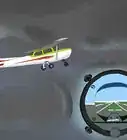
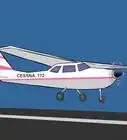
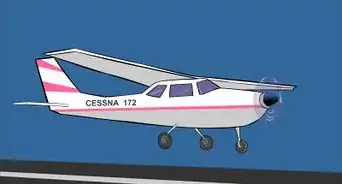
Impress your friends on your aviation knowledge. Landing a plane is the most important part of a flight. Fly safe! These instructions assume you are approaching a towered airport for landing in a left traffic pattern, and the winds are calm and visibility is good.
Steps
-
1Get the ATIS (Automatic Terminal Information Service) make sure you tell the control tower what happened (if it is an emergency) 10 miles (16 km) out from entry into the airspace.[1] ATIS will give you a code such as "Information alpha" to give to tower. Contact the control tower or approach control for that airport, and state the following:
- "tower/approach name, aircraft tail number, location, altitude, Landing with information whatever "ATIS" code you received above." The tower will give you instructions. This guide assumes they instructed you to take left (or right) traffic for Runway X and to report on 45 (45 degree downwind entry to runway being used). (This is a rough guideline, it's missing some specific information that tower sometimes asks for)
- "tower/approach name, aircraft tail number, location, altitude, Landing with information whatever "ATIS" code you received above." The tower will give you instructions. This guide assumes they instructed you to take left (or right) traffic for Runway X and to report on 45 (45 degree downwind entry to runway being used). (This is a rough guideline, it's missing some specific information that tower sometimes asks for)
-
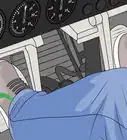
2Do your pre-landing check with your checklist: Brakes checked, undercarriage down & locked, Mixture fully rich, Fuel selector on both, Flaps as required, (Propeller pitch fixed), Suction indicating, Oil Temps. and Press. (Ts&Ps) in green, Master on, Mags on both, (Carb. heat to HOT if RPM is below 1500RPM) Hatches & Harness' locked and latched, Landing lights on. PLANE CLEAR TO LAND.[2]Advertisement
-
3Apply Carb. Heat and make your descent to where you reach pattern altitude for that airport by the time you reach the 45° entry leg. You can be a little higher on the 45. Let's assume the pattern altitude is 1,200 feet (365.8 m) MSL. Try to descend at 500 feet (150 m) per minute. That will be easier on your ear drums.
-
4Reach the 45 and contact the tower and tell them how many miles you are out on the 45 and your altitude. The tower might clear you to land or will acknowledge.
-
5Remember that when you reach 1⁄4 mile (0.4 km) from the runway, turn downwind.[3] By now the tower should have cleared you to land. You should have slowed the plane to 80 to 85 knots and powered the engine to around 2000 rpms.
-
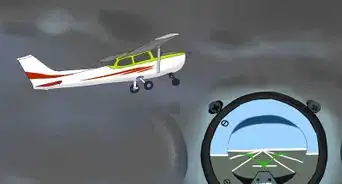
6Know that when you are abeam the downwind runway numbers, turn on your carburetor heat on, power back to 1500 rpm. Hold the nose level until the airspeed drops into the white arc, then extend 10 degrees of flaps. Pitch for 75 knots using outside visual reference, then confirm with the airspeed indicator. Make sure you coordinate your turns with the rudder pedals. Be especially careful not to use excessive inside rudder however: skid + stall = spin!
-
7When the threshold of the runway is 45° behind you, turn left base, and apply another 10 degrees of flaps. This should bring your airspeed down to 70 knots. Do not add flaps while in the turn; only after turn is complete. You are now perpendicular to the runway. Be especially careful not to overshoot your final turn at an airport with parallel runways, because the parallel runway might have landing traffic.[4]
-
8Turn Final. When the field is made (you would reach it even if the engine were to quit), extend the next 10 degrees of flaps (again, after the turn is complete). The spot on the ground where you will land will appear stationary. Use pitch to maintain approach speed (usually 60-70KIAS). Use power to control altitude. Be careful to keep airspeed above 60KIAS, but do not fixate on the airspeed indicator. Use the ailerons to correct for any crosswind and the rudder pedals to keep the plane aligned with the runway center-line.
-
9When you are a few feet off the ground, gently power back and level off. Keeping level will require increasing amounts of back pressure on the yoke, and (increasing amounts of aileron in a crosswind). After touchdown keep the yoke pulled all the way back and to whichever side is needed for crosswind. Only apply the brakes if necessary (for field length or to avoid holding up other landing traffic). Continue on the runway centerline until you reach taxi speed (a fast walking pace), then turn off at the nearest taxiway and do not stop until you have passed the hold short line.[5]
-
10Complete your post landing checks, then call tower if they have not called you already.[6]Advertisement


Community Q&A
-
QuestionWhat is a standard turn?
 Community AnswerA standard turn is one with a bank angle, and one that will take you 2 minutes to complete a full 360 degree circle.
 -
QuestionI took 5 yrs off after 220 hrs flight time. My check off instructor demonstrated an engine out (power to idle) on downwind. He put it into a slip and maintained it to landing, flared and a smooth landing. I tried it and my landing was not as smooth. Is this a safe maneuver?
 Community AnswerA slip landing should not be necessary if your approach is normal. Some use the slip to lose altitude when their approach is too high. A slip is dangerous because you could stall the aircraft. A go-around might be safer if you're too high.
 -
QuestionHow do I note the AGL with the altimeter?
 Community AnswerThe altimeter, if properly adjusted for barometric pressure, indicates mean sea level altitude. AGL is the difference between the altimeter indication and surface elevation.
 -
QuestionAt what altitude do I start my descent on a short final in a 172? I think 1,700 ft at 1,500 RPM, correct?
 DanoyachtcaptTop AnswererIf you're making a standard downwind, base, final approach, your altitude should be about 500 ft AGL on your turn to base leg. If you're on a straight in approach, then 1000 ft is better, but obstacles and the terrain on final approach will determine what your actual altitude should be.
 -
QuestionWhen do I start my flare?
 OMalley567Community AnswerStart to round out at the threshold, and enter your pre-flare. Continue to pull back on the yoke, and make sure you are at an appropriate speed.
 -
QuestionWhy don't they show cross control stalls in training?DanoyachtcaptTop AnswererCross control landings are dangerous, especially for a beginner, as you are dangerously close to the ground. It's safer to go around than to risk the cross control stall.
-
QuestionWhat if the landing gear is fixed and it doesn't move?DanoyachtcaptTop AnswererThere is a Cessna 172R that has retractable gear, so you need to get some training for that.
-
QuestionShould I pull the yoke slowly right after throttle idle cut off, or wait for a little bit more descent?Community AnswerAdjust your back pressure on the yoke to maintain enough air speed for the plane to keep flying. To arbitrarily increase without close monitoring of speed is a dangerous habit.
-
QuestionWhat if the plane is out of fuel?
 WikiaWangTop AnswererIf your plane is out of fuel, your engine will stop running. This means that you will have no more lift and will have to make an emergency landing. Contact the ATC and declare an emergency.
 -
QuestionHow do I turn without banking?WikiaWangTop AnswererTo avoid banking, use the rudder. The rudder changes your heading without changing your bank angle. However, avoid using the rudder while cruising, since it can cause your plane to become unstable. Also, do not use your rudder to long; using it to long can cause what is know as a hard-over, and your plane will start to bank.
Warnings
- This is only a general guide. Ask your instructor about the specific procedures at your local airport.Thanks!
- If you don't know how to fly a plane, this can be dangerous.Thanks!
- Flying a plane without a pilot certificate is illegal and dangerous.Thanks!
- Don't fly under the influence of drugs or alcohol.Thanks!
Advertisement


References
- ↑ https://www.experimentalaircraft.info/flight-planning/aircraft-performance-2.php
- ↑ https://web.cs.wpi.edu/~rich/courses/cs525u-s08/projects/mtavares/Cessna172.pdf
- ↑ https://www.boldmethod.com/learn-to-fly/maneuvers/how-to-fly-a-traffic-pattern-at-non-towered-airports/
- ↑ http://krepelka.com/fsweb/lessons/student/studentlessons06.htm
- ↑ https://www.youtube.com/watch?v=PlLwxj8fxlY
- ↑ http://leaviation.com/wp-content/uploads/All%20Site%20Files/Employee_Docs/Flight_School/Checklists/Cessna172N_Checklist_revised_11-2-12.pdf
About This Article
Advertisement