This article was co-authored by wikiHow staff writer, Hannah Madden. Hannah Madden is a writer, editor, and artist currently living in Portland, Oregon. In 2018, she graduated from Portland State University with a B.S. in Environmental Studies. Hannah enjoys writing articles about conservation, sustainability, and eco-friendly products. When she isn’t writing, you can find Hannah working on hand embroidery projects and listening to music.
There are 10 references cited in this article, which can be found at the bottom of the page.
This article has been viewed 1,033 times.
Learn more...
Ivy is a woody vine that can grow outwards or climb upwards. Its leaves stay green all year round, so it’s great for groundcover or to keep as a decoration inside of your home. If you have an ivy plant that you’d like to keep around for a long time, you can take care of it while it is still growing to ensure your ivy plant lasts for upwards of 20 years.
Steps
Method 1
Method 1 of 2:Taking Care of an Indoor Ivy Plant
-
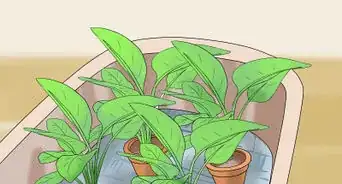
1Plant your ivy in a terra cotta or clay pot. Make sure that the bottom of your pot has holes so excess moisture can drain out. Try to stay away from plastic pots, as those can hold in too much moisture.[1]
- You can find plant pots at most garden supply stores.
-
2Use well-draining potting soil. Ivy is fairly drought tolerant, so it doesn’t need soil that holds onto moisture. Find a soil that specifies “well-draining” so the water doesn’t pool up in the pot.[2]
- You can find well-draining soil at your local garden center.
-
3Keep your ivy in indirect light. Most ivy plants are fairly shade tolerant, and they can actually burn if they get too much direct sun. Place your potted ivy somewhere that sits in shade for most of the day and doesn't get a lot of direct sunlight.[3]
- You can find out how much sun an area gets by checking on it every hour throughout the day.
-
4Water your ivy when the soil seems dry. Most ivy plants are fairly drought tolerant, so they don’t need to be watered every day. Check on the soil around your ivy every other day and give it some water if it’s dry.[4]
- If the leaves of your ivy turn brown or crispy, water your plant more often.
-
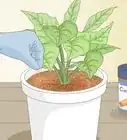
5Add fertilizer once a month in the spring, summer, and fall. Buy a plant food fertizlier from a garden supply store and add it to the top of your pot. Gently mix it in with the top layer of soil to add nutrients to your pot and help your ivy grow.[5]
- You don't need to add fertilizer to the ivy in the winter time, since it probably won't grow as much because of the colder temperatures.
-
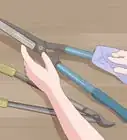
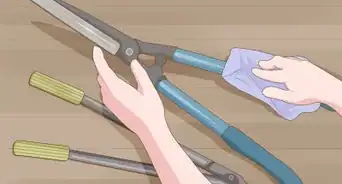
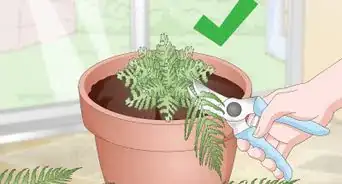
6Cut back the vines if they get too long. If your ivy plant is getting too long for its area, you can take a pair of sharp pruners and snip the vines back until they are the length you want them. Ivy is fairly resilient, so you don’t need to worry about cutting it back too much.[6]
- Your ivy plant may try to climb your walls, if you let it.
-
7Trim off any leaves with spider webs on them. Although pests aren’t super common with ivy plants, the red spider mite can become a problem if you leave it around for too long. If you see any leaves on your ivy with small spider webs, use sharp pruners to snip those leaves off and throw them in the garbage.[7]
- Try spraying white vinegar or neem oil on your ivy as a natural way to get rid of spider mites.
-
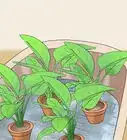
8Move your ivy to a larger pot once it stops growing. If you notice that your ivy plant’s roots are peeking out through the holes in your pot or that it hasn't grown any larger in a few weeks, buy a new pot that’s 2 to 4 inches (5.1 to 10.2 cm) wider in diameter than your old one. Gently tease your ivy plant out of its old pot and plant it in its new pot, adding any soil to fill in the gaps if you need to.[8]
Tip: Try not to disturb the roots when you move your plant from pot to pot. This will help it adjust better to its new pot without going into shock.


Method 2
Method 2 of 2:Caring for Outdoor Ivy
-
1Find an area where the soil drains well. If you have any loam, chalk, or sand mixed into your soil, that’s a good place to plant your ivy. Otherwise, choose an area where the water doesn’t puddle up after a heavy rain storm.[9]
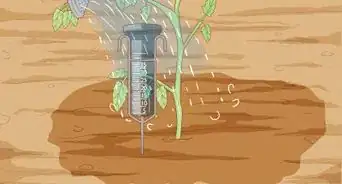
- You can test the drainage of your soil by directing a stream of water into it and then seeing how long it takes for the water to soak in. If it takes more than 5 minutes, your soil isn’t well-draining.
-
2Plant ivy after the threat of frost is over. When you put ivy in the ground for the first time, make sure your area is not going to get frozen over any time soon. While ivy can withstand some freezing temperatures once it gets established, it prefers to stay above 40 °F (4 °C).[10]
- If you are planting ivy outside, it will be able to withstand some freezing temperatures during the winter once it gets established. However, if temperatures go below 23 °F (−5 °C), the ivy probably won’t survive.
-
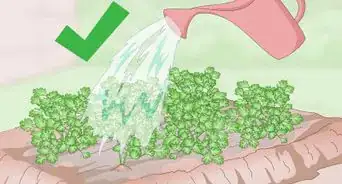
3Water your newly-planted ivy when the soil seems dry. Ivy is pretty drought tolerant, so you shouldn't need to water your outdoor ivy every day. After you plant your ivy outdoors, keep the soil watered whenever it dries out. If you live in a rainy area, once your ivy gets established you probably won’t need to water it at all.[11]
- If the leaves of your ivy turn brown or crispy, water your plant more often.
-
4Put a fence around your ivy to stop deer. If you live outside of a major city, deer are going to be your number one pest. The only way to keep deer away fully is to put a small fence around your plants to stop them from eating through your ivy.[12]
- Since ivy grows so quickly, it probably won’t matter if a deer has a nibble here or there. However, if the deer are eating a lot of your ivy while it is still young, they could damage it.
-
5Pull any weeds that pop up around ivy outside. If you are using your ivy as ground cover, watch out for common weeds like dandelions or grass. If you see them, pull the weeds out by hand, and try not to disturb the roots of your ivy.[13]
- Weeds can use up the water and nutrients in the soil that should be going to your ivy plant, which is why it’s important to control them.
- Once your ivy gets established as a ground cover, the weeds will probably stop popping up.
-
6Prune back shoots in April once your ivy is established. When your ivy is still growing, you don’t need to trim it at all. Once the area is covered with ivy, use sharp pruners to snip back any new growth in the spring so your ivy stops spreading.[14]
- This is to control the growth of your ivy so that it doesn’t leave its designated area. Ivy loves to spread, so it will cover more areas if you let it.
-
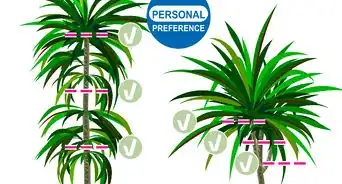
7Cut off any branches that make the ivy top-heavy. If your ivy is climbing upward or it’s in a pot, use sharp pruners to snip off any branches at the top that are making it droop or fall over. This will help the ivy grow upwards, not outward.[15]
- If your ivy is climbing up a wall, you may need to give it a wooden terrace or some stakes to climb so that it doesn’t fall over.
-
8Keep ivy away from gutters and pipes. If your ivy is climbing up a wall or terrace, make sure it doesn’t reach any important parts of your home. Ivy shoots are skinny enough to get into pipes or gutters and clog them up.[16]
Warning: If you do notice ivy in your gutters or pipes, clear them out right away to avoid any damage.


Warnings
- English ivy is invasive in the Pacific Northwest of the United States, meaning that it may choke out native and oriental plants if you plant it outside. Keep English ivy in a pot, not the ground, if you’d like to grow it in that region.[17]Thanks!
- English ivy is poisonous when ingested. Keep it away from pets and small children.[18]Thanks!

References
- ↑ https://www.apartmenttherapy.com/lush-amp-lively-english-ivy-best-tips-for-growing-care-243241
- ↑ https://www.rhs.org.uk/Plants/43091/i-Hedera-helix-i/Details
- ↑ https://plants.usda.gov/java/charProfile?symbol=HEHE
- ↑ http://www.missouribotanicalgarden.org/PlantFinder/PlantFinderDetails.aspx?taxonid=276595
- ↑ https://www.apartmenttherapy.com/lush-amp-lively-english-ivy-best-tips-for-growing-care-243241
- ↑ https://www.apartmenttherapy.com/lush-amp-lively-english-ivy-best-tips-for-growing-care-243241
- ↑ https://www.rhs.org.uk/advice/profile?pid=190
- ↑ https://extension.psu.edu/repotting-houseplants
- ↑ https://www.rhs.org.uk/Plants/43091/i-Hedera-helix-i/Details
- ↑ https://plants.usda.gov/java/charProfile?symbol=HEHE
- ↑ http://www.missouribotanicalgarden.org/PlantFinder/PlantFinderDetails.aspx?taxonid=276595
- ↑ https://extension.colostate.edu/topic-areas/natural-resources/preventing-deer-damage-6-520/
- ↑ https://extension.colostate.edu/topic-areas/yard-garden/ground-cover-plants-7-400/
- ↑ http://www.bbc.co.uk/gardening/basics/techniques/pruning_pruneclimbers1.shtml
- ↑ http://www.bbc.co.uk/gardening/basics/techniques/pruning_pruneclimbers1.shtml
- ↑ http://www.bbc.co.uk/gardening/basics/techniques/pruning_pruneclimbers1.shtml
- ↑ https://www.invasive.org/alien/pubs/midatlantic/hehe.htm
- ↑ https://www.invasive.org/alien/pubs/midatlantic/hehe.htm
About This Article