wikiHow is a “wiki,” similar to Wikipedia, which means that many of our articles are co-written by multiple authors. To create this article, volunteer authors worked to edit and improve it over time.
There are 16 references cited in this article, which can be found at the bottom of the page.
Learn more...
Guinea pigs make wonderful animals as pets and provide plenty of happiness to people's lives. While guinea pigs are relatively easy to care for, they also require special attention and are susceptible to an array of health issues due to their small stature. The best way to keep your guinea pig healthy and prevent them from becoming sick is to properly care for your guinea pig and provide them the right diet and enriched environment.
Steps
Part 1
Part 1 of 4:Maintaining a Healthy Diet
-
1Select a high-quality pellet brand. Pellets make up 15% of your guinea pig's daily diet. You should feed your guinea pig 1/8 cup of pellets each day. Choose an adult pellet brand that's specialised for guinea pigs and fortified with vitamin C. Oxbow, Science Selective, and Vetafarm are a few recommended brands to choose from.[1]
- Choose a timothy hay based pellet for adult guinea pigs older than 6 months, and choose a alfalfa (or lucerne) hay based pellet for pregnant, nursing, or growing guinea pigs under 6 months of age.[2]
- Avoid mixed pellets with treats, seeds, or dried fruit, as these encourage unhealthy selective feeding.[3]
- Avoid feeding your guinea pig rabbit or other rodent food, such as pellets for hamster or mice. These pellets do not contain the necessary vitamins specialised for cavies.
-
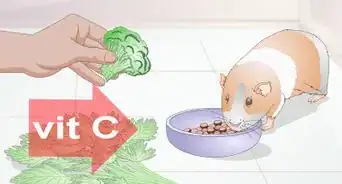
2Feed your guinea pig one cup of fresh vegetables a day. Vegetables make up 15% of your guinea pig's daily diet, and they are essential for vitamins. Bell peppers can be fed to your guinea pig daily, while every other vegetable should be fed in rotation 2-4 times a week. Plenty of variety is key to a healthy diet.[4]
- Cabbage, broccoli, parsley, spinach, tomatoes, and kale are a few recommended vegetables to feed your guinea pigs sparingly.
- Provide fruit in variation a few times a week. Since fruit is high in sugar, you should refrain from feeding them to your guinea pig every day.[5]
Tip: Avoid feeding your guinea pig lettuce, as it's high in water and too low in fibre, which can cause digestive issues such as bloat or diarrhoea.
-
3Provide your guinea pig with a fresh supply of hay. Guinea pigs are fibrevores, meaning that they require large amounts of hay and grass to maintain a healthy digestive system.[6] Hay makes up 80% of your guinea pig's daily diet and should be provided 24/7.
- Choose fresh, grassy hay that has a green colour to it, such as timothy hay. Avoid alfalfa or lucerne hay unless fed to guinea pigs under 6 months of age or pregnant or nursing sows.[7]
-
4Refrain from feeding your guinea pig commercial treats. Commercial treats that are often found in pet stores are unhealthy for guinea pigs as they are high in sugar and contain harmful ingredients, such as flour, nuts, or seeds.[8] As an alternative to commercial treats, feed your guinea pigs fruits sparingly.
- Pea flakes, Oxbow baked treats, and forage mix are a few suitable commercial treats that don't contain harmful ingredients. Though, they may still be high in sugar and should be fed minimally.
- Yogurt drops, mineral wheels, and vitamin C drops shouldn't be fed to guinea pigs, as they have a number of adverse health effects.[9]
-
5Give your guinea pig fresh and clean water every day. Water is essential to aid your guinea pig with their digestion. One guinea pig will drink approximately 100ml (3.3 ounces) of water a day.[10]
- Replace your guinea pig's water bottle with fresh and clean water every day to avoid algae build up or bacteria from entering the water.


Part 2
Part 2 of 4:Providing an Adequate Environment
-
1Choose a large cage for your guinea pig. Guinea pigs utilise floor-space, therefore you must buy a cage that has enough horizontal space, since guinea pigs do not burrow or climb. 1-2 guinea pigs will need the minimum space requirements of 7.5 square feet (or 27" x 41"). The more space you can give your guinea pig, the happier they will be.[11]
- Cubes and Coroplast (C & C) or Midwest cages make ideal indoor enclosures, as they are cheap and easy to build. Otherwise, a rabbit hutch or chicken coop are acceptable for outdoor use.
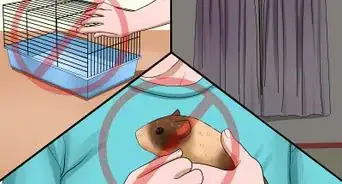
- Avoid vertical cages, aquariums (glass tanks), and cages with wire floors. These enclosures are not suitable for guinea pigs and can cause health issues.[12]
-
2Place the cage in a suitable location. Because guinea pigs are sensitive to noise and temperature fluctuations, The Humane Society of the United States suggests to keep your guinea pig indoors.[13]
- The ideal temperature range for guinea pigs is approximately 65-75 degrees Fahrenheit. Place your guinea pig's cage away from heat sources, direct sunlight, and drafts.[14]
- Keep your guinea pig's cage away from noisy objects, such as stereo systems or television sets.[15]
- Your guinea pig’s cage should be in an environment that is well lit (but not exposed to direct sunlight) and offers your guinea pig access to daily human activities.[16]
-
3Line the base of the cage with safe bedding. Fleece and wood shavings are two of the most popular bedding materials you can use in your guinea pig's cage. Otherwise, paper bedding like CareFresh is another satisfactory option. Line the base of the cage with an absorbent material like newspaper or puppy pads, and then layer your bedding on top.
- Aspen and kiln-dried pine shavings that have been dust extracted are safe options for wood shavings. Never use cedar shavings, as the hydrocarbon oils in the wood can cause respiratory issues.[17]
-
4Add accessories to the cage. Your guinea pig will need a food bowl, water bottle, hidey, and few extra supplies. A litter tray and toys are optional.
- Choose a ceramic bowl for your guinea pig's food as opposed to a light plastic one to prevent your guinea pig from tipping the contents of the bowl over their cage.
- Add a small house inside of the cage so that your guinea pig has a private refuge when stressed or tired. This can be a small cardboard box or a commercially produced house available at your local pet store.[18]
-
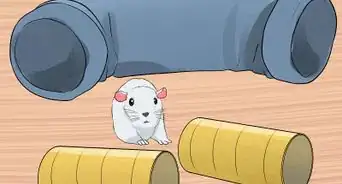
5Add toys to the cage. Toys help to encourage your guinea pig's exercise, enrichment, and mental stimulation. Because guinea pigs love to explore, consider placing obstacles inside of their cage, such as ramps, tunnels, bridges, hammocks, and steps.
- Guinea pigs are very food-oriented. Try introducing them to treat balls, hay stuffers, vegetable kebabs, and other toys that include food.
Warning: Never use exercise wheels or balls. These toys are not designed for guinea pigs and will severely damage their spine and feet.[19]


Part 3
Part 3 of 4:Caring for Your Guinea Pig
-
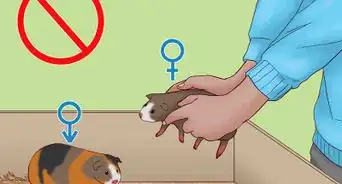
1Make sure your guinea pig has a companion. Guinea pigs are social herd animals, meaning they thrive in pairs or groups of three or more. Guinea pigs do not do well in solitary confinement and may even present depression-like symptoms as a result.[20]
- It's extremely important to introduce guinea pigs of the same sex, otherwise they will breed. Female guinea pigs do well in groups of three or more while male guinea pigs should be kept in pairs.
- While introducing two guinea pigs, carefully monitor them for aggressive interactions. Males are especially territorial.[21]
- It's a common myth that two male guinea pigs will fight. Compatibility between two guinea pigs is determined by the personalities of the individuals rather than their gender. Some guinea pigs will fight with any cage-mate you try to pair them with, but the vast majority thrive on company and delight in having a friend.[22]
-
2Feed your guinea pig every day. Your guinea pig will require frequent top-up of hay, which they should have access to constantly. Pellets and vegetables should be given to your guinea pigs in small portions once a day.
- Each guinea pig requires one cup of vegetables and 1/8 cup of pellets a day.[23]
-
3Socialise with your guinea pig regularly. Guinea pigs are social animals that enjoy the company of their humans. Because guinea pigs are quite timid, it's important to establish a routine and bond with your guinea pig before you attempt to handle them.
- Visit your guinea pig's cage and spend the minimum of 15-20 minutes talking to them each day. Your guinea pig will acclimate to your voice and begin to recognise you.[24]
- Guinea pigs are very food-oriented. The best way to establish your guinea pig's trust is by utilising food. Make sure you feed your guinea pig everyday at the same time so that they associate you with food. Then, hand-feed your guinea pig while they are hungry to encourage them to approach you on their own.[25]
-
4Play with your guinea pig. Guinea pigs are inquisitive animals that love to explore. The best way to encourage your guinea pig to play is to introduce them to floor time.
- Floor time is organised by creating a safe open space and placing a variety of toys and treats on the floor to encourage your guinea pig to play.
- If you don't have a spare room to organise floor time for your guinea pig, you can use a playpen to act as a barrier.
- Place obstacles such as ramps, tunnels, bridges, logs, and steps around the cage to encourage your guinea pig to explore.
-
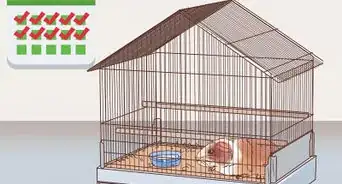
5Clean your guinea pig's cage. Your guinea pig's environment should be cleaned at least once a week. Frequent changing (every 3 or 4 days or less) will prevent odours and promote good health.[26]
- Spot-clean your guinea pig's cage by removing soiled bedding, droppings, and stale food from the cage daily.[27]
- Remove the bedding and contents from the cage to prepare for a deep-clean. Scrub the cage with warm water and mild soap weekly; let dry before adding fresh bedding.[28]
- Sanitise the food bowl, water bottle, and cage accessories with dish soap or one part white vinegar to three parts water.
-
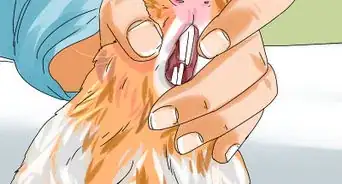
6Groom your guinea pig. You should prepare a grooming schedule for your cavy at least once a month to maintain their fur, nails, and teeth. Begin by gently brushing your guinea pig's coat with a soft-bristled brush, untangling all of their fur, and learning how to trim your guinea pig's nails. This is also a good opportunity to check your guinea pig's teeth for dental problems.[29]
- Long-haired guinea pigs require daily grooming to prevent matting and knots from forming.[30]


Part 4
Part 4 of 4:Monitoring Your Guinea Pig's Health
-
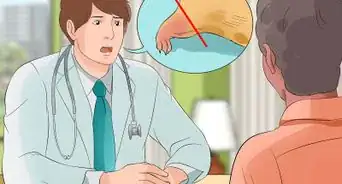
1Monitor your guinea pig's behaviour. Guinea pigs that present signs of abnormal behaviour are generally at risk of harbouring disease or other health defects. If your guinea pig seems droopy, sluggish, puffed up, or is frequently sneezing or coughing, immediately consult a veterinarian.[31]
- The first sign of health decline is generally a loss of appetite followed by abnormal behaviour and lack of mobility.
- Observe your guinea pig's droppings and urine, too. Healthy droppings look like uniform-shaped pellets that are firm and a medium to dark brown colour.[32] Healthy urine should be clear to yellowish or slightly cloudy.
-
2Examine your guinea pig on a weekly basis. Check your guinea pig's problem areas, such as teeth, feet, eyes, ears, nose, and genitals, for any abnormalities. If abnormalities are present, consult a veterinarian.
- Your guinea pig's eyes should be clear and clean, not crusty or lustreless.[33]
- Their nose should be clean and free of discharge or discolouration.[34]
- Their teeth should be clean and unstained and the long incisors in the upper jaw should overlap and just touch the bottom incisors.[35]
- Check the feet to be sure they are well formed and move easily. The feet should be uninjured and without flakes, red spots, or scars.[36]
-
3Weigh your guinea pig weekly. A substantial drop in weight is the first sign of health issues among guinea pigs. Use a kitchen scale to weigh your guinea pig each week. A one ounce fluctuation is normal. However, two to three ounces should place you on alert. If there is a four ounce fluctuation, seek a vet.[37]
Tip: The average adult male guinea pig should weigh anywhere from 900-1200 grams and the average adult female guinea pig should weigh anywhere from 700-900 grams.[38]
-
4Book an annual vet check-up. While guinea pigs do not require routine vaccinations, an annual exam and parasite check is recommended. Seek a veterinarian who is experienced in treating guinea pigs.[39]
- Preferably, you should book a check-up with your vet every 6 months at minimum.


Warnings
- Do not feed your guinea pig harmful vegetables like avocado, onion, leek, potato, tomato stems, mushrooms, garlic, or lettuce.Thanks!
- Yogurt drops, mineral wheels, and vitamin C drops shouldn't be fed to guinea pigs, as they have a number of adverse health effects.Thanks!
- Avoid vertical cages, aquariums (glass tanks), and cages with wire floors. These enclosures are not suitable for guinea pigs and can cause health issues.Thanks!
- Never use cedar shavings, straw, corncob, or cat litter as bedding.Thanks!


References
- ↑ https://www.animalhumanesociety.org/adoption/guinea-pig-care
- ↑ https://www.guinealynx.info/diet.html
- ↑ https://www.humanesociety.org/resources/guinea-pig-feeding
- ↑ https://www.guinealynx.info/fave.html
- ↑ https://www.humanesociety.org/resources/guinea-pig-feeding
- ↑ https://www.humanesociety.org/resources/guinea-pig-feeding
- ↑ https://www.animalhumanesociety.org/adoption/guinea-pig-care
- ↑ https://www.humanesociety.org/resources/guinea-pig-feeding
- ↑ https://www.guinealynx.info/diet.html
- ↑ https://lafeber.com/mammals/guinea-pigs-drink/#:~:text=Guinea%20pigs%20normally%20drink%20about,%2C%20activity%20level%2C%20or%20illness.
- ↑ https://www.humanesociety.org/resources/guinea-pig-housing
- ↑ https://www.humanesociety.org/resources/guinea-pig-housing
- ↑ https://www.humanesociety.org/resources/guinea-pig-housing
- ↑ https://www.humanesociety.org/resources/guinea-pig-housing
- ↑ https://www.humanesociety.org/resources/guinea-pig-housing
- ↑ https://www.animalhumanesociety.org/adoption/guinea-pig-care
- ↑ https://www.animalhumanesociety.org/adoption/guinea-pig-care
- ↑ https://www.animalhumanesociety.org/adoption/guinea-pig-care
- ↑ https://squeaksandnibbles.com/can-guinea-pigs-run-in-balls/
- ↑ https://www.guinealynx.info/companionship.html
- ↑ https://www.rspca.org.au/blog/2021/safe-and-happy-guinea-pigs
- ↑ https://www.guinealynx.info/companionship.html
- ↑ https://www.humanesociety.org/resources/guinea-pig-feeding
- ↑ https://animals.mom.com/socialize-guinea-pig-1858.html
- ↑ https://animals.mom.com/socialize-guinea-pig-1858.html
- ↑ https://www.guinealynx.info/housing.html
- ↑ https://www.aspca.org/sites/default/files/upload/images/guinea_pig_edu.pdf
- ↑ https://www.aspca.org/sites/default/files/upload/images/guinea_pig_edu.pdf
- ↑ https://kb.rspca.org.au/knowledge-base/how-should-i-keep-and-care-for-my-guinea-pigs/
- ↑ https://kb.rspca.org.au/knowledge-base/how-should-i-keep-and-care-for-my-guinea-pigs/
- ↑ https://www.animalhumanesociety.org/adoption/guinea-pig-care
- ↑ https://www.oxbowanimalhealth.com/blog/the-scoop-on-small-pet-poop-normal-abnormal-and-everything-in-between/
- ↑ https://www.msdvetmanual.com/all-other-pets/guinea-pigs/selecting-a-guinea-pig
- ↑ https://www.msdvetmanual.com/all-other-pets/guinea-pigs/selecting-a-guinea-pig
- ↑ https://www.msdvetmanual.com/all-other-pets/guinea-pigs/selecting-a-guinea-pig
- ↑ https://www.msdvetmanual.com/all-other-pets/guinea-pigs/selecting-a-guinea-pig
- ↑ https://guinealynx.com/weigh.html
- ↑ https://guinealynx.com/weigh.html
- ↑ https://www.animalhumanesociety.org/adoption/guinea-pig-care