This article was co-authored by wikiHow Staff. Our trained team of editors and researchers validate articles for accuracy and comprehensiveness. wikiHow's Content Management Team carefully monitors the work from our editorial staff to ensure that each article is backed by trusted research and meets our high quality standards.
This article has been viewed 17,404 times.
Learn more...
Interested in a unique fish that's completely different from the others? Or maybe you're looking for a low-maintenance fish that likes to be pet? Either way, the Japanese weather loach is a great choice. These unique freshwater fish are native to East Asia but have become popular around the world as aquarium fish thanks to their friendly, hardy nature.
Steps
Method 1
Method 1 of 3:Setting up Your Aquarium
-
1Purchase a tank with 40 US gal (150 L) of space and a 4 ft (1.2 m) length. This is the minimum amount of space you need for Japanese weather loaches. Never use plastic tanks as they aren't great for holding humidity and heat and always fill the tank with room temperature water.[1]
- Keep a lid on your tank and safety caps on your filters at all times to prevent your fish from escaping.
-
2Create a bottom substrate with small-grained sand or gravel. You can find these materials at any pet or aquarium store. Keep your substrate 2 to 3 inches (5.1 to 7.6 cm) thick for the best results.[2]
- Be sure the substrate is fine to ensure your fish don't injure themselves when they root for food or bury themselves in it.
-
3Decorate the tank with plants, rocks, and shelters. After adding your sand, start adding some decorations, such as large, smooth snags and stones and water-worn rocks. The more shelters for your fish, the better![3]
- Add 2 to 3 pieces of driftwood along with some twisted roots for hiding places.
- If you provide hardy plants, make sure the roots are protected. Ideally, the plants should be potted.
-
4Install an under-gravel or power filter. If this is your first tank, a power filter is best as it hangs on the back of the tank and is simple to install. For under-gravel filters, be sure that the powerhead or air pump is strong enough for your tank size.[4]
- Choose a power filter that can filter your water 5 or more times each hour. For example, a 40 US gal (150 L) tank requires a filter that circulates at least 200 gph.
- Regularly vacuum your gravel to avoid clogging under-gravel filters.
-
5Fill your tank with conditioned water. Purchase a water conditioner to remove chlorine from the water prior to adding it to your tank. Once it has been conditioned, add the water to your tank using a bucket or siphon.[5]
- To avoid purchasing a water conditioner, fill the tank with water and let it sit uncovered for 1 day before adding any fish. This will ensure that all the chlorine in the water evaporates.
-
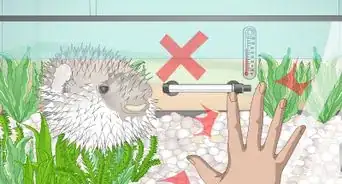
6Install a heater inside your tank to keep it warm. Most inside heaters attach via suction cups. Position it at or close to the mouth of your filter that expels water to ensure the water is heated evenly. Remember that most heat thermostats are pre-set to 70 to 77 °F (21 to 25 °C), so be sure to change it.
- Wait until your tank is filled with water before installing your heater.
- Buy a fully submersible heater with an adjustable thermostat if possible.
- If temperature is fluctuating, purchase weaker lights and see if it decreases the temperature.
- Be sure to give the heater 1 to 2 days to adjust to the water before you cycle your tank.


Method 2
Method 2 of 3:Caring for Your Fish
-
1Create a diet of fish insect larvae, small crustaceans, and dry food. Loaches are not picky and can eat live foods, frozen foods, pelleted and table foods, algae, and flakes. Just make sure to always include frozen or live food—such as daphnia and bloodworms—in their diet.[6]
- Provide your loaches with additional tubifex, shrimp (frozen or live), and vegetable foods like algae wafers.
- Loaches also eat snails, which is great for environments with snail problems.
-
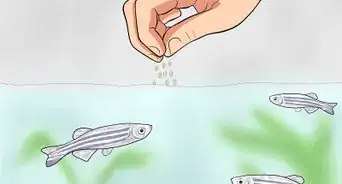
2Feed your fish 2 to 3 times daily. Regardless of the specific diet, always feed your loaches a few times a day. Remove uneaten food after 24 hours to prevent bacteria growth and decrease portion size based on the amount of leftovers.[7]
- Remember that it's always better to underfeed than overfeed.
-
3Stroke and hand-feed your fish when they're comfortable with you. Japanese weather loaches have a tendency to get very attached to their owners. Once they adapt to you, stroke them on the back and let them eat right from your hands to build a bond with them.[8]
- Most loaches should be comfortable with you after about 2 weeks.
-
4Keep your Japanese weather loaches with temperate community fish. Some examples include Lake Tebera rainbowfish, variatus platies, golden barbs, rosy barbs, red phantom tetras, argentine bloodfins, and many subtropical danionins. Weather loaches can also be kept with fancy goldfish.[9]
- Avoid keeping your fish with aggressive species, as well as tiny fish or fry that might be scared of the loach's unpredictable and sudden darts around the tank.


Method 3
Method 3 of 3:Maintaining Your Tank
-
1Keep the water pH between 6.0 and 8.0. Test the water pH with pH paper every day. If it's too low, increase pH by adding 1 teaspoon (4.9 mL) of baking soda per 5 gallons (19 L) of water. If it's too high, decrease pH by adding add peat moss.[10]
- Purchase both pH paper and peat moss from any pet store or online supplier.
-
2Keep tank temperature between 68 to 72 °F (20 to 22 °C). Set your tank's temperature with a temperature controller and be sure to monitor it every day. If your tank doesn't have a built-in thermometer, use an LCD thermometer.[11]
- Monitor your temperature every day.
- Remember that small nighttime dips in temperature are normal.
-
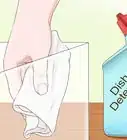
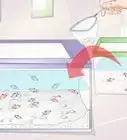
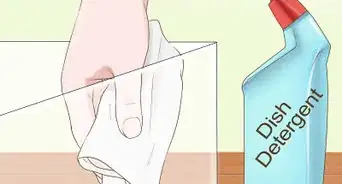
3Clean your fish tank weekly to prevent waste buildup. Start by using a fish net to remove your fish and place them in a bucket of conditioned water. Now, wipe down the glass with an algae pad, clean gravel with a siphon-type vacuum for gravel, and use a 1:1 solution of vinegar or aquarium-safe glass cleaner and water.[12]
- Clean any tank decorations with your algae pad.
- Be sure that no soap, bleach, or cleaning chemicals get into your water.
- Use a plastic or razor blade for difficult algae.
- If you don't have a gentle aquarium siphon and vacuum, make one on your own!
-
4Change 30 percent of the water each week. Either use a bucket to swap water manually or use a siphon to avoid the heavy lifting. Always replace your water with purified and dechlorinated water.[13]
- Be sure that the temperature of the new water is 68 to 72 °F (20 to 22 °C).
-
5Test your water for nitrite and ammonia regularly. Dip ammonia strips into the water regularly to make sure levels are undetectable. Similarly, use nitrate strips to make sure levels are less than 10 ppm.[14]
- Purchase both ammonia and nitrite testing papers from pet stores, big-box suppliers, or online stores.
- Change water weekly to keep nitrite levels low.
- Scoop out excess food and organic matter daily to keep ammonia levels undetectable.


Community Q&A
-
QuestionCan a weather loach eat goldfish food?
 Community AnswerIt really depends on the ingredients, but I'd recommend feeding it blood worms or sinking wafers.
 -
QuestionCan I keep one loach in a jar by itself?
 Community AnswerNo, I wouldn't do this. A jar is too small for any fish. I recommend a 10-gallon tank or larger if you want your loach to be happy and healthy.
 -
QuestionI have a small fish tank and ghost fish. Are these fish friendly?Community AnswerWell, "friendly" isn't really something that goes with fish and other fish, but they will school with other weather loaches. They may get aggressive towards smaller fish, but they'll do fine with fish that have similar water requirements most of the time.
-
QuestionI have a weather loach with 6 clown loaches, and he is schooling with them. Why is that?
 Landon KoskiCommunity AnswerLoaches tend to school with each other, even if they are different kinds. If they are not picking on him, then I wouldn't worry about it.
 -
QuestionWhy is my loach not reacting to the storm?Community AnswerLoaches are not very aware. They will just sit there, even though a storm. Do not worry.
-
QuestionI want to know if my loach is a male or female, because my grandchildren want to know?
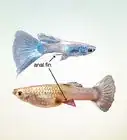
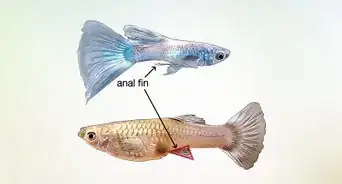
 Community AnswerSexing a weather loach is rather easy. The male's pectoral fins are longer and thicker, giving the fins a triangular shape. Females have rounder pectoral fins. Males often appear to be standing up on their pectoral fins while resting on the bottom of the tank.
Warnings
- Like all other loaches, Japanese weather loaches are scaleless, which means you should never add aquarium salt.Thanks!
- Be sure to cycle your aquarium before making any purchase on aquarium animals or plants.Thanks!
- Make sure your gravel isn't jagged.Thanks!
Things You'll Need
- Aquarium
- Air pump
- Ammonia and nitrite test kit
- Driftwood or other ornaments (Optional)
- Hood with lighting
- Live/artificial plants
- pH test kit
- Proper filtration
- Substrate





References
- ↑ https://meethepet.com/dojo-loach/
- ↑ http://animal-world.com/encyclo/fresh/loaches/DojoLoach.php
- ↑ http://animal-world.com/encyclo/fresh/loaches/DojoLoach.php
- ↑ https://www.fishkeepingworld.com/how-to-set-up-a-fish-tank/
- ↑ https://www.fishkeepingworld.com/how-to-set-up-a-fish-tank/
- ↑ http://animal-world.com/encyclo/fresh/loaches/DojoLoach.php
- ↑ http://animal-world.com/encyclo/fresh/loaches/DojoLoach.php
- ↑ http://animal-world.com/encyclo/fresh/loaches/DojoLoach.php
- ↑ https://www.practicalfishkeeping.co.uk/features/articles/weather-loaches-and-how-to-keep-them
- ↑ http://www.fishbase.org/summary/3016
- ↑ http://www.fishbase.org/summary/3016
- ↑ https://www.practicalfishkeeping.co.uk/features/articles/weather-loaches-and-how-to-keep-them
- ↑ http://injaf.org/articles-guides/beginners-guides/the-nitrogen-cycle-and-the-fishless-cycle-getting-your-aquarium-ready-for-fish/
- ↑ https://www.practicalfishkeeping.co.uk/features/articles/weather-loaches-and-how-to-keep-them
About This Article