X
wikiHow is a “wiki,” similar to Wikipedia, which means that many of our articles are co-written by multiple authors. To create this article, 9 people, some anonymous, worked to edit and improve it over time.
This article has been viewed 13,041 times.
Learn more...
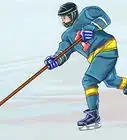
Understanding how we skate reveals the secret of fast skating. Forget a direct application of Newton's 2nd law; forget toe skating; Instead, learn mechanical advantage, and how to optimize it for the fastest skating.
Steps
Part 1
Part 1 of 2:Understanding the Physics Behind Skating
Part 1
-
1Understand that velocity does not increase after a leg thrust is finished. Like a bullet from a gun, after it leaves the muzzle and is no longer affected by the force of the expanding gas behind it, its velocity immediately begins to decay. Likewise, after a leg thrust is made, velocity decays until the next leg thrust. The sooner the following thrust is made, the less the velocity has decayed, and therefore, the greater the amount of energy that can be directed toward shortening the time of the full thrust, rather than re-accelerating the body mass and slowing down the thrust speed.
-
2Realize the importance of mechanical advantage. No one can skate faster than the relationship between the speed of the thrust and the mechanical advantage of the thrust. If we know the mechanical advantage and we know the speed of the thrust, we define our velocity, diminished only by ice friction, which is minimal, and wind resistance.
- Using mechanical advantage, you can generate a forward velocity faster than you can thrust your leg. This is similar to how birds and fish move forward faster than they can beat a wing or flip a tail. If this were not so, no creature could go faster than the speed of a thrust. Skaters would move along somewhere between 3 and 6 miles (4.8 and 9.7 km) and hour. That's dull hockey for sure.
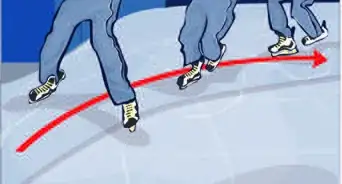
- Most other attempts to describing skating point to Newton's second law, as though our power leg was anchored to the ice as we pushed ourselves forward. This is totally false. Any skater who takes the time to observe their own motion knows that both legs, the gliding one and the powering one, are moving forward over the ice, maintaining the same angle to each other, while separating. We definitely do not push ourselves forward like a swimmer pushing off the end of a pool.
Advertisement -
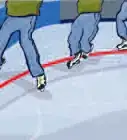
3Imagine what you're going to do. Imagine 2 tracks on which 2 little cars are running. These tracks start close to each other and then diverge. We place the cars on the tracks near each other where the tracks are closest, but push the left hand car a little ahead of the right hand car.
- Now we apply a force between the cars, such that it pushes on the right hand car perpendicular to its track and on the left hand car about 20 degrees below perpendicular to its track. This force has to be dissipated somewhere. So the left hand car starts to move forward. If the angle between the cars must remain constant, the right hand car must also begin moving along its track. The force will continue for a while and then stop.
- Now the separation between the cars is greater, but the left hand car has moved along its track nearly 3 times farther than the cars have separated. The force separated the cars one unit, while the left car moved forward approximately three units. This is the mechanical advantage of skating.
-
4Conceptualize it with trigonometry. The problem is no more complicated than solving distances on a right triangle with a little trig (use the sine function, kids). The equivalent values are these:
- The separation of the cars is the length of our pushing "stride", and the hypotenuse is the distance traveled during the time of the stride, from which we can calculate forward velocity. The outward angle controls the mechanical advantage, which is approximately 3 to 1 at an optimum angle.
- Clearly, if the force on the left car (skate) were directly from the side, we would go nowhere. But as the angle increases to the rear, we begin to move forward. But at one degree, we would have to have legs like tree trunks to get things going – and if we could actually make a push stride in a fraction of a second, like we really do, you would be the fastest skater ever, clocking in at over 300 miles (480 km) and hour.
-
5Be aware of what this all means. What does this tell us about skating fast? Several things: obviously, the speed of extension and the "angle of separation" (which determines mechanical advantage) define speed.Advertisement


Part 2
Part 2 of 2:Putting Theory into Practice
Part 2
-
1Adjust your thrust angle as you skate. Realize that if you tried to push straight back, like the Newton's 2nd Law people like to describe skating, you would have zero mechanical advantage and move along precisely at the speed of your thrust minus fiction and wind resistance, which is 3 to 6 mph (4.8 to 9.7 km/h).
- The optimum angle, to our glide skate, of our "skate separating" thrust changes as our speed changes. When you need to overcome mass, the angle is much more to the rear where the mechanical advantage is less but the power is greater. As you pick up speed in a few strides, the angle shallows out to an optimum of about 20 degrees – just like shifting into high speed gears on your 10-speed bike. The higher you can make that angle (19 or 18 degrees below perpendicular) and still maintain stride speed, the faster you will go. For example, if you can stride out 24 inches (61 cm) (an adult stride, to be sure), and you do it at 20 degrees and in a quarter second, you will be going precisely 15.95 mph (25.67 km/h) minus drag.
-
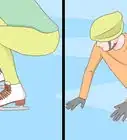
2Lower your hip. Use a proper posture that lowers the hip to allow more directed power in the stride and a longer stride.
-
3Direct the force straight down through the foot. A toe flip at the end is pointless. Skating on one's toes from a standstill is also pointless, as it matters only that our leg is planted for two strides at a steep rearward angle to move from zero velocity to 5 mph (8.0 km/h) quickly, then transition in several more strides to a 20 degree separation angle, and the benefit of optimum mechanical advantage. It goes without saying that strong legs are your objective in the gym, and a fast thrust is what you're parental luck of the draw gave you.
- Speed decay between strides is also important to address, but that's a problem in drag calculations. It's obvious, however, that quick striders will have an advantage, since they won't have to waste as much energy recapturing lost velocity.
-
4Work on the "butt down – head up" posture. This accomplishes so much, particularly for hockey. It keeps your center of gravity lowered making a player much more stable. It keeps the angle of the stick with the ice constant (no bobbing up and down as we skate). It allows a player to see the whole ice (and would-be checkers) in front of him or her, and still catch enough of a peripheral view of the puck to stickhandle without losing the puck. It puts the hips in a lower position allowing the leg to "coil up" and extend out harder and faster – and for more of the force vector to be directed horizontally instead of into the ice. It allows for greater power in crossover turns, and, of course, kids, it impresses the fans when you're reffing that Pee-Wee game, and there just might be a scout in the crowd.
-
5Prove it to yourself! For you math kids, build a spreadsheet solving a right triangle, one through 89 degrees of separation, with the hypotenuse being the gliding skate, and the long side being the distance traveled by the pushing skate, and the short side being the stride length. Then practice your conversions from inches or feet per second to miles per hour, and assign speeds to your "push out" to see what you have to do to skate really fast. Then start thinking about how birds and fish might use the same principle – there's a winning science project in there somewhere.Advertisement





About This Article
Advertisement