This article was co-authored by Sydney Axelrod and by wikiHow staff writer, Madeleine Criglow. Sydney Axelrod is a certified life coach and the owner of Sydney Axelrod LLC, a life coaching business focused on professional and personal development. Through one-on-one coaching, digital courses, and group workshops, Sydney works with clients to discover their purpose, navigate life transitions, and set and accomplish goals. Sydney has over 1,000 hours of relevant coaching certifications and holds a BBA in Marketing and Finance from Emory University.
There are 7 references cited in this article, which can be found at the bottom of the page.
This article has been viewed 61,527 times.
Getting work done, meeting deadlines, and being productive 100% of the time is difficult for everyone. It’s even harder if you struggle with time management. Luckily, there are several ways you can improve your time management skills. These range from simple changes in your day-to-day to complete overhauls in how you schedule your life! This article explores the many time management techniques you can use to get things done more efficiently, including making a daily schedule, getting rid of distractions, and organizing the perfect workspace.
Steps
Method 1
Method 1 of 13:Set clear and measurable weekly goals.
-
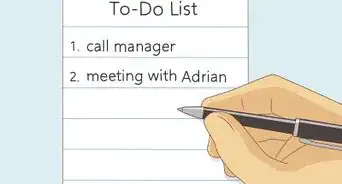
1Write down everything you would like to accomplish. Review your list and prioritize what absolutely has to get done that week, such as a task with a looming deadline. Setting specific goals helps keep you motivated and will make you feel extra accomplished when you’ve achieved everything you set out to do.[1]
- Challenge yourself to complete more than you think you can, but don’t go overboard. If you have a massive research paper due on Friday, it’s probably not the time to add organizing your entire home and writing a novel to your list.
- Instead, try setting the goals of finishing your research paper, organizing your closet, and writing ten pages of your novel.
Advertisement

Method 2
Method 2 of 13:Create a daily schedule to organize tasks.
-
1Use a calendar or a piece of paper for scheduling. Map out exactly how you want to use your time each day, leaving nothing out of your schedule. Include how much time you would like to spend on each task. For example, start your schedule with something like, “7:30 AM - 8:00 AM: Wake up and eat breakfast.” Follow that with the first major task of your day, such as “8:00 AM - 8:30 AM: Answer emails.”[2]
- You may not follow your schedule exactly, as life can sometimes surprise you with how long a task will take. Regardless, a schedule is a great guideline for keeping you on track to reach your weekly goals.

Method 3
Method 3 of 13:Prioritize daily tasks by importance.
-
1Pick the hardest or most pressing task of the day to do first. Let’s say you’ve got a colossal amount of homework to do, and you don’t know where to start. Review the due dates of your assignments as well as the difficulty level of each one, and prioritize accordingly. Getting a difficult, time consuming assignment out of the way first will make you feel accomplished and ready to tackle the rest of your to-do list![3]
- For example, if you have a massive math assignment due tomorrow and some quick vocabulary worksheets due at the end of the week, start with the math homework.
Advertisement

Method 4
Method 4 of 13:Concentrate on one task at a time.
-
1It’s hard to get things done when you’re doing too many things at once. As you cross things off your to-do list, keep your mind focused on the task at hand. Shut out thoughts about your other responsibilities, and avoid going back and forth between unrelated duties. It’s much more efficient to tackle one responsibility at a time. [4]
- For example, instead of answering emails and returning phone calls at the same time, answer all of your emails before you make your phone calls.
- Switching back and forth between tasks is more work for your brain and slows down the process.

Method 5
Method 5 of 13:Minimize distractions and interruptions.
-
1Give each task your full attention. Turn off any distractions such as email, phone, and social media notifications. You should also eliminate noise, such as a nearby TV or radio. Set aside time when you don’t want to be disturbed and don’t address any interruptions unless it's absolutely necessary.[5]
- For example, if you plan to write for 45 minutes, don’t answer your phone or respond to any emails during this time. Once the 45 minutes are up, you can check your email.
- Social media is a big distraction. Schedule social media time throughout the day and stay away from it unless it is during a scheduled time block.
Advertisement

Method 6
Method 6 of 13:Take short breaks so you don't burn out.
-
1You can't work or be productive 24 hours a day. Schedule breaks throughout your day to give yourself some time to rest and relax. A break allows you to recharge and come back to a task with a fresh perspective. Try to do something on your break that is completely unrelated to your task, like drawing a picture, strumming a guitar, or playing a game of chess on your phone! You may also consider:[6]
- Calling a friend
- Taking a walk
- Meditating or doing some stretching

Method 7
Method 7 of 13:Delegate tasks that others can handle for you.
-
1You don't have to do everything yourself! Allowing another person to take care of something gives you a chance to devote yourself to your other tasks while still getting everything done. Be sure you delegate to someone reliable and trustworthy! You don’t want to worry about whether the person will actually get it done.[7]
- Remember that delegating is a sign of strength and intelligence, not weakness. Everyone has to ask for help sometimes!
Advertisement

Method 8
Method 8 of 13:Track your time with a journal or app.
-
1Carry a notebook and write down everything you do and for how long. Alternatively, download a free time tracking app like Due Time Tracking, Calendar, or TopTracker to keep tabs on how you spend each minute.[8] Make sure you are honest. At the end of the day, review how you spent your time. Do this every day for a week to get a good picture of how you typically spend your day. At the end of the week, consider making changes if you find you spent way too many minutes (or even hours) checking social media or surfing the web.[9]
- It’s best to track your time for a few days in a row to get an honest look at your schedule. Some days you may attend a birthday dinner or a doctor’s appointment, which aren’t everyday tasks and could throw off your schedule.

Method 9
Method 9 of 13:Review your task list at the end of each day.
-
1Take note of what you completed as well as what still needs to get done. Cross off the tasks you finished and make a new to-do list for the next day, starting with what you didn’t accomplish. Making time for this extra step each night helps you celebrate what you achieved while keeping your goals for the next day in mind. It can also help you get a better idea of what tasks take the most time. Use that information to reassess how much time you should give yourself to complete certain tasks.[10]
- It’s completely okay to find that you didn’t get all of your tasks done! Remember that tomorrow is a new day. Keep pushing yourself to meet your goals!
Advertisement

Method 10
Method 10 of 13:Motivate yourself with rewards.
-
1At the start of a task, promise yourself a reward at the end of it. For example, if you have a writing assignment you need to complete but are in no mood to do, allow yourself to go on a 20-minute walk to a nearby park once you’re done with the assignment![11]
- Make sure your reward is something that you really enjoy.
- Your reward should never cause a setback or get you off track. For example, going to the movies or taking the rest of the day off after completing a 30-minute task may not be a good idea.

Method 11
Method 11 of 13:Say no to extra projects if your plate is full.
-
1It’s easy to take on more than you can handle. Be realistic when agreeing to new responsibilities, keeping what you have to get done already in mind. For example, if your schedule is fully booked with classes and soccer practice during the school week, it may not be the best time to join another club.[12]
- Learn to say “no." If you cannot say no, be honest about your time constraints. For example, if someone asks you to get something done by the end of the day, you may say, “I'm a little overloaded right now, but I can have it to you by the end of tomorrow.”
- Over-scheduling can also lead to stress. When you are stressed, you become less productive.
Advertisement

Method 12
Method 12 of 13:Take advantage of your downtime.
-
1Make a quick list when you’ve got extra time. For example, try using the bus ride to work or school to do some extra planning. This is especially helpful if you find yourself particularly stressed out about your responsibilities during your leisure time![13]
- Don't devote all of your downtime to planning and organizing. This could become stressful and do more harm than good. You still need some time to relax!
- If you have 10 minutes of downtime, start by devoting 2 or 3 minutes to getting organized.

Method 13
Method 13 of 13:Organize your workspace to improve productivity.
-
1Declutter your desk or find a quiet, calm space in your home. If your desk is brimming with papers, envelopes, pens, and garbage, anyone would be a little stressed or distracted! Tidy up your workspace so that you eliminate any potential distractions. Throw away any garbage, dust off your laptop and desk, and try organizing your papers in a folder or binder.[14]
- You don’t have to eliminate all your personal touches, though! Add a few pictures to look at when you’re looking for a jolt of happiness, or consider a cute pen holder or desk plant to give your space some pizzazz.
Advertisement

Community Q&A
Did you know you can get expert answers for this article?
Unlock expert answers by supporting wikiHow
-
QuestionWhat are some good time management skills?
 Klare Heston, LCSWKlare Heston is a Licensed Independent Clinical Social Worker based in Cleveland, Ohio. With experience in academic counseling and clinical supervision, Klare received her Master of Social Work from the Virginia Commonwealth University in 1983. She also holds a 2-Year Post-Graduate Certificate from the Gestalt Institute of Cleveland, as well as certification in Family Therapy, Supervision, Mediation, and Trauma Recovery and Treatment (EMDR).
Licensed Social WorkerUsing a calendar, setting reminders on electronic devices, structuring your day, and setting priorities so that your time does not get away from you.
Support wikiHow by unlocking this expert answer.
-
QuestionHow can students improve time management skills?Klare Heston, LCSWKlare Heston is a Licensed Independent Clinical Social Worker based in Cleveland, Ohio. With experience in academic counseling and clinical supervision, Klare received her Master of Social Work from the Virginia Commonwealth University in 1983. She also holds a 2-Year Post-Graduate Certificate from the Gestalt Institute of Cleveland, as well as certification in Family Therapy, Supervision, Mediation, and Trauma Recovery and Treatment (EMDR).
Licensed Social WorkerThey can improve their skills by using various organizational devices, whether those are electronic or paper and pencil. Everyone responds better to one or the other.Support wikiHow by unlocking this expert answer.
-
QuestionHow can I improve my time management skills at work?Klare Heston, LCSWKlare Heston is a Licensed Independent Clinical Social Worker based in Cleveland, Ohio. With experience in academic counseling and clinical supervision, Klare received her Master of Social Work from the Virginia Commonwealth University in 1983. She also holds a 2-Year Post-Graduate Certificate from the Gestalt Institute of Cleveland, as well as certification in Family Therapy, Supervision, Mediation, and Trauma Recovery and Treatment (EMDR).
Licensed Social WorkerSet up and keep to a schedule. Establish priorities. Use the early hour to look over what you need to accomplish that day. Use electronic reminders. Set goals.Support wikiHow by unlocking this expert answer.
-
QuestionHow can I be more productive?
 Sydney AxelrodSydney Axelrod is a certified life coach and the owner of Sydney Axelrod LLC, a life coaching business focused on professional and personal development. Through one-on-one coaching, digital courses, and group workshops, Sydney works with clients to discover their purpose, navigate life transitions, and set and accomplish goals. Sydney has over 1,000 hours of relevant coaching certifications and holds a BBA in Marketing and Finance from Emory University.
Certified Life CoachTry to set boundaries with your time and figure out what things are taking too much of your energy. If you're struggling with productivity, try setting goals that are really doable and achievable so that you can stay confident and motivated to complete other tasks on your to-do list.Support wikiHow by unlocking this expert answer.
-
QuestionHow do I avoid over-scheduling myself?
 Community AnswerRank the things you need to schedule from least to most important, and build the most important items into your schedule first. Once you've finished the more difficult tasks on your list, you can take the smaller items one by one to prevent yourself from becoming overwhelmed.
 -
QuestionHow do I keep up with my tasks? I make lists but I never end up following them.
 CageyCatTop AnswererSome top innovators say people should not use lists, especially because it makes some people feel overwhelmed and defeated. The innovators' idea is that everyone can wake up and think of 3 or 4 things they know they need to do. They think this frees up creativity and the desire to actually do what needs done. You could try it both ways--a list with due dates, and the other way with doing 3 or 4 things you know you must do. Then choose what way works best for you.
 -
QuestionI plan to finish a certain portion but I can finish 50% only?CageyCatTop AnswererIt sounds like you need to trick your brain (brains love to encounter unpredictable, impromptu solutions)! Let's say it is Monday and you have 20 pages to read by Friday (that's 4 nights to read it). Your brain might like if you read 5 pages each night---but backwards! Or you could start at the beginning and read every-other page: 1, 3, 5.... The next night, read 2, 4, 6... and so on. Your brain sounds sick and tired of "no fun"---so, make it fun. Build in rewards-- study 1/2 hour, then watch 1/2 hour of TV, or game, or YouTube... but be a drill sergeant and be back to work after that time of play.
-
QuestionWhat to do if I am constantly failing to follow the timetable? I am gradually loosing self-confidence.CageyCatTop AnswererSet aside the timetable and get your brain energized again! Do things backwards, upside down, starting from "End" back to "The Beginning". Be silly when planning how to study. Like, it's okay to recite new words and definitions while taking a bubble bath. Make studying into your own private game.












-Step-8.webp)
References
- ↑ https://www.nyu.edu/students/academic-services/undergraduate-advisement/academic-resource-center/tutoring-and-learning/academic-skills-workshops/time-management.html
- ↑ https://ideas.ted.com/feel-overwhelmed-and-stressed-its-time-for-you-to-track-your-time/
- ↑ https://www.entrepreneur.com/article/299336
- ↑ http://psychcentral.com/lib/6-tips-to-improve-your-time-management-skills/
- ↑ Sydney Axelrod. Certified Life Coach. Expert Interview. 30 June 2020.
- ↑ https://www.entrepreneur.com/article/299336
- ↑ https://www.nyu.edu/students/academic-services/undergraduate-advisement/academic-resource-center/tutoring-and-learning/academic-skills-workshops/time-management.html
- ↑ https://www.entrepreneur.com/article/269991
- ↑ Sydney Axelrod. Certified Life Coach. Expert Interview. 30 June 2020.
- ↑ https://www.entrepreneur.com/article/299336
- ↑ https://www.nyu.edu/students/academic-services/undergraduate-advisement/academic-resource-center/tutoring-and-learning/academic-skills-workshops/time-management.html
- ↑ Sydney Axelrod. Certified Life Coach. Expert Interview. 30 June 2020.
- ↑ http://psychcentral.com/lib/6-tips-to-improve-your-time-management-skills/
- ↑ https://academicresourcecenter.harvard.edu/productivity
About This Article

To improve your time management skills, make a to-do list at the beginning of every day and week, which will help you allocate your time better. Try to prioritize your most important tasks first so you're not using up valuable time on tasks that could wait until another day. Also, work on one thing at a time until it's finished since multitasking can actually slow you down and make you less productive. If you're working on a long-term project, write down important milestones on a calendar and set reminders on your phone so you don't lose track of time. To learn how to stay motivated when you're juggling a lot of tasks, scroll down!