X
wikiHow is a “wiki,” similar to Wikipedia, which means that many of our articles are co-written by multiple authors. To create this article, volunteer authors worked to edit and improve it over time.
Learn more...
Wire Fox Terriers originated in Britain, are members of the Terrier Group. [1] They do share a few characteristics with other dog breeds (particularly some in the Terrier Group), but they also have many distinguishing characteristics. This wikiHow will teach you what those are, and how to figure out whether or not a dog is a Wire Fox Terrier.
Steps
Method 1
Method 1 of 3:Viewing the Body Structure
Method 1
-
1Know what size the dog is. Both male and female Wire Fox Terriers are around 15.5 inches (39 cm) tall, while male Wire Fox Terriers weigh approximately 18 pounds (8.2 kg), and females are usually a little smaller in weight, weighing anywhere from 15–17 pounds (6.8–7.7 kg). [2]
-
2Look at the dog's head overall. Wire Fox Terriers have an overall head length of between 7–7.25 inches (17.8–18.4 cm) (with females having smaller heads). The skull's top-line is close to flat, and it has a slight slope to it along with a gradually decreasing width closer to the dog's eyes. [3]Advertisement
-
3Note the dog's eyes. Wire Fox Terriers have eyes that are relatively small, very close to a circle shape, and not that far apart from each other. The eyes should not be prominent, and instead set rather deep in the head, and they should be a darker color. [4]
-
4View the dog's ears. Wire Fox Terriers should have small V-shaped ears, that are moderately thick. The ear flaps should be folded over neatly, and drop forward and relatively close to the dog's cheeks. The top-lines of the dog's ears should be above the level of their skull. [5]
-
5
-
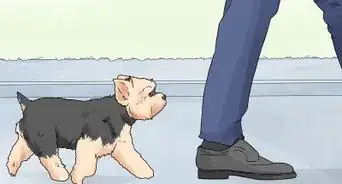
6Examine the dog's gait. Wire Fox Terriers typically carry their legs straight and forward, with the front legs swinging perpendicular and parallel to the dog's sides (like a clock's pendulum). [8]Advertisement


Method 2
Method 2 of 3:Looking at the Coat
Method 2
-
1See what color the dog is. Wire Fox Terriers should be predominantly white, but other than that, there isn't really any particular color that Wire Fox Terriers need to be (as long as white is the predominant color). [9]
-
2Note if the coat has varying lengths. On the dog's neck and shoulders, the coat should be 3⁄4–1 inch (1.9–2.5 cm). It's a little longer on back, rib, quarter and wither areas, being around 1.5 inches (3.8 cm) in length. It should also not be that long in the upper/lower jaw areas.[10]
-
3Feel the texture of the dog's coat. Wire Fox Terriers should have a coat with a wiry, dense texture (like the matting found on a coconut). The coat should also have a particularly "crisp" feel on the forelegs, and the upper and lower jaws. [11]
- Occasionally, the coat may have a "crinkly" feel to it or be slightly wavy. [12]
Advertisement


Method 3
Method 3 of 3:Noticing Temperament
Method 3
-
1Note whether or not the dog is outgoing. Wire Fox Terriers are known to be outgoing, and thus adaptable to a lot of different routines. [13]
-
2See if the dog is alert. Wire Fox Terriers are relatively alert dogs, who can alert their owner of anything that may be approaching. [14]
-
3Look for fearlessness. Wire Fox Terriers are known to be bold, fearless dogs, meaning they may occasionally get themselves into mischief. [15]
-
4Know if the dog is lively. Wire Fox Terriers are lively dogs, who thrive when given a job to do, as well as lots of activity (such as frequent walks or games of fetch). [16]
-
5Check for intelligence. Wire Fox Terriers are overall known to be relatively intelligent dogs. [17]
-
6Notice whether or not the dog is independent. Although they are intelligent, Wire Fox Terriers are also known to be independent, meaning they require a sense of humor, consistency and patience when you are training them. [18]Advertisement












References
- ↑ https://www.akc.org/dog-breeds/wire-fox-terrier/
- ↑ https://www.akc.org/dog-breeds/wire-fox-terrier/
- ↑ https://images.akc.org/pdf/breeds/standards/WireFoxTerrier.pdf
- ↑ https://images.akc.org/pdf/breeds/standards/WireFoxTerrier.pdf
- ↑ https://images.akc.org/pdf/breeds/standards/WireFoxTerrier.pdf
- ↑ https://images.akc.org/pdf/breeds/standards/WireFoxTerrier.pdf
- ↑ https://images.akc.org/pdf/breeds/standards/WireFoxTerrier.pdf
- ↑ https://images.akc.org/pdf/breeds/standards/WireFoxTerrier.pdf
- ↑ https://images.akc.org/pdf/breeds/standards/WireFoxTerrier.pdf
- ↑ https://images.akc.org/pdf/breeds/standards/WireFoxTerrier.pdf
- ↑ https://images.akc.org/pdf/breeds/standards/WireFoxTerrier.pdf
- ↑ https://images.akc.org/pdf/breeds/standards/WireFoxTerrier.pdf
- ↑ https://www.dogtemperament.com/wire-fox-terrier-temperament/
- ↑ https://www.hillspet.com/dog-care/dog-breeds/wire-fox-terrier
- ↑ https://www.dogtemperament.com/wire-fox-terrier-temperament/
- ↑ https://www.hillspet.com/dog-care/dog-breeds/wire-fox-terrier
- ↑ https://www.dogtemperament.com/wire-fox-terrier-temperament/
- ↑ https://www.dogtemperament.com/wire-fox-terrier-temperament/
About This Article
Advertisement