wikiHow is a “wiki,” similar to Wikipedia, which means that many of our articles are co-written by multiple authors. To create this article, 20 people, some anonymous, worked to edit and improve it over time.
There are 9 references cited in this article, which can be found at the bottom of the page.
This article has been viewed 81,898 times.
Learn more...
Tarantulas (Theraphosidae) are among the largest spiders in the world. They are a member of the primitive group of spiders known as Mygalomorphae. Although many people consider tarantulas to be hairy and scary, it may surprise you to know that some people love them so much that they keep them as pets, and some people even eat them for dinner. Tarantulas can be found on every continent except Antarctica. This article explains how to tell tarantulas apart from other types of spiders.
Steps
-
1Know what a tarantula spider is. Here are some key characteristics.[1]
- Physical features: Large and hairy
- Venomous: Yes. But most are not medically significant, meaning at worst you can probably expect mild symptoms such as a bee sting. However in exceptional rare cases a stronger reaction may occur
- Lives in: Habitats range from arid scrub to rain-forests and jungles: South America, Central America, Southern states of North America, but also much of Africa Southeast Asia, Australasia and also southern parts of Europe.[2]
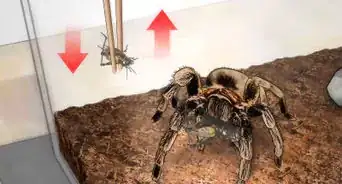
- Eats: A tarantula will pounce on any prey that it can subdue. It kills by injecting its venom through its fangs and into its prey. Examine the areas of invertebrates like grasshoppers and beetles, but also lizards and rodents. Tarantulas may find these all very tasty, but if you spot their likely prey, you are not likely to see a tarantula in pursuit.

Method 1
Method 1 of 3:Identifying a Tarantula Spider
Tarantulas are mainly brown and black, but several species are far more colorful. The following characteristics are common to most species of tarantulas (or spiders in general):
-
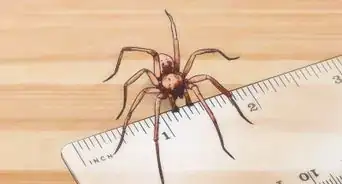
1Look for a very large, hairy body and hairy legs. However, some adult tarantulas can be less than 0.5 centimeter (0.2 in).[3]
- The body length and height can be up to 3” (76 mm).
- The leg span can be as much as 3 to 5” (76 to 127 mm).
-
2Check for a red-brown to black color; most tarantulas don’t have obvious markings. However color is extremely variable, and many other distantly related spiders are the same colour as many tarantulas.[4]
-
3Observe the form. A tarantula like all spiders has a frontal segment (opisthosoma) connected through a narrow waist to the abdomen which is oval-shaped.
-
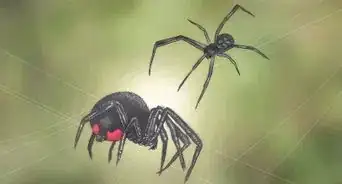
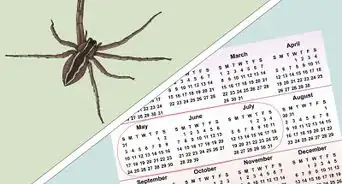
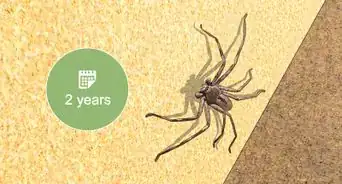
4Look for a single small group of typically eight eyes on the forehead, but all tightly clustered onto a single mound, not like shown here. This would be a huntsman. Another often confused are Wandering spiders, where two of the eight eights are lower down and closer to the mouth parts than the remaining eyes
-
5Look at the features of the mouth area; there are two backward-pointing fangs just below the eyes and 2 pedipalps (leg-like appendages) near the mouth. The direction the fangs bite can be very diagnostic - if biting 'backwards' (paraxial) then this reduces the possible identity to just several broad groups (spider families) which includes tarantulas.
-
6Notice the fangs; tarantula’s fangs (and in other close families) move up and down (paraxial), whilst all other spider’s fangs move horizontally (axial) to pinch.


Method 2
Method 2 of 3:Recognizing Tarantula Spider Habitats
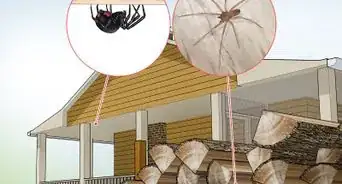
Tarantulas don’t spin webs; most live in burrows underground. They use their fangs to dig the burrows. However, you can also sometimes spot tarantulas in other places.:
-
1Look for tarantulas in trees as well as under tree roots.[5]
-
2Examine rock cliffs for makeshift tarantula burrows.


Method 3
Method 3 of 3:Treating a Bite
Most tarantulas are not poisonous, and despite the size of this spider, its bite is no worse than getting a bee sting.
-
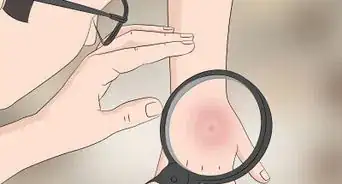
1If a tarantula bites you, wash the area where you were bitten and apply an antiseptic ointment.[6]

Community Q&A
-
QuestionIs there a significant difference in size between male and female tarantulas?
 Community AnswerIt depends on the species.
 -
QuestionHow much does a tarantula cost?
 Community AnswerThis depends on the species. More common tarantulas will cost around $30, but rarer tarantulas can cost up to $200.
 -
QuestionCan I kiss a spider?Community AnswerNo. It is very dangerous to kiss a spider if they are venomous. Do not attempt to do this.
-
QuestionHow can I become a tarantula?Community AnswerThat is impossible.
-
QuestionAre grey tarantulas poisonous?
 Community AnswerNo, they are not poisonous, they are quite calm and will love attention.
 -
QuestionIs it okay to house two tarantulas in the same enclosure?Community AnswerThe more the better!
-
QuestionWhat are the tarantula's two pointy thing on its back?
 Chong Yin SingCommunity AnswerThe pointy things are called Urticating hairs (setae). These are found in about 90% of the species of tarantula (spiders of the family Theraphosidae) found in the New World. They are not found in tarantulas from other parts of the world.
Warnings
- The Goliath bird eater tarantula from South America is the largest, if not hairiest, of the species (about the size of a dinner plate), but it is not deadly. African, Asian, and Australian tarantulas have more potent venom than American species, though none are regarded as deadly.Thanks!




References
- ↑ https://www.livescience.com/39963-tarantula.html
- ↑ https://www.desertmuseum.org/kids/oz/long-fact-sheets/tarantula.php
- ↑ https://www.pestwiki.com/tarantulas/#1_Body_Structure_and_Size
- ↑ https://texasinsects.tamu.edu/tarantula/
- ↑ https://animals.sandiegozoo.org/animals/tarantula
- ↑ https://www.youtube.com/watch?v=vI9-7cSH1oA
- Herbert and Lorna Levi, Spiders and Their Kin, (New York, NY; St. Martin’s Press 2002)
- Lorus and Margery Milne, Audubon Society Field Guide to North American Insects & Spiders, (New York, NY: Alfred A. Knopf, Inc. 1980)
- Al David, Tarantulas: A Complete Introduction, (Neptune City, NJ; T. F. H. Publications, Inc. 1987)