wikiHow is a “wiki,” similar to Wikipedia, which means that many of our articles are co-written by multiple authors. To create this article, volunteer authors worked to edit and improve it over time.
This article has been viewed 33,629 times.
Learn more...
The Shiba Inu is a Japanese breed that has been around since ancient times.[1] A member of the non-sporting group of dogs,[2] they are small in size, but lovable and confident. If you're aware of the breed's temperament and characteristics, you will be able to get a better idea of whether a dog is a Shiba Inu.
Steps
Method 1
Method 1 of 3:Knowing the Structure
-
1
-
2See if the dog has pricked ears. Shibas have small, perked up ears that resemble that of a wolf. The ears are triangular in shape and are angled forward atop the dog's head.[5]
-
3Notice a brushy and curly tail. Most Shiba Inu have curled tails, but the dog may have a less common tail type called a sickle tail.[6] Both tail types curl towards the dog's back, but the sickle tail is less curled.
- Curled tails, or "ringed tails," are more commonly seen in purebred dogs such as the Shiba Inu. These tails are shaped as a small curl over the dog's back.
- Sickle tails are similar to curled tails; however, sickle tails are less curled. Sickle tails are part of the AKC standard[7] but are not as desirable as curled tails.
-
4Pay attention to the dog's eye color. The AKC standards list that the eyes of a Shiba Inu should be dark brown in color with black rims. They are described as being somewhat triangular.[8]
-
5Look at the muzzle of the dog. A Shiba's muzzle should be round and firm with a black nose. The jawline is strong and gives the dog a powerful expression. The muzzle can take up approximately 40% of a Shiba Inu's face.[9]
-
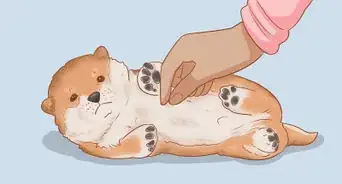
6Notice the shape of the dog's paws. Shibas have round paws. These circular paws are catlike in appearance. The pads at the bottom of the paws are thick.[10]
-
7See if the dog has a muscular build. Though small, Shiba Inu have a well-muscled body. They have a sturdy build that compliments their smooth gait.[11]


Method 2
Method 2 of 3:Taking a Close Look at the Coat
-
1Analyze the texture of the dog's coat. Shiba Inu have thick double coats. Their fur is moderately straight and short in length. The undercoat is soft, while the top coat is more coarse.[12]
-
2Recognize the dog's fur color. Shiba Inu have four possible coat colors: red, black and tan, cream, and sesame.
- Red is the most commonly seen coloring of a Shiba Inu. It is the preferred coat color of the AKC for this breed.
- Black and tan Shiba Inu are also popular.
- Cream Shiba Inu are frowned upon by the AKC and go against the breed standards.[13]
- Sesame Shiba Inu are the least commonly seen. Some Shibas resemble the sesame coat pattern but are actually more of a red with black tips.
-
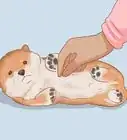
3Look for the urajiro markings. This Japanese word refers to a Shiba Inu's white marks. These appear on places such as the face, neck, stomach, legs, and tail.[14]
- Because the urajiro markings can't appear on an already cream colored coat, the cream variant of this breed is not recognized by the AKC.[15]


Method 3
Method 3 of 3:Assessing Temperament
-
1
-
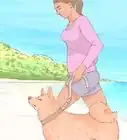
2Notice an abundance of energy. Shibas are very lively and energetic. They are swift runners and should be watched while off leash.[17]
-
3See if the dog is clever. With their intelligence, Shiba Inu are prone to getting into trouble when left alone. Because of this, they work best in houses with large fences.[18]
-
4Look for a hunting instinct. Being bred as hunting dogs, Shiba Inu will have a strong, natural hunting instinct.[19] They may chase other animals, such as other dogs, cats, or birds.[20]
Did you know? The ancestors of the Shiba Inu were used to hunt large game in the mountainous regions of Japan, though nowadays, Shiba Inu stick to pursuing smaller animals.[21]
-
5Pay attention to the dog's attention level. Shiba Inu are attentive and alert. See if the dog has the attentiveness to match the Shiba Inu's bold personality.[22]


Community Q&A
-
QuestionWhere and how popular is the Shiba Inu?
 HelpieTop AnswererThe Shiba Inu is ranked 44th on the AKC's list of dog breed popularity. It is a common breed in the US, and the most popular companion breed in Japan, according to the AKC.
 -
QuestionWhat breed are the Shiba Inus in the Roblox game, Adopt Me?HelpieTop AnswererThe breed of dog would be a Shiba Inu, as a Shiba Inu is a breed rather than a species (the species would be a dog).
-
QuestionIs “Doge” a Shiba Inu?HelpieTop AnswererYes, the Doge dog is a Shiba Inu. You can tell by its red coloring, urajiro markings, and other key features of the breed.
-
QuestionWhat would the characteristics be of a Shibu Inu mixed with German Shepherd?HelpieTop AnswererThe dog would likely be smaller than a German Shepherd but larger than a Shiba Inu. It may have a curled tail, inheriting that Shiba Inu trait, and would likely have some German Shepherd coloring, such as brown or black. Check out How to Identify a German Shepherd to learn about some key German Shepherd traits that may appear in a Shiba Inu/German Shepherd mix.
-
QuestionCan a cream Shiba Inu change to sesame?HelpieTop AnswererThough a Shiba Inu's coat color may alter over time, such as sesame-appearing dogs growing to have red coats, it's very unlikely for a cream-coated dog to grow into a sesame coat as cream coats are very light in color, while sesame coats are dark.
-
QuestionMy dog looks exactly like a shiba inu with a pointed muzzle, heavy tan and white coat, curled tail, and large round paws, but they have floppy ears rather than perked ears. Are they a purebred?HelpieTop AnswererDepending on your dog's age, it's possible that their ears haven't perked up yet. Shiba inu puppies are born with floppy ears. Their ears usually stand up when they are between 6 and 10 weeks old. If your dog is older than 12 weeks and still has floppy ears, it's possible that they may be a mixed breed or have a health condition. Consider DNA testing if you're concerned about your dog's breed.







References
- ↑ https://www.akc.org/dog-breeds/shiba-inu/
- ↑ https://www.akc.org/dog-breeds/shiba-inu/
- ↑ https://www.akc.org/dog-breeds/shiba-inu/
- ↑ https://www.akc.org/dog-breeds/shiba-inu/
- ↑ http://images.akc.org/pdf/breeds/standards/ShibaInu.pdf
- ↑ http://images.akc.org/pdf/breeds/standards/ShibaInu.pdf
- ↑ http://images.akc.org/pdf/breeds/standards/ShibaInu.pdf
- ↑ http://images.akc.org/pdf/breeds/standards/ShibaInu.pdf
- ↑ http://images.akc.org/pdf/breeds/standards/ShibaInu.pdf
- ↑ http://images.akc.org/pdf/breeds/standards/ShibaInu.pdf
- ↑ https://www.akc.org/dog-breeds/shiba-inu/
- ↑ http://images.akc.org/pdf/breeds/standards/ShibaInu.pdf
- ↑ http://images.akc.org/pdf/breeds/standards/ShibaInu.pdf
- ↑ http://images.akc.org/pdf/breeds/standards/ShibaInu.pdf
- ↑ http://images.akc.org/pdf/breeds/standards/ShibaInu.pdf
- ↑ https://www.yourpurebredpuppy.com/reviews/shibainu.html
- ↑ https://www.yourpurebredpuppy.com/reviews/shibainu.html
- ↑ https://www.yourpurebredpuppy.com/reviews/shibainu.html
- ↑ https://www.akc.org/dog-breeds/shiba-inu/
- ↑ https://www.yourpurebredpuppy.com/reviews/shibainu.html
- ↑ https://www.akc.org/dog-breeds/shiba-inu/
- ↑ https://www.akc.org/dog-breeds/shiba-inu/