X
wikiHow is a “wiki,” similar to Wikipedia, which means that many of our articles are co-written by multiple authors. To create this article, volunteer authors worked to edit and improve it over time.
There are 9 references cited in this article, which can be found at the bottom of the page.
Learn more...
Steps
Method 1
Method 1 of 3:Looking at the Body Structure
Method 1
-
1Notice the size of the dog. Male Briards are typically anywhere from 23–27 inches (58–69 cm) tall and weigh anywhere from 60–100 pounds (27–45 kg), while female Briards are slightly smaller, and usually are somewhere between 22–25.5 inches (56–65 cm) tall, and they weigh anywhere from 50–80 pounds (23–36 kg). [3]
- They're usually fully matured by 1-2 years of age, but they reach their full size when they’re between 6-8 months old. [4]
-
2Look at the dog’s ears. A Briard’s ears are high up on their head, with their ear length being equal to or a little less than 1/2 the length of its head. The ears should also be covered with the dog’s long hair. [5]
- When cropped, the ears of the dog are upright and parallel to each other, facing slightly forward if the dog is alert. [6]
-
3Examine the eyes of the dog. A Briard’s eyes are usually set well apart from each other and are quite large. The dog will either have black or black/brown colored eyes, and the eyelid rims are usually very dark, similar in color to the coat. [7]
-
4Notice the nose. A Briard’s nose is a square shape as opposed to round, and it is always black. [8]
-
5Take a close look at the dog’s head overall. A Briard’s head is overall quite large, giving an impression of length. [9]
-
6Examine the dog’s tail. A Briard’s tail is not cut and is well feathered. It’s carried low on the dog’s body, and if you’re looking at it from the right side, it should form a "J" shape. [10]
-
7


Method 2
Method 2 of 3:Examining the Coat
Method 2
-
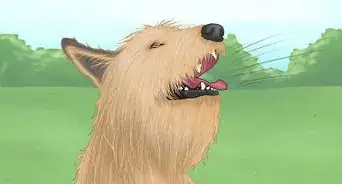
1Glance at the overall appearance of the dog's coat. Briards have long hair and are double-coated. They have a coarse outercoat, which can be six inches long or more. The undercoat is fine and tight, covering the dog's entire body. [13]
- Though the Briard’s hair may be long, it should never hide the head's form or cover the eyes completely. [14]
-
2Understand that a Briard can be many possible colors. Their coat may be black or different shades of gray and/or tawny. In fact, pretty much the only color they typically aren’t is white. A combination of these colors (or the occasional stray white hair) can also sometimes occur. [15]
-
3Notice a need for regular brushing. A Briard will need to be brushed to the skin multiple times per week, using a quality pin brush. [16]


Method 3
Method 3 of 3:Noticing the Dog's Temperament
Method 3
-
1Notice a need for regular exercise. Briards are athletic dogs, and as such, they will need exercise (both physical, such as walks or games of fetch, and mental, such as agility) often. [17]
-
2Look for intelligence. Briards are intelligent dogs and thus should be relatively easy to train. [18]
-
3See if the dog is stubborn. Briards are relatively independent (though they also love being with their owners), so they may occasionally refuse a command. [19]
-
4Notice whether the dog is loyal. As stated earlier on, although Briards are relatively independent, they are also known to be loyal to, and protective of, their owners. [20]
-
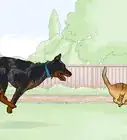
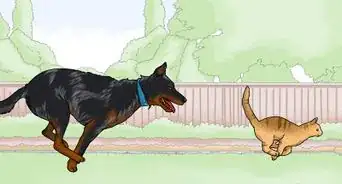
5Look for attempts to "herd". Since the Briard is a herding dog, it may attempt to herd humans or other animals in a variety of ways, including using its head or barking at them. [23]
- Be sure to train the Briard not to do this while it’s still young, since it could become an issue as the dog gets older and its head gets bigger. [24]








References
- ↑ https://www.akc.org/dog-breeds/briard/
- ↑ https://dogtime.com/dog-breeds/briard#/slide/1
- ↑ https://www.akc.org/dog-breeds/briard/
- ↑ https://www.hillspet.com/dog-care/dog-breeds/briard
- ↑ https://images.akc.org/pdf/breeds/standards/Briard.pdf
- ↑ https://images.akc.org/pdf/breeds/standards/Briard.pdf
- ↑ https://images.akc.org/pdf/breeds/standards/Briard.pdf
- ↑ https://images.akc.org/pdf/breeds/standards/Briard.pdf
- ↑ https://www.akc.org/dog-breeds/briard/
- ↑ https://images.akc.org/pdf/breeds/standards/Briard.pdf
- ↑ https://www.akc.org/dog-breeds/briard/
- ↑ https://images.akc.org/pdf/breeds/standards/Briard.pdf
- ↑ https://images.akc.org/pdf/breeds/standards/Briard.pdf
- ↑ https://images.akc.org/pdf/breeds/standards/Briard.pdf
- ↑ https://images.akc.org/pdf/breeds/standards/Briard.pdf
- ↑ https://www.akc.org/dog-breeds/briard/
- ↑ https://www.yourpurebredpuppy.com/reviews/briards.html
- ↑ https://images.akc.org/pdf/breeds/standards/Briard.pdf
- ↑ https://www.hillspet.com/dog-care/dog-breeds/briard
- ↑ https://www.dogzone.com/breeds/briard/
- ↑ https://www.dogzone.com/breeds/briard/
- ↑ https://www.hillspet.com/dog-care/dog-breeds/briard
- ↑ https://www.dogtemperament.com/briard-temperament/
- ↑ https://www.dogtemperament.com/briard-temperament/