This article was co-authored by wikiHow staff writer, Sophia Latorre. Sophia Latorre is a Content Manager on the wikiHow team. Before joining wikiHow, Sophia worked as a technical editor and was published in six International Energy Agency (IEA) Wind Annual Reports. Now, she writes, edits, and reviews articles for the wikiHow Content Team, working to make the content as helpful as possible for readers worldwide. Sophia holds a BA in English from Colorado State University.
There are 7 references cited in this article, which can be found at the bottom of the page.
This article has been viewed 2,590 times.
Learn more...
If you live in an arid climate, using a humidifier to add extra moisture to the air in your home could help relieve symptoms of asthma. A humidifier isn’t a replacement for medication or other asthma treatments, but using one may help you breathe a bit easier. Be wary of increasing the humidity too much, though, as that could actually make asthma worse. There are lots of different options, from cool-mist humidifiers to steam vaporizers, but don’t let that deter you—it’s easy to find the best humidifier for your needs.
Steps
Method 1
Method 1 of 2:Choosing a Humidifer
-
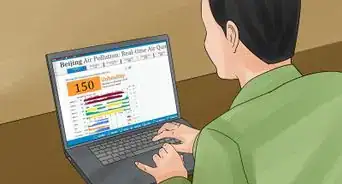
1Use a humidifier if the humidity in your home is less than 30%. The ideal indoor humidity level is between 30% and 50%. Get a hygrometer, which is a tool that measures humidity, to see what your home’s humidity level is. If it’s less than 50%, you have dry air, so go ahead and use a humidifier.[1]
- If the air in your home is too dry, you’re more likely to catch respiratory infections like the cold or the flu, which can make your asthma symptoms worse. Dry air can also cause dry skin, a sore throat, and other respiratory symptoms.
-
2Have a central humidifier installed for the most effective option. Central humidifiers, or whole-house humidifiers, are the most expensive type, and they rely on your home’s heating and cooling systems to humidify the air. That means you don’t have to worry about filling up a standalone unit.[2]
- Hire an HVAC professional to install a central humidifier in your home.
-
3Go for a steam-based humidifier to reduce germs. Steam-based humidifiers boil water to create steam. This means the water vapor is germ-free. However, these types can get pretty hot and the steam could burn you.[3]
- Don’t leave young children unattended around a steam-based humidifier—they could get scalded.
-
4Select an evaporative humidifier for an inexpensive option. Evaporative humidifiers are pretty cheap and easy to clean. They work by running water through a wet wick, which releases the water into the air, but not bacteria or minerals.[4]
- However, you will need to change the filter frequently if you go with this type of humidifier.
-
5Get an ultrasonic humidifier for a quiet, energy-efficient unit. Ultrasonic humidifiers use high-frequency vibration to turn water into mist. This means, though, that any minerals or bacteria in the water also get turned into mist, so it’s super important that you clean this type at least twice per week.[5]
-
6Opt for a dehumidifier if the humidity in your home is more than 50%. While dry air can make asthma symptoms worse, the same is true for air that has too much humidity. Use a hygrometer to measure the humidity in your home. If it’s too high, get a dehumidifier to draw water out of the air.[6]
- Dust mites and mold thrive in really humid areas and can contribute to breathing problems.


Method 2
Method 2 of 2:Using a Humidifier Safely
-
1Set the humidifier 4 feet (1.2 m) away from you. Choose a flat, stable surface with good air circulation. Set a waterproof mat or a towel on the surface before placing the humidifier on top of it.[7]
- It’s especially important to keep the unit a few feet away from you if it’s a warm-mist humidifier to prevent burns.
-
2Put distilled water in your humidifier. Tap water contains a lot of minerals, which can increase bacteria growth inside your humidifier. Additionally, if you use tap water in a humidifier, it will release these minerals into the air and you can breathe them in. Fill your humidifier’s water reservoir with distilled or even demineralized water to avoid these issues.[8]
- Don’t overfill the humidifier! Stop adding water once you reach the fill line.
- If you notice fine white dust (from vaporized minerals) on any furniture or surfaces around the humidifier, turn it off right away. Clean the area as well as the humidifier.[9]
-
3Refill your humidifier every day. To keep the water as clean as possible, unplug your humidifier each day, then dump out the old water. Dry the humidifier, including the water tank, with a clean towel, then refill the unit with fresh, distilled water.[10]
- Wipe up any spilled water on or around the humidifier to prevent water damage.
- A room humidifier uses about 1 gallon (3.8 L) of water each day.[11]
-
4Clean the unit twice a week. Humidifiers can easily increase bacteria and mold growth, which could worsen your asthma. Every 3 days or so, unplug the humidifier and dump out the water as usual. Then, clean the humidifier with 3% hydrogen peroxide to remove mineral deposits. Rinse and dry it before refilling it with distilled water.[12]
- You can use distilled white vinegar as an alternative to hydrogen peroxide.[13]
- It may seem like a pain to clean your humidifier so often, but it’s really important for your health!
-
5Change the filter in the humidifier at least once a month. Each unit is different, so read the manual to figure out how often to replace the filter according to the manufacturer. Usually, you’ll need to change the filter every 30 days or so. Stock up on filters so you have them on hand and can swap them out frequently.[14]
- Regularly changing the filter limits how much bacteria and mold are released into the air.
-
6Avoid adding essential oils to your humidifier. While some humidifier models have spaces to add vapor rub or essential oils, don’t use these features! They release chemicals in the air that can worsen asthma symptoms or even cause respiratory illnesses.[15]


Warnings
- Ask your doctor if they recommend using a humidifier if you have asthma. Remember that this is not a replacement for asthma medication.[17]Thanks!
- Don’t use tap water in a humidifier as the minerals in the water will be released into the air.[18]Thanks!
- Dirty humidifiers can lead to upper respiratory infections, so clean yours frequently![19]Thanks!
- High humidity levels can worsen asthma symptoms.[20]Thanks!










References
- ↑ https://www.nationalasthma.org.au/news/2016/indoor-humidity
- ↑ https://health.clevelandclinic.org/how-you-can-tell-if-you-need-a-humidifier/
- ↑ https://www.childrenscolorado.org/conditions-and-advice/parenting/parenting-articles/danger-of-humidifiers/
- ↑ https://www.childrenscolorado.org/conditions-and-advice/parenting/parenting-articles/danger-of-humidifiers/
- ↑ https://www.childrenscolorado.org/conditions-and-advice/parenting/parenting-articles/danger-of-humidifiers/
- ↑ https://www.nationalasthma.org.au/news/2016/indoor-humidity
- ↑ https://asthma.ca/wp-content/uploads/2017/08/asthma_humidifiers_vaporizers2_eng.pdf
- ↑ https://asthma.ca/wp-content/uploads/2017/08/asthma_humidifiers_vaporizers2_eng.pdf
- ↑ https://www.mayoclinic.org/diseases-conditions/common-cold/in-depth/humidifiers/art-20048021
- ↑ https://www.mayoclinic.org/diseases-conditions/common-cold/in-depth/humidifiers/art-20048021
- ↑ https://health.clevelandclinic.org/how-you-can-tell-if-you-need-a-humidifier/
- ↑ https://www.mayoclinic.org/diseases-conditions/common-cold/in-depth/humidifiers/art-20048021
- ↑ https://www.childrenscolorado.org/conditions-and-advice/parenting/parenting-articles/danger-of-humidifiers/
- ↑ https://health.clevelandclinic.org/how-you-can-tell-if-you-need-a-humidifier/
- ↑ https://www.nationwidechildrens.org/family-resources-education/700childrens/2018/01/humidifiers-for-respiratory-infections-are-they-helpful-or-harmful
- ↑ https://www.consumerreports.org/humidifiers/why-you-should-clean-your-humidifier/
- ↑ https://www.mayoclinic.org/diseases-conditions/common-cold/in-depth/humidifiers/art-20048021
- ↑ https://www.mayoclinic.org/diseases-conditions/common-cold/in-depth/humidifiers/art-20048021
- ↑ https://www.mayoclinic.org/diseases-conditions/common-cold/in-depth/humidifiers/art-20048021
- ↑ https://www.nationalasthma.org.au/news/2016/indoor-humidity
About This Article