wikiHow is a “wiki,” similar to Wikipedia, which means that many of our articles are co-written by multiple authors. To create this article, volunteer authors worked to edit and improve it over time.
This article has been viewed 3,655 times.
Learn more...
Guinea pigs are social animals. This means that they should always have at least one companion or cage mate. Although it can be difficult to introduce two guinea pigs with stubborn personalities, with the right methods and proper care during the bonding stage, they will eventually learn to adapt. It's essential to keep your guinea pigs in pairs and to try your best to create a neutral environment so that both cavies can get along.
Steps
Part 1
Part 1 of 2:Setting Up a Cage for Two Guinea Pigs
-
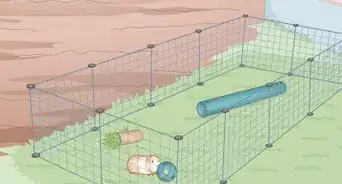
1Expand their cage to an appropriate size. Guinea pigs require the minimum of 7.5 square feet for two sows and 10.5 square feet for two boars.[1] The more space you are able to provide your guinea pig, the more likely they are to get along.
Did you know?: Male guinea pigs are very territorial and rarely get along in groups with three or more guinea pigs.
-
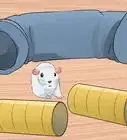
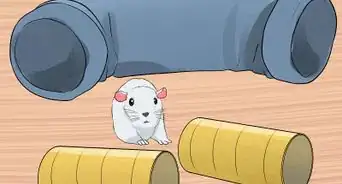
2Provide at least three hiding spots. Each guinea pig should have one hiding spot each, and a neutral hiding spot for the dominant guinea pig to "claim". Bridges, wooden huts, corner curtains, pigloos, and tunnels are all a few examples of good hiding spots you can purchase online or from your local pet store.
- When you are first introducing your guinea pigs and bonding them for the first 1-2 weeks, it's important to purchase hiding spots that have two entrances/exits. This is to prevent your dominant guinea pig from cornering the submissive guinea pig, as fighting could occur if your guinea pig feels trapped.
-
3Provide two bowls per guinea pig. Guinea pigs tend to bicker a lot around feeding time. Set up two feeding stations and separate your guinea pigs during feeding time to prevent arguments. You should have two bowls for their vegetables and two bowls for their pellets.
- If you can, set up two separate hay piles. However, guinea pigs will happily chew on large piles of hay without fighting. Their hay should not be confined in a hay rack.
-
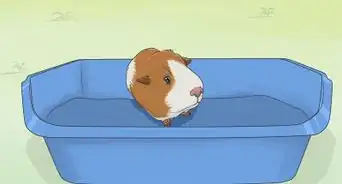
4Set up a temporary cage. In the case of an emergency, you will need to separate both guinea pigs by placing the submissive guinea pig inside a temporary cage. This should only be done when blood is drawn.
- Prepare a small to medium-sized cage or box with bedding, a hide, food, and water.
-
5Clean the cage before you add both guinea pigs. Because guinea pigs are territorial, a cage with scent markings can cause a higher risk of fighting between both guinea pigs. Clean the cage with detergent and all of their accessories, including pet bowls, and add fresh bedding.


Part 2
Part 2 of 2:Bonding Your Two Guinea Pigs
-
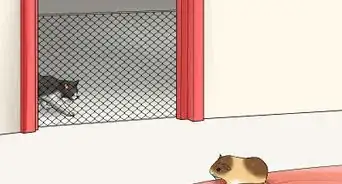
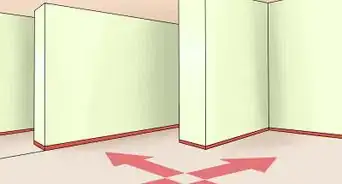
1Introduce your guinea pigs to each other. Set up a neutral area in your home. This could be a bedroom, bathroom, or kitchen; somewhere that is safe and secure for your guinea pigs to familiarise themselves.[2]
- If you have set up a new cage for your guinea pig's prior, you could use this as a neutral area to introduce the two.
- Ensure that the pair of guinea pigs you are planning on introducing are compatible. Guinea pigs of the same sex make good pairs. If you plan on housing a male and female guinea pig together, ensure that either one of the guinea pigs is desexed. Consider their personalities.[3]
- When introducing your guinea pigs, you should try to avoid introducing them multiple times. Have the introduction done and over within one session. This alleviates stress and lessens the risk of fighting.
Warning: You should first quarantine your new guinea pig for two weeks before introducing them to ensure there are no parasites or contagious illnesses.[4]
-
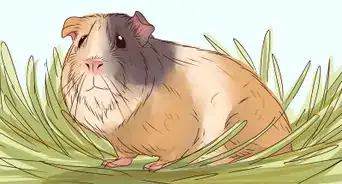
2Set up large piles of hay in the area. Hay and other foods offer as a great distraction to your guinea pigs during their introduction and bonding period. Guinea pigs love to graze, burrow, and play inside hay piles.
- Have at least two piles of hay for your guinea pigs to graze. The idea is to eliminate the risk of fighting by providing unlimited amounts of food so that your guinea pigs aren't territorial.
- You do not want your guinea pig fighting over small amounts of hay. If there are more than one large piles of hay, the submissive guinea pig will usually back off and eat somewhere else.
-
3Distract your guinea pigs with treats. While it's important not to intervene through hand-feeding so that you do not disrupt the bonding process, scattering large amounts of treats around the cage is a good idea to distract both guinea pigs.
- Cut-up vegetables and fruits make delicious and enticing treats. Otherwise, you can purchase commercial treats from a pet store and spread them throughout the cage.
- Vegetables like carrots, cucumbers, cherry tomatoes, zucchini and bell peppers are generally some of the favourites.
-
4Monitor your guinea pig's behaviour. Your guinea pigs may exhibit hostile signs, such as rumble strutting and chasing, which are perfectly normal in terms of establishing dominance.[5] The only time you should step in and separate both guinea pigs is when blood is drawn. If your guinea pigs are given adequate space and distractions, they will learn to move on. Normal signs include:[6]
- Sniffing.
- Throwing their head back.
- Dragging their butts.
- Raised fur.
- Yawning.
- Teeth chattering.
- Chasing.
- Nudging.
- Rumble-strutting (shifting weight from one leg to the other and moving their bum side to side).
- Light nipping.
- Headbutting.
- And mounting (which is seen in both girl and boy pairs).
-
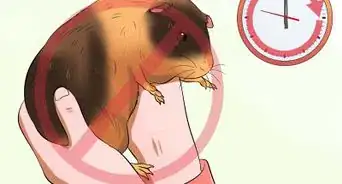
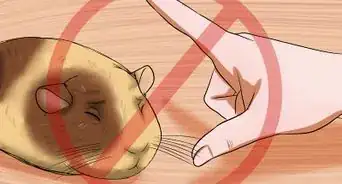
5Avoid intervening during the introduction. The best way to introduce two guinea pigs is to have them get to know each other in one session, rather than multiple episodes of introductions. Avoid intervening as much as possible, as doing so can make them panic and halt the bonding process.[7]
-
6Separate your guinea pigs if blood is drawn. While it's normal for guinea pigs to exhibit hostile behaviour, if this behaviour turns into a major fight, it's important to separate the guinea pigs as soon as possible. Place a towel over both guinea pigs and using the same towel, wrap it around one of the guinea pigs and separate them.[8]
- Do not mistake light nipping as a serious fight. This is a normal behaviour of dominance, and shouldn't seriously harm your guinea pig.
Warning: Avoid handling your guinea pig a few hours after the fight, as they can remain confrontational and suddenly lash out or bite.[9]
-
7Feed your guinea pigs separately if possible. Guinea pigs are most territorial over space and food. If possible, purchase two bowls for each guinea pig (one for their vegetables and one for their pellets). Feed them at the opposite corner of the cage, or separate the submissive guinea pigs if they become aggressive during feeding time.


Community Q&A
-
QuestionMy guinea pig's brother passed away and we're going to get a bonded pair to put with my single guinea pig. How should I introduce a pair to a single?
 Amy HarrisonTop AnswererBoars have difficulty co-existing in groups of three or more due to acts of dominance and territorial disputes. While it may be possible for the three of your guinea pigs to co-exist peacefully, you should also prepare for things to turn sour. To introduce the three, place them on a neutral ground, such as a spare bedroom. Distract them with plenty of food, such as hay and scattered vegetables, and make sure they aren't disrupted during the introduction process.
 -
QuestionI have a 9 month old boar and I want to get a 4 month old boar, will they get along?Amy HarrisonTop AnswererIt's likely, since older guinea pigs get along better with younger guinea pigs, but this isn't a guarantee. Introducing your two boars on a neutral ground with plenty of food to distract them will help them get along better.
Warnings
- Do not use exercise wheels or balls on your guinea pigs. These are dangerous and aren't suitable for guinea pigs.Thanks!
- Do not house a male and female together if they are not desexed. Breeding guinea pigs is complicated and sometimes dangerous.Thanks!
- You will need to wait at least 6 weeks before housing a desexed male with a female guinea pig, as they can sometimes reproduce after surgery.Thanks!
- Separate your guinea pigs immediately if blood is drawn and serious fighting occurs.Thanks!
- Do not confine your guinea pig's hay to a hay rack. Hay racks have been proven to be dangerous, and do not optimise their need to graze throughout the day.Thanks!



References
- ↑ https://www.humanesociety.org/resources/guinea-pig-housing
- ↑ https://www.animalhumanesociety.org/behavior/guinea-pig-bonding-basics
- ↑ https://www.somerzby.com.au/blog/how-to-introduce-guinea-pigs-to-each-other/
- ↑ https://www.animalhumanesociety.org/behavior/guinea-pig-bonding-basics
- ↑ https://www.animalhumanesociety.org/behavior/guinea-pig-bonding-basics
- ↑ https://www.somerzby.com.au/blog/how-to-introduce-guinea-pigs-to-each-other/
- ↑ https://www.somerzby.com.au/blog/how-to-introduce-guinea-pigs-to-each-other/
- ↑ https://www.animalhumanesociety.org/behavior/guinea-pig-bonding-basics
- ↑ https://www.somerzby.com.au/blog/how-to-introduce-guinea-pigs-to-each-other/