This article was co-authored by wikiHow Staff. Our trained team of editors and researchers validate articles for accuracy and comprehensiveness. wikiHow's Content Management Team carefully monitors the work from our editorial staff to ensure that each article is backed by trusted research and meets our high quality standards.
There are 9 references cited in this article, which can be found at the bottom of the page.
This article has been viewed 7,319 times.
Learn more...
Eggs are delicious and a great source of protein, but as you likely know, they can also contain bacteria that can make you sick if you don't handle the eggs properly. To properly handle eggs, be vigilant about washing down surfaces and cook eggs to a proper temperature. Also, be careful about how you store eggs to keep them fresh.
Steps
Method 1
Method 1 of 3:Avoiding the Spread and Ingestion of Bacteria
-
1Start with clean utensils, bowls, and hands. Eggs can pick up bacteria fairly easily, so make sure you start with all clean items. That includes washing your hands thoroughly before you handle the eggs.
-
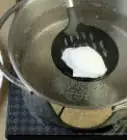
2Cook eggs to the proper temperature. If you cook just eggs to 140 degrees Fahrenheit (60 degrees Celsius), you kill any bacteria. If you mix the eggs with sugar or milk (in a custard), you should aim for 160 degrees Fahrenheit (71 degrees Celsius) to properly kill bacteria.[1]Advertisement
-
3Avoid eating raw or runny eggs. Eggs should be cooked until the egg and white set; don't eat eggs if they haven't reached this stage. You should also skip eating cookie dough and other batters with raw eggs.[2]
- If you enjoy eating cookie dough, try buying edible cookie dough from the store specifically made for eating raw. You can also find recipes for making cookie dough without eggs, but you'll also need to heat treat the flour for these recipes.
-
4Separate eggs with a funnel or egg separator. If you need to separate the egg yolk from the white, use a device to do it. Using your hands or even the eggshell can encourage the spread of bacteria. A funnel works well, because the white runs out the bottom while the yolk stays in the funnel.[3]
- If you break the yolk, you'll need to start with a new egg. Fresher eggs are less likely to break.
-
5Scrub your hands thoroughly after you handle eggs. Immediately after handling eggs, wash your hands. To wash your hands properly, use soap and water. Scrub your hands for at least twenty seconds to remove bacteria.[4]
-
6Wash everything that came in contact with the eggs thoroughly. After you cook with eggs, make sure to scrub everything down. Disinfect the counter tops, and clean bowls, utensils, and cutting boards with hot water and soap. You can also run items through the dishwasher.[5]
- This step includes scrubbing anything that came in contact with the shell, as well. So if you set a whole egg on the counter, you need to wipe it down afterwards.
-
7Skip washing store-bought eggs. Store-bought eggs are washed before you bring them home (in the U.S.). If you try to wash them, you could just spread bacteria from the shells around your kitchen.[6]
- Eggs in other countries typically aren't washed before coming to the store, but it still isn't a good idea to wash them.
-
8Throw away dirty or cracked eggs. If you discover eggs that have a dirty shell or that have shells that cracked before you brought them home, you should throw those eggs out. They're often contaminated with bacteria.[7]Advertisement


Method 2
Method 2 of 3:Handling Backyard or Farmer's Market Eggs
-
1Wipe down dirty eggs with a cloth or fine sandpaper. Don't use water to clean eggs, as that can draw bacteria to the inside of the egg. Instead, rub the outside down with a cloth, soft brush, or even fine sandpaper to remove the dirt. Rub them until they look clean.[8]
-
2Keep track of how long you've had the eggs. If you raise chickens to produce your own eggs, you need to keep track of when they were laid so you can use them before they go bad. Eggs generally keep a month to five weeks in the fridge.
- You can use a system where you always place the older eggs towards the front of the carton to use first.
-
3Eat eggs only from healthy chickens. If one of your chickens is sick, you should isolate it from the rest of the flock. You'll know a bird is getting sick by lethargy, sneezing, runny eyes, and coughing, just to name a few symptoms. Once you've isolated the bird, make sure you don't eat any eggs from this chicken.[9]
-
4Check to see if an egg is still good. If you're unsure about whether an egg is good, place it in a bowl of water. If it stays on the bottom, it still good. If it tips up a bit, it's also good, but you should use it quickly. However, if it floats, you should toss it because it's not good anymore.[10]Advertisement


Method 3
Method 3 of 3:Storing Eggs Properly
-
1Keep them in their original container. The original container has an expiration date on it, so you can easily refer to it later. If you throw it out, you won't be able to check them. Plus, the original container protects the eggs.[11]
-
2Chill them down in the cold part of the refrigerator. Often, your refrigerator will have a place for eggs in the door. However, that's not the best place for eggs. That area tends to be warmer, since it gets drafts from the door opening and closing. Instead, place them on a shelf to keep them cooler.[12]
- Eggs should be kept at 40 degrees Fahrenheit (4 degrees Celsius) at all times. You can use a thermometer to check the temperature in different parts of your refrigerator.[13]
-
3Place eggs away from other food items. Eggshells can harbor bacteria, so you don't want them to come into contact with other foods, particularly ones you will eat raw. Make sure the eggshells can't touch foods like fresh vegetables and fruits.[14]
- The container should be mostly safe, but you should still probably keep it from touching other items in the fridge.
-
4Freeze eggs out of their shells. If you need to keep eggs for longer, it's best to take them out of their shells. Crack them into a freezer-safe container, and then scramble the yolks into the whites until the mixture is mostly homogeneous. Place the eggs in the freezer.
- When you want to defrost eggs, place them in the refrigerator overnight. Don't defrost them at room temperature, as that encourages bacteria growth.
Advertisement





References
- ↑ https://www.incredibleegg.org/egg-nutrition/safe-food-handling-tips/#1
- ↑ https://www.cdc.gov/features/salmonellaeggs/index.html
- ↑ https://www.incredibleegg.org/egg-nutrition/safe-food-handling-tips/#1
- ↑ https://www.cdc.gov/features/salmonellaeggs/index.html
- ↑ https://www.cdc.gov/features/salmonellaeggs/index.html
- ↑ http://www.eggsafety.org/safe-handling-kitchen/
- ↑ https://www.cdc.gov/features/salmonellaeggs/index.html
- ↑ https://www.cdc.gov/features/salmonellaeggs/index.html
- ↑ http://www.fresheggsdaily.com/2013/10/handling-contagious-illness-in-your.html
- ↑ http://www.thekitchn.com/how-to-test-eggs-for-freshness-how-to-find-out-tips-from-the-kitchn-46368
- ↑ http://www.eggsafety.org/safe-handling-kitchen/
- ↑ http://www.eggsafety.org/safe-handling-kitchen/
- ↑ https://www.cdc.gov/features/salmonellaeggs/index.html
- ↑ https://www.incredibleegg.org/egg-nutrition/safe-food-handling-tips/#1
About This Article