This article was co-authored by Lauren Kurtz. Lauren Kurtz is a Naturalist and Horticultural Specialist. Lauren has worked for Aurora, Colorado managing the Water-Wise Garden at Aurora Municipal Center for the Water Conservation Department. She earned a BA in Environmental and Sustainability Studies from Western Michigan University in 2014.
There are 12 references cited in this article, which can be found at the bottom of the page.
This article has been viewed 3,652 times.
Weigelas are beautiful, ornate shrubs with flowers that are known to attract hummingbirds. Weigela shrubs can be planted directly into your garden in a spot where they will get ample sunlight. These plants are native to China, Korea, and Japan, but they can thrive in USDA hardiness zones 4 through 10 and provide food for pollinators like bees and butterflies.[1]
Steps
Part 1
Part 1 of 3:Preparing the Soil
-
1Choose a spot with full sun or light shade. Weigelas require full sunlight to thrive and bloom to their full potential. If necessary, these plants can tolerate some light shade. Choose a spot in your garden to plant weigelas that is not obstructed or overshadowed by structures or other plants.[2]
- Weigelas are drought resistant and are unlikely to be damaged by sun exposure.
-
2Test your soil to make sure that it is well-drained. Weigelas grow best in soil that is well-drained rather than dense or clumpy.[3] To test the soil, dig a hole that is 12–18 inches (30–46 cm) wide and 12–18 inches (30–46 cm) deep and fill it with water. If it takes more than an hour for the water to seep into the ground, you have poorly-drained soil.[4]
-
3Fix poorly-drained soil with an organic soil amendment. Soil can be aerated by adding organic materials such as vermiculite, perlite, sand, or compost to it. Break up the top 8 inches (20 cm) of the soil with a rake or shovel and add a layer of your soil amendment of choice. Work it into the soil as evenly as possible.[5]
- The layer of soil amendment should be about 2 inches (5.1 cm) thick.
- Buy organic soil amendments at a garden center or hardware store.


Part 2
Part 2 of 3:Planting a Weigela Shrub
-
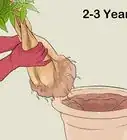
1Dig a hole in the soil that is as deep and twice as wide as the root ball. Provide ample place for the weigela's roots to spread once it is in the ground. Using a trowel, dig a hole that is 2 times wider and just as deep as the root ball.[6]
- Gently remove the plant from its pot before digging the hole to see how large the root ball is.
-
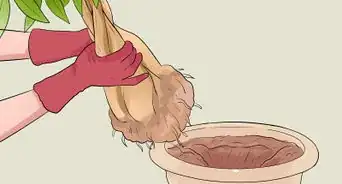
2Gently insert the shrub in the hole and spread its roots. Carefully put the shrub into the center of the hole. Tug softly at the roots to pull them outwards. Ensure that they make good contact with the soil.[7]
-
3Refill the hole and pat it down gently. Refill the hole surrounding the plant with the soil you removed. Carefully firm down the soil with your hands. Do not press too hard, which may ruin the aeration of the soil.[8]
-
4Apply mulch around the base of the plant. Mulch will help protect your weigela's vulnerable growing roots from weeds and weather damage.[9] Use an organic mulch material like dry leaves, grass clippings, tree bark, or sawdust. Apply the mulch around the base of your weigela plant in a layer that is 4–5 inches (10–13 cm) thick.[10]


Part 3
Part 3 of 3:Caring for Weigelas
-
1Water your weigelas once a week unless it rains. Weigelas require ample hydration to thrive and bloom. Water your weigelas once a week until the soil is wet, but not pooling. If it rains more than 1 inch (2.5 cm) during the week, don't water your weigelas until the following week.[11]
-
2Deadhead spent flowers as you find them during the growing season. To keep your weigelas growing beautifully, dead flower heads should be removed as soon as you spot them. Gently squeeze the flower near the stem and pull away the dead bloom. The flower should come off easily if it is wilted.[12]
- Dead flower heads will look limp and shrivelled.
- If the flower does not come off easily, use scissors or pruners to trim the stem just above the top leaf node.
-
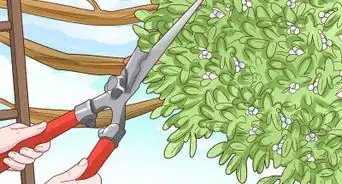
3Prune weigela after it blooms. Trim away dead wood with hand pruners throughout the spring as needed. Grasp a dead branch and trace it downwards to where it meets a young, healthy stem. Cut the dead branch just above this junction and remove it.[13]
- Shape your weigela after it’s finished flowering.
- In total, you should be cutting back about 20-30% of your plant each year.[14]
- Pruning weigela in the fall may result in the loss of flowers in the next growing season.
-
4Add a balanced fertilizer to the soil to encourage more blooms. It is not necessary to fertilize your soil to grow weigelas, but doing so may increase the number of blooms the shrub produces. Spray the soil with a fertilizer that contains equal amounts of nitrogen, phosphorus, and potassium. Do this once a year, preferably in the late winter before the shrubs bloom.[15]
-
5Inspect weigelas for gray mold and treat them with fungicide. Gray mold can be recognized by gray or white spots on leaves, gray webbing, or a fuzzy gray growth on your weigela shrubs. Cut down and remove any infected plants to prevent the spread of the fungus. Apply a biological fungicide to your remaining weigelas to prevent gray mold in the future.[16]
- Use biological fungicides instead of chemical fungicides to prevent damage to your plants.
- Apply fungicide every 2-3 weeks.[17]
- Prune your weigelas to provide more space between branches, lowering the risk of gray mold.


Community Q&A
-
QuestionDo I need to deep root water a weigela before the winter freeze?
 Community AnswerI can only tell you that they are pretty forgiving. I planted a bare root "My Monet" last summer, it's a dwarf variety and it withstood our super hot summers in Missouri and came through the winter like a champ. My pistachio hydrangeas did not! I don't know how old your shrub is, but it never hurts to mulch heavily before winter to keep the roots warm. A bedding of straws works equally well.
Things You'll Need
- Garden rake or shovel
- Vermiculite, perlite, sand, or compost
- Trowel
- Mulch (dry leaves, grass clippings, tree bark, or sawdust)
- Hand pruners
- Balanced fertilizer
- Biological fungicide







References
- ↑ https://plantcaretoday.com/growing-weigela-care.html
- ↑ http://www.missouribotanicalgarden.org/PlantFinder/PlantFinderDetails.aspx?kempercode=c367
- ↑ https://www.southernliving.com/plants/weigela
- ↑ https://www.bhg.com/gardening/yard/soil/what-is-well-drained-soil/
- ↑ https://durham.ces.ncsu.edu/files/library/32/UNH%203.PDF
- ↑ https://plantcaretoday.com/growing-weigela-care.html
- ↑ https://plantcaretoday.com/growing-weigela-care.html
- ↑ https://plantcaretoday.com/growing-weigela-care.html
- ↑ https://plantcaretoday.com/growing-weigela-care.html
- ↑ https://www.brighterblooms.com/planting-directions/mulching-information/
- ↑ https://plantcaretoday.com/growing-weigela-care.html
- ↑ https://plantcaretoday.com/growing-weigela-care.html
- ↑ https://www.bhg.com/gardening/plant-dictionary/shrub/weigela--cardinal-shrub-/
- ↑ http://www.finegardening.com/genus/weigela
- ↑ http://www.dailyherald.com/entlife/20170806/gardeners-go-wild-over-weigela
- ↑ https://www.almanac.com/pest/gray-mold-or-botrytis
- ↑ https://www.planetnatural.com/pest-problem-solver/plant-disease/gray-mold/
About This Article