This article was co-authored by wikiHow staff writer, Amber Crain. Amber Crain has been a member of wikiHow’s writing staff for the last six years. She graduated from the University of Houston where she majored in Classical Studies and minored in Painting. Before coming to wikiHow, she worked in a variety of industries including marketing, education, and music journalism. She's been a radio DJ for 10+ years and currently DJs a biweekly music program on the award-winning internet radio station DKFM. Her work at wikiHow supports her lifelong passion for learning and her belief that knowledge belongs to anyone who desires to seek it.
There are 8 references cited in this article, which can be found at the bottom of the page.
This article has been viewed 1,607 times.
Learn more...
Tatsoi, also known as spinach mustard, is a delicious leafy green that you can easily grow in containers or in your garden. If you're new to gardening, tatsoi is great because it grows so fast and isn't particularly finicky. These greens prefer cool weather, so plant your seeds in the spring for an early summer crop and again in the late summer to enjoy a fall harvest. Tatsoi is chock-full of micronutrients and has a slightly spicy mustard flavor that tastes delicious in salads and sandwiches!
Steps
Method 1
Method 1 of 2:Growing Conditions
-
1Plant seeds in spring or fall when the temperature is 59–75 °F (15–24 °C). Tatsoi is a cool weather crop—it doesn’t do well in heat, but it can withstand light frost. Plant the seeds in the spring for a late spring/early summer crop and again in the late summer for a fall harvest.[1]
-
2Choose a location that gets 6 hours of sunlight daily. Tatsoi thrives in full sun, so plant seeds in a spot that gets 5-6 hours of sunlight daily to ensure an ample harvest.[4] These greens aren’t super finicky, though! They will tolerate partial shade, if necessary.[5]
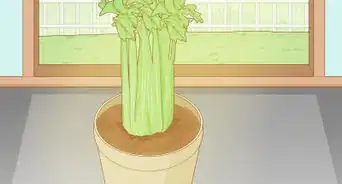
- Tatsoi grows well in containers. If you’re growing tatsoi in a container, position it in a warm, sunny window.
- If you’re growing tatsoi outside, look for a spot that gets shade during the hottest part of the day.
-
3Pick a spot with well-draining soil or use potting soil in a container. Tatsoi performs best in sandy-loamy soil that drains well.[6] To test soil drainage, dig a 12 by 12 in (30 by 30 cm) hole, fill it with water, and let it sit overnight. Refill the hole with water the next day and monitor how quickly it drains. Ideally, you want soil that drains about 2 in (5.1 cm) per hour.[7]
- If soil drainage is slow, mix in compost or manure and test it again.
-
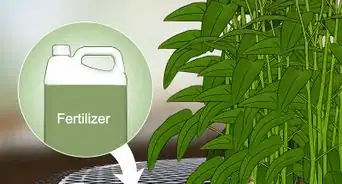
4Use a shovel or rake to work compost or well-rotted manure into the soil. If you’re planting the greens outside in your garden, use a shovel to turn the soil and remove any rocks that you come across. Then, add an organic fertilizer, like compost or well-rotted manure, to the soil and mix it in well with a shovel or rake.[8]
- If you’re using potting soil, you don’t need to add compost.[9]
-
5Test garden soil for a pH range of 5.5-7.5 before planting seeds. Tatsoi doesn’t grow well in acidic soil. Buy a pH testing kit at your local nursery and follow the directions to measure the pH. Anything lower than 5.5 is too acidic for tatsoi.[10]
- Mix lime into your soil if it’s too acidic and test it again to make sure it falls in the right range.[11]
- If you're using store-bought potting soil, the pH range should be listed on the bag.
-
6
-
7Space seeds 2 in (5.1 cm) apart in containers and garden rows. Give each seedling at least 2 in (5.1 cm) of space on each side whether you're growing in containers or your garden. If you’re planting multiple rows in your garden, put 10 in (25 cm) of space between each row.[14]


Method 2
Method 2 of 2:Plant Care and Harvesting
-
1Keep the soil moist but never soggy until the seedlings sprout. Monitor the soil every day and keep it uniformly moist so the seeds can germinate. Once seedlings sprout and grow 2 leaves, water them whenever the soil looks lighter in color and feels dry to the touch.[15]
- If you’re growing tatsoi in pots, water the greens whenever you see the soil pulling away from the sides of the container.
-
2Thin seedlings 8 in (20 cm) apart once they've grown 2 leaves each. Pull up the weakest seedlings so the stronger ones can thrive. Give each seedling about 8 in (20 cm) of space on each side.[16]
- The greens are edible at this stage, so you can eat the tender seedlings that you pull up. Baby greens taste great in salads and on sandwiches.[17]
-
3Weed between the plants regularly to keep them healthy. Pluck any weeds that spring up between individual plants as soon as you see them. That way, your greens have plenty of air circulation and don't have to compete with the weeds for nutrients. This is especially important if you're growing a fall crop.[18]
-
4Use mesh or netting to protect your plants from bugs and birds. Bugs, especially beetles, can be a problem for spring crops and birds love eating these tender baby greens! If you’re struggling with these issues, cover your beds with insect mesh or netting to protect the plants.[19]
- Clearing leaf clutter during the fall can prevent issues with late-season bugs.
-
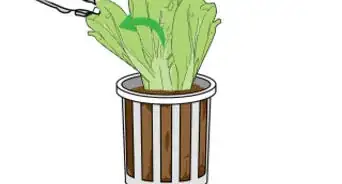
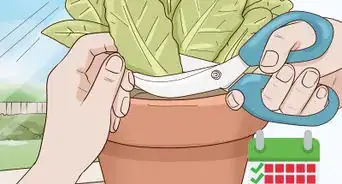
5Pluck or cut off individual leaves after 45 days to start harvesting. You can start harvesting as early as 25 days after planting if you want to enjoy the tender baby greens. Otherwise, give your plants about 45 days to mature before harvesting leaves. Pinch or snip off the leaves to harvest them.[20]
- Once your plants are full-grown, continue picking individual leaves or pull up the entire plant for harvesting.[21]
- Tatsoi stalks are edible, too! Harvest them when you up the whole plant. The stalks have a fresh, sweet taste that works wonderfully in salad mixes.[22]
- Store harvested leaves and stalks in the fridge to keep them fresh. Be sure to rinse them off thoroughly with water before eating them.[23]
-
6Harvest regularly to keep the greens productive and prevent bolting. Tatsoi grows fast, so it’s important to harvest regularly to keep the plants healthy and happy. Don’t allow your greens to grow stalks with seeds on them, or “bolt,” since the leaves tend to get bitter at this stage.[24]
- If some of your plants do start to bolt, it’s best to harvest the whole plant immediately before the flavor is ruined.


Things You’ll Need
- Tatsoi seeds
- Compost or manure (for garden planting)
- Shovel
- Potting soil and pots (for container planting)
- pH testing strips
- Lime (for acidic soil only)
- Mesh or netting (for pest issues)

References
- ↑ https://www.growveg.com/plants/us-and-canada/how-to-grow-tatsoi/
- ↑ http://www.omafra.gov.on.ca/CropOp/en/spec_veg/brassicas/taht.html
- ↑ https://cals.arizona.edu/fps/sites/cals.arizona.edu.fps/files/cotw/Tatsoi.pdf
- ↑ https://www.growveg.com/plants/us-and-canada/how-to-grow-tatsoi/
- ↑ https://www.bbg.org/gardening/article/grow_mizuna_and_other_asian_greens
- ↑ http://www.omafra.gov.on.ca/CropOp/en/spec_veg/brassicas/taht.html
- ↑ https://extension.tennessee.edu/Williamson/Horticulture/Consumer%20Horticulture/DIY%20Soil%20Drainage%20Perk%20Test%20for%20Your%20Yard%20(2016).pdf
- ↑ https://www.growveg.com/plants/us-and-canada/how-to-grow-tatsoi/
- ↑ https://www.bbg.org/gardening/article/grow_mizuna_and_other_asian_greens
- ↑ http://www.omafra.gov.on.ca/CropOp/en/spec_veg/brassicas/taht.html
- ↑ http://www.bbc.co.uk/gardening/basics/techniques/growfruitandveg_growingbrassicas1.shtml
- ↑ https://www.growveg.com/guides/growing-oriental-leaves-from-sowing-to-harvest/
- ↑ https://extension.colostate.edu/topic-areas/nutrition-food-safety-health/growing-container-salad-greens-9-378/
- ↑ https://www.growveg.com/plants/us-and-canada/how-to-grow-tatsoi/
- ↑ https://extension.colostate.edu/topic-areas/nutrition-food-safety-health/growing-container-salad-greens-9-378/
- ↑ https://www.growveg.com/plants/us-and-canada/how-to-grow-tatsoi/
- ↑ https://www.bbg.org/gardening/article/grow_mizuna_and_other_asian_greens
- ↑ https://www.growveg.com/guides/growing-oriental-leaves-from-sowing-to-harvest/
- ↑ https://www.growveg.com/guides/growing-oriental-leaves-from-sowing-to-harvest/
- ↑ https://www.bbg.org/gardening/article/grow_mizuna_and_other_asian_greens
- ↑ https://www.growveg.com/plants/us-and-canada/how-to-grow-tatsoi/
- ↑ https://cals.arizona.edu/fps/sites/cals.arizona.edu.fps/files/cotw/Tatsoi.pdf
- ↑ https://extension.colostate.edu/topic-areas/nutrition-food-safety-health/growing-container-salad-greens-9-378/
- ↑ https://extension.colostate.edu/topic-areas/nutrition-food-safety-health/growing-container-salad-greens-9-378/
About This Article