This article was co-authored by wikiHow staff writer, Janice Tieperman. Janice is a professional and creative writer who has worked at wikiHow since 2019. With both a B.A. and M.A. in English from East Stroudsburg University, she has a passion for writing a wide variety of content for anyone and everyone. In her free time, you can find her working on a new crochet pattern, listening to true crime podcasts, or tackling a new creative writing project.
There are 18 references cited in this article, which can be found at the bottom of the page.
This article has been viewed 4,715 times.
Learn more...
Skip the trip to the grocery store—you can grow and enjoy fresh strawberries from the comfort of your home with hanging baskets! These fruits thrive in warm, sunny weather, so it’s best to get your plants ready in March or April.[1] It’s really easy to arrange and care for these sweet berries, as long as you have some basket gardening supplies on hand and a sunny, outdoor space where you can hang the basket.
Steps
Method 1
Method 1 of 4:Types of Strawberries
-
1Choose everbearing strawberries if you’d like a longer growing season. As the name suggests, everbearing strawberries can be harvested throughout the growing season.[2] Typically, you can harvest your strawberries once in early summer, and again in early autumn.[3]
- These berries aren’t as high quality as day neutral strawberries, but they might be a good option if you’d like to harvest your tasty fruit more than once.[4]
-
2Pick out June-bearing strawberries if you’d like a summer crop. June-bearing strawberries yield a lot of strawberries in a short, 2-3 week period, so they aren’t a great option for a long-term garden.[5] Like the name suggests, June-bearing crops are ready to harvest in mid-June to early July, depending on when you plant them.[6]
- June-bearing strawberries produce the most fruit overall, even if they don’t bloom as long.
-
3Opt for day-neutral strawberries for a more consistent crop. Day-neutral strawberries are a popular alternative for everbearing strawberries, since they also provide fruit throughout the growing season.[7]
- Day-neutral strawberries are typically ready for harvest in June, the middle of July, and late August.
-
4Go for alpine strawberries if you’d like smaller plants. Despite popular belief, you don’t plant a single strawberry plant in your hanging basket. Instead, you can plant at least 4 different strawberry plants in a single container, which gives you a bigger yield.[8] Alpine strawberries may make the planting process a little easier, since their plants are naturally smaller than other strawberry varieties.[9]


Method 2
Method 2 of 4:Basket Prep
-
1Line a woven hanging basket with aerated polythene lining. Drape a sheet of polythene lining around the inside of the basket, which will make it easier to arrange and display your fruit. Cut a few holes along the bottom of the lining, so your strawberries can drain properly.[10]
- You can pick up woven hanging baskets online or in a gardening store. These baskets have a metal chain attached to the rim, so it’s really easy to hang them up outside.
- Generally, a 14 in (35 cm) basket can hold about 4 strawberry plants.
-
2Fill the bottom half of the basket with potting mix and compost. Set your lined basket in an open area with the rest of your gardening supplies. Scoop all-purpose potting mix into the bottom half of the basket, so your roots have some wiggle room to grow.[11] Additionally, mix in some soil-based compost, which is super nourishing for your strawberry plants.[12]
-
3Add slow-release fertilizer and water-retaining crystals into the soil. Pick up a bottle of slow-release feed granules from a gardening store, which helps give your strawberries an extra boost of nourishment. Scatter a small handful of these granules into the soil, which helps keep your strawberries nourished.[15] Then, sprinkle a small handful of water-retaining crystals into the soil mixture, so the soil holds onto moisture after you water it.[16]
- Any kind of general slow-release fertilizer will work for this—you don’t need to worry about getting a specific ratio.


Method 3
Method 3 of 4:How to Plant
-
1Place your strawberry plants in water 30 minutes before you plant them. Fill a large bucket with a few inches or centimeters of water. Remove your strawberry plants from your planter and soak the roots in the water ahead of time, which will make them easier to plant.[17]
-
2Coax the roots apart. Gently tease the roots so they aren’t stuck to the bottom of the soil. It’ll be easier to plant your strawberries in the basket if they’re nice and loose.[18]
-
3Space out at least 4 plants around the edge of the container. Arrange your strawberry plants close to the edge of the basket, spacing them out equally around the rim.[19] Individual strawberry plants aren’t very big, so you can fit around 4-6 plants in a single basket.[20]
- As a general rule of thumb, try to keep your plants 10 in (25 cm) apart.
-
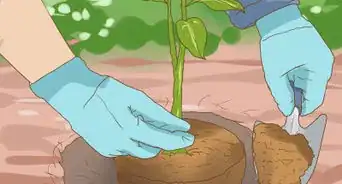
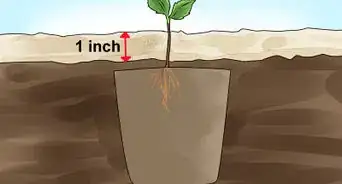
4Plant the strawberries so the tops of the root balls are 1 in (2.5 cm) below the basket rim. Give your strawberry plants plenty of room to breathe beneath the soil mixture. Ideally, arrange the plants so the roots are about 1 in (2.5 cm) beneath the edge of the basket.[21]
-
5Fill the basket just below the rim with potting mix. Top off your basket so all your strawberry plants are tucked in. Pat the soil down around the plants, keeping it about 1 in (2.5 cm) beneath the rim of your hanging basket.[22]


Method 4
Method 4 of 4:Strawberry Care
-
1Hang your strawberries in a spot that gets at least 6 hours of sunlight. Find an open, sheltered area outside your home where your plants won’t be bothered too much by the weather.[23] Look for a spot with a lot of direct sunlight, like a patio, porch, or deck, where your berries can get around 6 hours of direct sunlight each day.[24]
- Don’t hang your berries up too high—you still want bees to be able to pollinate your fruit.[25]
-
2Water the soil everyday if it’s warm outside. Strawberries love sunlight, so they need a lot of water to stay healthy. Get in the habit of watering your berries whenever it’s warm outside, so your fruit stays hydrated and well-nourished.[26]
- Try to water your fruit throughout the week. Strawberries can get pretty thirsty, and should get 1 in (2.5 cm) of water every week.[27]
-
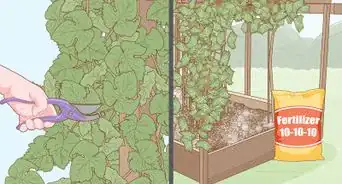
3Nourish your plants with tomato fertilizer once every other week. Drizzle liquid tomato fertilizer over the surface of your plants to help your fruit production along. Try to do this once every 2 weeks, so your strawberries get lots of nutrients.[28]
- You can find tomato fertilizer at most gardening stores.
- Strawberries work best with any kind of balanced fertilizer.[29]
-
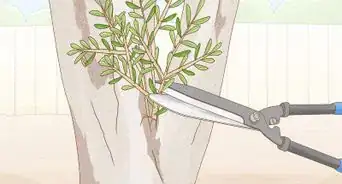
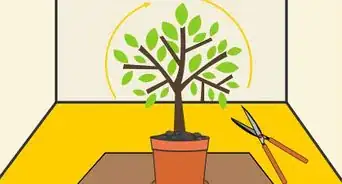
4Trim off “runners” as they grow from your basket. Keep an eye on your strawberries as they bloom, especially for any long, dangling fruits known as runners. Try to clip these off with a pair of pruning shears, so your plant isn’t overworking itself.[30]
- You can replant “runners” and grow new strawberry plants from them.[31]
-
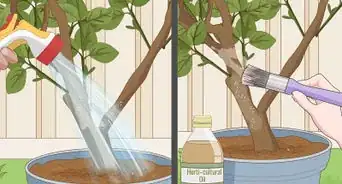
5Spritz your plants with fungicide if they develop powdery mildew. Follow the instructions on the fungicide as you spray the product on the upper and lower leaves of your strawberries. Use the spray as soon as you notice any sign of the mildew, which looks white or gray.[32]
- Day-neutral strawberries tend to get powdery mildew more than other types of strawberries.
-
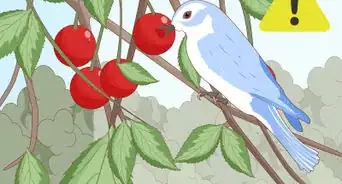
6Cover your plants with netting to protect them from birds. Unfortunately, birds tend to view hanging strawberries as free snacks. Protect your crops by draping a sheet of bird netting on top of the hanging basket, which will make it a lot harder for any feathered friends to help themselves.[33]
-
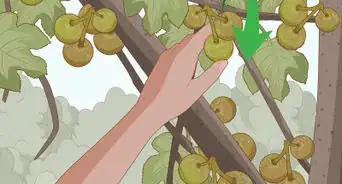
7Pluck the strawberries once they’re red. Harvest your berries as they turn ripe throughout the summer. Try to pick them in the middle of the day when it’s really warm outside, so the berries will taste extra juicy and delicious.[34]
- It’s best to eat your freshly picked strawberries right away, since they don’t store that well in the freezer.
-
8Move the baskets to a warmer area in the winter. Certain types of strawberries might last until autumn. Once the weather gets chilly, bring your strawberries inside your home, or get rid of the plant altogether.[35]
- When winter comes, you can either dump out the plant and start fresh next summer, or keep your dormant plant inside. The choice is yours![36]


Warnings
- Don’t use regular garden soil to plant your strawberries—this isn’t great for drainage.[39]Thanks!
Things You’ll Need
- Pre-planted strawberries
- Hanging basket
- Polythene lining
- Scissors
- Potting mix
- Compost
- Bucket
- Water
- Garden trowel
- Tomato fertilizer
- Pruning shears



References
- ↑ https://web.extension.illinois.edu/strawberries/growing.cfm
- ↑ https://web.extension.illinois.edu/strawberries/growing.cfm
- ↑ https://extension.umn.edu/fruit/growing-strawberries-home-garden
- ↑ https://extension.psu.edu/growing-strawberries
- ↑ https://web.extension.illinois.edu/strawberries/growing.cfm
- ↑ https://extension.umn.edu/fruit/growing-strawberries-home-garden
- ↑ https://extension.umn.edu/fruit/growing-strawberries-home-garden
- ↑ https://m.youtube.com/watch?v=MRnsEPquW5w&t=0m50s
- ↑ https://kidsgardening.org/strawberries-in-a-hanging-basket/
- ↑ https://www.gardenersworld.com/how-to/grow-plants/strawberry-hanging-basket/
- ↑ https://m.youtube.com/watch?v=MRnsEPquW5w&t=1m30s
- ↑ https://www.gardenersworld.com/how-to/grow-plants/strawberry-hanging-basket/
- ↑ https://m.youtube.com/watch?v=MRnsEPquW5w&t=1m30s
- ↑ https://davesgarden.com/guides/articles/growing-strawberries-in-a-hanging-garden
- ↑ https://abacare.org.uk/2019/06/04/gardening-grow-how-planting-strawberries-in-hanging-baskets/
- ↑ https://m.youtube.com/watch?v=MRnsEPquW5w&t=1m30s
- ↑ https://extension.psu.edu/growing-strawberries
- ↑ https://m.youtube.com/watch?v=MRnsEPquW5w&t=1m45s
- ↑ https://www.gardenersworld.com/how-to/grow-plants/strawberry-hanging-basket/
- ↑ https://m.youtube.com/watch?v=MRnsEPquW5w&t=0m50s
- ↑ https://m.youtube.com/watch?v=MRnsEPquW5w&t=2m0s
- ↑ https://m.youtube.com/watch?v=MRnsEPquW5w&t=2m9s
- ↑ https://www.gardenersworld.com/how-to/grow-plants/strawberry-hanging-basket/
- ↑ https://extension.umn.edu/fruit/growing-strawberries-home-garden
- ↑ https://www.gardenersworld.com/how-to/grow-plants/strawberry-hanging-basket/
- ↑ https://m.youtube.com/watch?v=MRnsEPquW5w&t=2m37s
- ↑ https://web.extension.illinois.edu/strawberries/growing.cfm
- ↑ https://m.youtube.com/watch?v=MRnsEPquW5w&t=2m37s
- ↑ https://extension.psu.edu/growing-strawberries
- ↑ https://savvygardening.com/growing-strawberries-in-pots/
- ↑ https://www.gardenersworld.com/how-to/grow-plants/strawberry-hanging-basket/
- ↑ http://ipm.ucanr.edu/PMG/PESTNOTES/pn7494.html
- ↑ https://m.youtube.com/watch?v=MRnsEPquW5w&t=2m35s
- ↑ https://www.rhs.org.uk/advice/grow-your-own/fruit/strawberries
- ↑ https://kidsgardening.org/strawberries-in-a-hanging-basket/
- ↑ https://www.bhg.com/gardening/container/plans-ideas/berries-in-containers/
- ↑ https://davesgarden.com/guides/articles/growing-strawberries-in-a-hanging-garden
- ↑ https://abacare.org.uk/2019/06/04/gardening-grow-how-planting-strawberries-in-hanging-baskets/
- ↑ https://www.bhg.com/gardening/container/plans-ideas/berries-in-containers/
About This Article