This article was co-authored by Steve Masley. Steve Masley has been designing and maintaining organic vegetable gardens in the San Francisco Bay Area for over 30 years. He is an Organic Gardening Consultant and Founder of Grow-It-Organically, a website that teaches clients and students the ins and outs of organic vegetable gardening. In 2007 and 2008, Steve taught the Local Sustainable Agriculture Field Practicum at Stanford University.
wikiHow marks an article as reader-approved once it receives enough positive feedback. In this case, 100% of readers who voted found the article helpful, earning it our reader-approved status.
This article has been viewed 262,358 times.
Spring onions are mild onions that can be eaten raw in salads or added to stir fries and soups to add flavour. They are similar to green onions or scallions, but they have a small bulb at the base. In some countries, such as England, all green onions are referred to as spring onions. You can grow spring onions from seeds or bulbs. Once planted it is important that you keep the soil moist and weed-free in order to help the plants grow.
Steps
Method 1
Method 1 of 3:Growing from Seeds
-
1Select an open area in your garden that receives plenty of sunlight. Spring onions do not have strict requirements for sunlight, but they do need at least partial sun in order to grow.[1]
- Alternatively, you can grow spring onions in a small pot or windowsill garden that is close to the house.
-
2Break up the soil in your garden. Spring onions thrive in loose soil that drains well. Clay-based soil or other heavy, dense soils may not work well. You can use a trowel to break up the soil on the day you sow your onions, or you can accomplish this gradually by raking over the plot every day for several weeks in advance.[2]
-
3Add a fertilizer to your soil. A week before planting the seeds, add a general fertilizer to the soil. If you are concerned about the potential effects of consuming garden chemicals, you may prefer to use an organic fertilizer. Mix the fertilizer into the soil as you break it up.[3]
-
4Test the pH of your soil. Use litmus paper or another testing kit to determine how acidic or neutral your soil is. Spring onions need a pH level ranging from 6.3 to 6.8 in order to grow.[4]
- You can drop the pH by adding manure or compost to the soil and you can raise the pH by adding lime to the soil.
-
5Plant the seeds between March and July. Spring onion seeds germinate best when the weather is moderate. Wait until after the last frost of the season, but do not procrastinate until the hottest days of summer.[5]
- Alternatively, you could plant a winter-hardy variety of spring onion in the late summer or early autumn months. These onions will take longer to grow and will be harvested in the early spring, sometime between March and May.[6]
-
6Dig shallow holes. The holes should be no more than 1⁄2 inch (1.3 cm) deep. Use your finger or a small drill to dig the hole. Place the seeds into the holes.[7]
-
7Space the seeds apart. Space the seeds approximately 2 inches (5.1 cm) apart in order to allow the onions enough room to grow and mature. If you are planting multiple rows of spring onions, there should be no less than 6 inches (15 cm) between the rows.[8]
-
8Loosely cover the seeds with soil. Once you have planted the seeds, they should be covered with about 1⁄2 inch (1.3 cm) of soil. This layer of soil will protect the seeds from the elements and natural predators, like birds.[9]
-
9Scatter the seeds. Rather than digging a small hole and planting each seed, you can scatter the seeds across the garden plot. Keep them scattered thinly, and rake them into the soil upon finishing. Cover these seeds with 1⁄2 inch (1.3 cm) of soil.[10]
- This method works because spring onions are typically harvested while they are still relatively small. This means they do not need too much room to grow.


Method 2
Method 2 of 3:Regrowing Store Bought Spring Onions
-
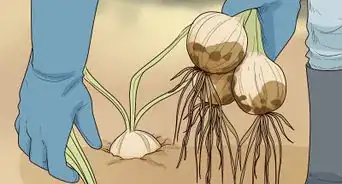
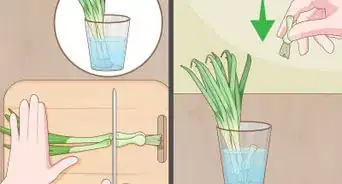
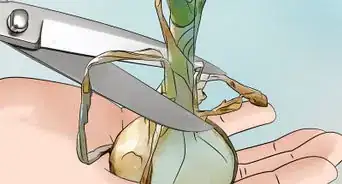
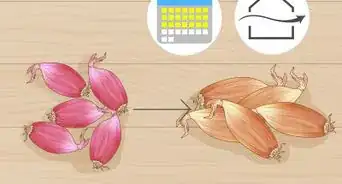
1Cut the spring onions and keep the roots. If you have purchased spring onions from the store, you can save the roots and replant them. After you have used the spring onions in your cooking, cut off the root approximately 1⁄2 inch (1.3 cm) from the end.[11]
-
2
-
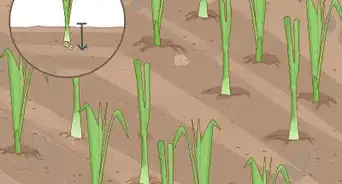
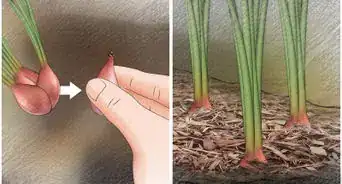
3Dig a row of small holes. The holes should be deep enough to completely cover the roots. Space the onions at least 1 inch (2.5 cm) apart.[14]
- If you are planting more than one row of onions, the rows should be no less than 6 inches (15 cm) apart.
-
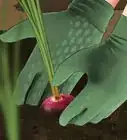
4Place one bulb into each hole. The roots should be completely covered and the sprouts should be sticking out of the soil.


Method 3
Method 3 of 3:Caring for and Harvesting Spring Onions
-
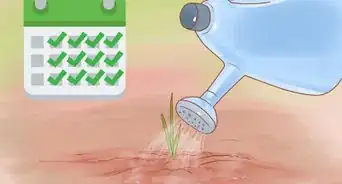
1Water the onions when the soil is dry. If you notice that the soil around the onions is dry, then you should water the area. Sprinkle your spring onions with water from a watering can or with a hose set to a light shower setting. Be careful not to overwater or water log the seeds. This can result in larger onions with a weak flavour.[15]
-
2Keep the area free from weeds. The more weeds your garden has, the more your onions will have to compete with them for nutrients and moisture. The strongest spring onions will grow in a weed-free space.[16]
- To remove weeds, pull out the roots or snip the weeds by hand instead of applying a broad chemical weed-killer.
- Alternatively, you can gently rake the soil periodically to prevent weeds from taking root.
-
3Lay mulch down. Mulch will retain moisture and prevent the soil from drying out too quickly. It also chokes many weeds, preventing them from competing for resources. Apply the mulch around your bulbs, but do not cover them completely.
-
4Apply a water soluble, liquid fertilizer as needed. Ordinarily, spring onions mature quickly enough and heartily enough to avoid fertilizer use. If the weather is particularly dry and uncooperative; however, you may need to apply a fertilizer to provide them with a boost of nutrients.
-
5Monitor your plants for pest problems. Spring onions mature quickly, so they do not suffer from pests as frequently as other onion varieties do. If you do notice pests, apply an organic pesticide to the infested crop to kill or ward them off.[17] ]
- Onion flies can be managed by spreading out your onion plants as well pushing down the soil around each plant firmly to prevent the flies from laying eggs. Another deterrent is to mix a light coating of sand with the soil.
-
6Watch for signs of disease. Spring onions do not fall victim to disease very often, but neck rot and white rot can occasionally grow on the bulbs. If these molds develop, remove the infected onions to prevent the disease from spreading to healthy ones.
- These diseases can often be mitigated or prevented by providing adequate soil drainage and rotating crops every year.
-
7Harvest spring onions after 8 weeks. Spring onions are usually ready to eat once they reach 6 inches (15 cm) in height with a thickness of about 1⁄2 inch (1.3 cm). This usually takes approximately 8 weeks, but some may take a few weeks longer.[18]
- You can allow your spring onions to continue growing past this point, but you should pull them once they reach a diameter of 1 inch (2.5 cm). Otherwise, the flavour will be weaker.
-
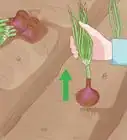
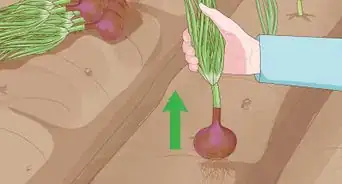
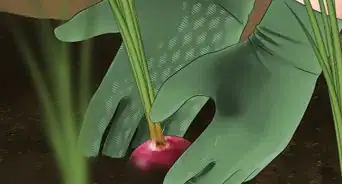
8Pull out the entire onion. Grab the onion at the base, close to the top of the soil and gently pull the onion out of the ground. Alternatively, you can use a small shovel to dig out the entire onion.[19]
- Alternatively, you can cut the tops off of the onion and leave the root planted. This way you will not actually remove the plant and the onions will continue to grow.


Community Q&A
Did you know you can get expert answers for this article?
Unlock expert answers by supporting wikiHow
-
QuestionHow do I regrow spring onions from cuttings?
 Steve MasleySteve Masley has been designing and maintaining organic vegetable gardens in the San Francisco Bay Area for over 30 years. He is an Organic Gardening Consultant and Founder of Grow-It-Organically, a website that teaches clients and students the ins and outs of organic vegetable gardening. In 2007 and 2008, Steve taught the Local Sustainable Agriculture Field Practicum at Stanford University.
Home & Garden SpecialistPlace the roots in water and wait until they start to develop new white root growth. Then, you can transfer them directly into soil.
Support wikiHow by unlocking this expert answer.
-
QuestionDo spring onions regrow?
 Maggie MoranMaggie Moran is a Professional Gardener in Pennsylvania.
Home & Garden SpecialistYes, they are easy to regrow. Simply take the bulbs with the roots attached and place them, roots down, into a small jar or cup. Place the cup in a sunny area and submerge the roots for about a week. At this point, you should start seeing regrowth.Support wikiHow by unlocking this expert answer.
-
QuestionHow long do spring onions take to grow?Maggie MoranMaggie Moran is a Professional Gardener in Pennsylvania.
Home & Garden SpecialistShoots appear within days and take, at most, two weeks to grow a shoot that can be harvested.Support wikiHow by unlocking this expert answer.
-
QuestionHow do you propagate green onions?Maggie MoranMaggie Moran is a Professional Gardener in Pennsylvania.
Home & Garden SpecialistYou take the green onion roots and put them in a glass of water that just covers the roots. Be sure to change the water every few days.Support wikiHow by unlocking this expert answer.
-
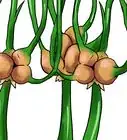
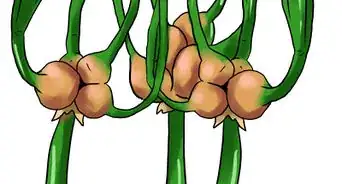
QuestionI let my spring onion go to seed and have noticed about 5 30-mm bulbs around each stalk -- are these edible?Maggie MoranMaggie Moran is a Professional Gardener in Pennsylvania.
Home & Garden SpecialistYes, spring onions are edible. Though you let these seed themselves and grow bulbs, they are just as good as ones you intended to grow.Support wikiHow by unlocking this expert answer.
-
QuestionHow much phosphate does spring onion need?
 Community AnswerBe very careful using phosphate or nitrogen. You could end up with all green and no onion bulb or sending them to seed way too early. If you do use it, apply only a very small amount.
 -
QuestionHow long do spring onions take to germinate?
 Community AnswerAll types of onion seeds can take up to 10 days. Some varieties, a bit longer. Don't try to hurry them up by applying warmth, as in a heated germinator. Cool germination is much better.
 -
QuestionCan spring onions be planted in water on top of pebbles in a glass jar in the windowsill?Community AnswerSpring onions should be planted in dirt. Your method includes too much water.
-
QuestionI planted onion sets last autumn and this spring they looked like smaller 'spring onions', is that what 'spring onions 'are? Or are they a particular variety and should I eat mine or not?Community AnswerThey should look like small green stalks, similar to a green onion or scallion.
-
QuestionWhat is the harvesting period after sowing?Community AnswerThe old wives tale is plant on the coldest day of the year and harvest before the hottest day of the year. In other words, plant your onions soon as the climate/soil is cool enough and harvest before the heat of summer.
Warnings
- Be mindful about any chemicals you put on your spring onions. Many fertilizers and pesticides can be harmful if consumed, which may make them unsafe to use on crops you plan to eat.Thanks!
Things You'll Need
- Rake
- Trowel
- Fertilizer
- Litmus paper or pH tester
- Compost or manure
- Agricultural lime
- Spring onion seeds
- Spring onion roots
- Watering can or hose
- Mulch


References
- ↑ http://www.gardenhealth.com/how-to-grow-spring-onions
- ↑ https://www.quickcrop.co.uk/learning/plant/spring-onion
- ↑ https://www.quickcrop.co.uk/learning/plant/spring-onion
- ↑ http://www.no-dig-vegetablegarden.com/growing-spring-onions.html
- ↑ http://www.no-dig-vegetablegarden.com/growing-spring-onions.html
- ↑ https://www.quickcrop.co.uk/learning/plant/spring-onion
- ↑ http://www.no-dig-vegetablegarden.com/growing-spring-onions.html
- ↑ http://www.no-dig-vegetablegarden.com/growing-spring-onions.html
- ↑ http://www.no-dig-vegetablegarden.com/growing-spring-onions.html
- ↑ https://www.quickcrop.co.uk/learning/plant/spring-onion
- ↑ http://www.greeningofgavin.com/2013/06/how-to-regrow-spring-onions.html
- ↑ Steve Masley. Home & Garden Specialist. Expert Interview. 20 March 2019.
- ↑ http://www.greeningofgavin.com/2013/06/how-to-regrow-spring-onions.html
- ↑ http://www.greeningofgavin.com/2013/06/how-to-regrow-spring-onions.html
- ↑ http://www.no-dig-vegetablegarden.com/growing-spring-onions.html
- ↑ http://www.gardenhealth.com/how-to-grow-spring-onions
- ↑ http://www.no-dig-vegetablegarden.com/growing-spring-onions.html
- ↑ http://www.no-dig-vegetablegarden.com/growing-spring-onions.html
- ↑ http://www.no-dig-vegetablegarden.com/growing-spring-onions.html
About This Article

If you want to grow spring onions from seeds, select an open area in your garden that receives plenty of sunlight and break up the soil well. Test the soil to ensure it’s between 6.8 and 6.8, and use additives to adjust the soil if it’s out of range. A week before planting the seeds, add a general fertilizer to the soil and mix it in. Plant the seeds in 1/2-inch deep holes between March and July, and water the onions whenever the soil is dry. Harvest your spring onions after 8 weeks. For tips from our horticulture reviewer on regrowing store-bought onions, read on!