This article was co-authored by wikiHow staff writer, Jessica Gibson. Jessica Gibson is a Writer and Editor who's been with wikiHow since 2014. After completing a year of art studies at the Emily Carr University in Vancouver, she graduated from Columbia College with a BA in History. Jessica also completed an MA in History from The University of Oregon in 2013.
There are 9 references cited in this article, which can be found at the bottom of the page.
This article has been viewed 7,226 times.
Learn more...
You don't need a green thumb to grow a healthy mint plant. Because it grows quickly and is so resilient, it's perfect for a beginner gardener. In fact, you may end up with too much mint since it spreads so easily! To help you get started with your own fresh mint plant, check out our answers to the most common questions about mint propagation.
Steps
Question 1
Question 1 of 7:How do you take a mint cutting?
-
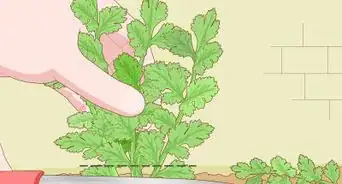
1Cut a 3 to 4 in (7.6 to 10.2 cm) piece of mint. You can get a cutting from a friend or cut a stem from a mint that you already have. Just be sure to use a healthy stem that has bright green leaves on it. Cut the stem just below a node which is where the plant branches off. Then, trim off all of the leaves near the bottom and leave around 5 or 6 at the top.[1]
- If your cutting has too many leaves, it will take longer for the cutting to start growing roots since it's putting its energy into all of those leaves.
Advertisement

Question 2
Question 2 of 7:Can you use store-bought mint?
-
1Of course—store-bought mint works just fine! The key thing is that you use a mint cutting that's healthy. The stem should be vibrant and green while the leaves shouldn't be dried or blackened.[2]
- If you know you're going to be growing mint from some of your store-bought mint, why not get the cutting started as soon as you bring it home? You can enjoy the mint leaves that you trim off of the cutting and you won't accidentally use up all of your mint before you start the cutting.

Question 3
Question 3 of 7:How do you root a mint cutting?
-
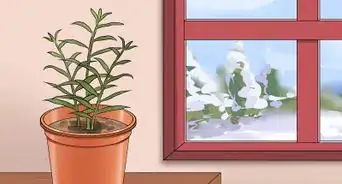
1Put the cutting into a glass of cool water. Stick the cutting into the water so the bottom 2 inches (5.1 cm) are submerged. The water keeps the cutting from drying out so roots can start growing.[3]
- Use a clear glass so you can easily see when the plant begins to grow roots.
-
2Set the glass in a sunny spot and let the roots grow for 1 to 2 weeks. Place your glass of water in a sunny window and change the water every day so the stem stays healthy. Check your cutting every few days to watch for tiny white roots growing from the bottom.[4]
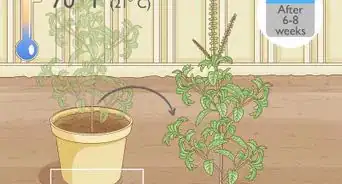
- Mint really likes temperatures between 55 and 70 °F (13 and 21 °C). Place your cutting in a warm room, patio, or garage so it grows quickly.
-
3Plant your mint cutting in soil so a new plant can grow. When you see small, white roots coming from the base of the stem, you know it's time to plant! Fill a plant pot with peat-free multipurpose compost or potting soil. Then, use your fingers to make a 2 in (5.1 cm) deep hole and put your cutting into it. Fill in the hole with soil and press down gently. Give your plant a drink of water and let it grow![5]
- Don't forget that your mint loves sunshine. Put your plant pot in a sunny spot in your house or set it outside where it will get lots of natural sunlight.
Advertisement


Question 4
Question 4 of 7:How often should I water my mint plant?
-
1Water your new plant whenever the soil starts to feel dry. To check, use your finger to dig into the soil around the mint. If it feels like it's drying out, water the plant until the soil is moist. If it still feels moist, wait a day or two and check the soil again.[6]
- If your plant is in a container, the pot should have drainage holes so excess water won't be trapped. If there's too much water around the roots, they can rot.

Question 5
Question 5 of 7:How deep will the mint's roots go?
-
1Mint roots grow 12 to 18 inches (30 to 46 cm) deep! The roots also spread if you plant a cutting directly into the ground and new plants can quickly take over the space. This is why it's important to put the mint cutting into a container. Choose a pot that's around 12 inches (30 cm) tall so the roots have room to grow.[7]
- To give your mint plants space to grow, plant the cuttings 2 to 3 inches (5.1 to 7.6 cm) apart in rows that are 18 to 24 inches (46 to 61 cm) apart.
Advertisement

Question 6
Question 6 of 7:Do I have to transplant the mint cutting to soil?
-
1No—you can grow the cutting in water until it stops putting on growth. If you love the look of plants growing in water or you just don't want to mess with soil, you can leave the cutting to grow in the water. Just change the water every day so the mint stays healthy. The mint will stop growing, though, so pay attention to yellowing leaves or stems. This means it's time to grow a new cutting or transfer your cutting to soil.[8]
- This is a cool way to grow a small amount of mint, especially if you've got space in a kitchen window and want a little herb garden.

Question 7
Question 7 of 7:Why is my mint cutting not growing?
-
1It may not grow if the cutting wasn't healthy to begin with. Look at the leaves of the cutting and the original mint plant, if you still have it. If you spot rust- or orange-colored patches, the plant might have mint rust. This is a fungal disease that can easily spread to other plants. If your cutting has mint rust, it won't put on healthy growth.[9]
- The best thing you can do is to start with a new, healthy stem.
-
2The stem might be rotting because the water needs to be changed. It's super important to change the water in the cutting glass every single day. If you don't, the water can turn cloudy as bacteria grow. This bacteria can sicken the mint stem so it starts looking dark or slimy. If this happens, you've got to start with a healthy cutting and a new glass of water.
- You don't need to use fancy water—tap water is fine as long as it's fresh!
Advertisement


Warnings
- Mint can spread quickly in your garden—some gardeners consider it to be invasive! If you don't want the mint taking over your other plants, plant your cutting in a container instead of in a garden bed.[10]Thanks!


References
- ↑ https://www.gardeningpatch.com/herbs/growing-mint//
- ↑ https://youtu.be/ftls90A6f4Y?t=28
- ↑ https://www.gardenersworld.com/how-to/grow-plants/how-to-grow-mint-from-cuttings/
- ↑ https://youtu.be/dqh3DH_JRKU?t=131
- ↑ https://www.gardenersworld.com/how-to/grow-plants/how-to-grow-mint-from-cuttings/
- ↑ https://www.thekitchn.com/everything-you-need-to-know-about-growing-mint-220865
- ↑ http://celosangeles.ucanr.edu/files/121762.pdf
- ↑ https://youtu.be/W5oCcgGixR0?t=347
- ↑ https://www.gardeningpatch.com/herbs/growing-mint/
About This Article