This article was co-authored by Rachel Guffey and by wikiHow staff writer, Hannah Madden. Rachel Guffey is a Plant Specialist and the Owner of Jungle House, a house plant shop based in Lawrence, Kansas. She specializes in plant education and caring for indoor plants. Rachel is passionate about using plants to help combat seasonal depression. She aims to make plants feel more accessible and approachable to everyone. Rachel has owned over 500 plants at one time.
wikiHow marks an article as reader-approved once it receives enough positive feedback. This article received 21 testimonials and 100% of readers who voted found it helpful, earning it our reader-approved status.
This article has been viewed 262,704 times.
If you’re looking for a large, foliage-rich houseplant, a fern is the right choice for you. With so many different species and varieties, you can pick any fern under the sun! Keeping ferns happy and healthy indoors isn’t tough, especially if you take note of their water, sunlight, and soil needs.
Steps
Method 1
Method 1 of 9:Pick a pot slightly larger than the fern’s root mass.
-
1You’ll want a plastic or clay pot with a drainage hole at the bottom. Ideally, your fern should have about 1 in (2.5 cm) of extra space. Measure your fern’s root mass and pick a pot just a little bit bigger than that. You’ll need to size up your pots as your fern gets bigger, so plan on making a few purchases over time.[1]
- While it’s often thought that a larger pot will give room for a small plant to grow, that’s actually not the case. Planting your fern in a pot that’s too large can cause the roots to get waterlogged.
- If you find a pot that you love but it doesn’t have a drainage hole, use a drill with a masonry bit to make a hole dead center in the bottom of the pot.
Advertisement

Method 2
Method 2 of 9:Fill the pot with organic soil containing peat moss.
-
1Look for a light, well-draining potting soil. Make sure it’s heavy on the peat moss, since that’s what will give your ferns a lot of nutrients. You can find great potting soil at most garden supply stores.[2]
- Ferns don’t need a ton of extra maintenance, so there’s no need to mix in compost or fertilizer before potting.
- Floor-growing ferns like to be planted in peat moss-rich mixture.[3]

Method 3
Method 3 of 9:Water your fern when the top of the soil is dry.
-
1Different fern species have different water needs. Most need to stay consistently moist to grow well. A good rule of thumb is to feel the soil before watering: if the soil is dry, it needs more water. If the soil is still wet, don’t water it just yet.[4]
- Boston Ferns need water whenever the soil gets dry, while Maidenhair and Button Ferns need to be watered every day. If you aren’t sure about your fern type, try looking up the specific species you have.
- Consider using distilled water to care for your ferns if your tap water is naturally hard.[5]
Advertisement

Method 4
Method 4 of 9:Keep the temperature between 60 and 72 °F (16 and 22 °C).
-
1Ferns prefer moderate temperatures that don’t fluctuate often. During the day time, try to keep your home around 72 °F (22 °C). At night, you can turn the temperature down to as low as 60 °F (16 °C).[6]
- If your home is consistently on the warmer side, you may need to water your fern more often.

Method 5
Method 5 of 9:Use a humidifier to keep the humidity above 50%.
-
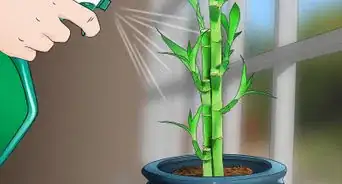
1Ferns are tropical plants, so they prefer high humidity. Set up a humidifier near your fern so it can get the moisture that it needs throughout the day.[7] You can also add moisture to your ferns by placing the pots in a tray filled with gravel. Pour about 1⁄4 in (0.64 cm) of water into the tray and refill it whenever it dries out.[8]
- You could also keep your fern in a room with plenty of running water, like a bathroom or kitchen.[9]
Advertisement

Method 6
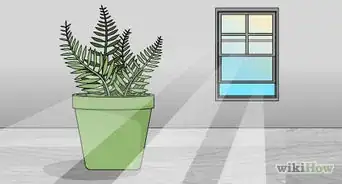
Method 6 of 9:Place the fern in an east-facing window.
-
1Direct sunlight can dry out your fern. An ideal spot for your fern is near an east-facing window; if that’s not an option, you can place it a few feet away from a west- or south-facing window instead. If you notice the leaves on your fern turning brown or dying, they might be getting too much sun.[10]
- You can filter the light from your windows with blinds, curtains, or outdoor foliage.
- In general, bright indirect to medium light is best for your fern.[11]

Method 7
Method 7 of 9:Fertilize your fern during the winter.
-
1Use a liquid houseplant fertilizer to encourage winter growth. Take a look at the bottle to see what the dosage recommendation is, then use about half of that amount. During the fall, summer, and spring, ferns don’t need to be fertilized.[12]
- If you’ve planted or repotted your fern within the last 6 months, don’t fertilize it just yet.
- When in doubt, go easy on the fertilizer. Adding too much can kill your ferns.
Advertisement

Method 8
Method 8 of 9:Spray pests off your fern with water.
-
1Scale, mealybugs, and spider mites are common fern pests. If you notice them, you can either pick them off by hand or blast the leaves with some water to remove them. If the pests are still a problem, try dipping a cotton swab in rubbing alcohol, then carefully wiping down the leaves of your fern.[13]
- If you notice fungus or fungal mites on the base of your plant, you might be watering your fern too much. Waterlogged roots can cause rot, which attracts fungus and fungal pests.

Method 9
Method 9 of 9:Divide and repot your fern every 2 or 3 years.
-
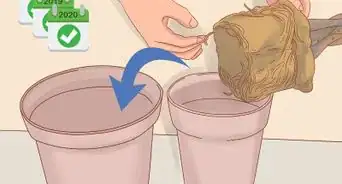
1Your fern will outgrow its original pot that you planted it in. When you notice that growth has stopped, carefully uproot your fern and use a sharp knife to divide the root mass into 2 or 3 bundles. Give each bundle its own pot, picking one that’s about 1 in (2.5 cm) larger than the root mass.[14]
- You can also transplant your fern outside once it gets too large for its pot.
Advertisement

Community Q&A
-
QuestionWhat's the best way to water indoor ferns?
 Mark LeahyMark Leahy is a Plant Specialist based in the San Francisco Bay Area. He is the Co-Owner of Bella Fiora, a custom design floral studio, and SF Plants, a plant shop and nursery. Mark specializes in floral artistry and indoor plants including floral arrangements, terrace planters, office plantscapes, and living walls. Mark and his business partner have been featured in Vogue, The Knot, Today’s Bride, Wedding Wire, Modern Luxury, San Francisco Bride Magazine, San Francisco Fall Antique Show, Black Bride, Best of the Bay Area A-List, and Borrowed & Blue.
Plant SpecialistWhat I do is actually dunk all my ferns into water without getting the leaves wet. I just lift up the leaves and dunk the nursery pot just below the water, hold it, see the bubbles go up, and then take it out. That way I know it's watered thoroughly. -
QuestionHow often should I water my fern?Mark LeahyMark Leahy is a Plant Specialist based in the San Francisco Bay Area. He is the Co-Owner of Bella Fiora, a custom design floral studio, and SF Plants, a plant shop and nursery. Mark specializes in floral artistry and indoor plants including floral arrangements, terrace planters, office plantscapes, and living walls. Mark and his business partner have been featured in Vogue, The Knot, Today’s Bride, Wedding Wire, Modern Luxury, San Francisco Bride Magazine, San Francisco Fall Antique Show, Black Bride, Best of the Bay Area A-List, and Borrowed & Blue.
Plant SpecialistI would say every 5 days or so, depending on the environment of your home. You don't want to let them dry out completely. -
QuestionWhat kind of lighting do indoor ferns prefer?Mark LeahyMark Leahy is a Plant Specialist based in the San Francisco Bay Area. He is the Co-Owner of Bella Fiora, a custom design floral studio, and SF Plants, a plant shop and nursery. Mark specializes in floral artistry and indoor plants including floral arrangements, terrace planters, office plantscapes, and living walls. Mark and his business partner have been featured in Vogue, The Knot, Today’s Bride, Wedding Wire, Modern Luxury, San Francisco Bride Magazine, San Francisco Fall Antique Show, Black Bride, Best of the Bay Area A-List, and Borrowed & Blue.
Plant SpecialistFerns can work in a bright room away from a window or in a room with moderate lighting. -
QuestionWhy does the soil my fern is in have white stuff on top? Should I be concerned about that?
 wikiHow Staff EditorThis answer was written by one of our trained team of researchers who validated it for accuracy and comprehensiveness.
Staff AnswerwikiHow Staff EditorStaff AnswerIf your potting soil has added nutrients in it, the white pieces could be small bits of perlite. If the white stuff wasn't there when you planted your fern, though, it could be mildew. Make sure you aren't overwatering your fern, and let the soil dry out before you water it again. -
QuestionHow do I get rid of white flies on my fern?wikiHow Staff EditorThis answer was written by one of our trained team of researchers who validated it for accuracy and comprehensiveness.
Staff AnswerwikiHow Staff EditorStaff AnswerTry using an insecticidal soap or Neem oil to get rid of the pests. You can also swipe them off with a cotton swab dipped in rubbing alcohol. -
QuestionWhy are the leaves falling off my fern?wikiHow Staff EditorThis answer was written by one of our trained team of researchers who validated it for accuracy and comprehensiveness.
Staff AnswerwikiHow Staff EditorStaff AnswerIt could be a few things: lack of water, too much sunlight, not enough humidity, or simply old age. Make sure that your fern gets plenty of water and isn't drying out throughout the day. If that doesn't work, your fern might just be reaching the end of its life. -
QuestionCan I place decorative stones on top of pots around fern fronds?
 Community AnswerYes you can, you just need to be careful that they are not so close together, because when you go to water the ferns, the water will just go down the stone and underneath them. So just be careful to spread them out so that they are even, and it's roomy for the fern.
 -
QuestionWhat should I do with the long, stringy part of the plant?
 Community AnswerIf it's what is called a runner, you can mound a small amount of soil over it and it will grow a new plant. You can then cut it from original plant if you want to start it in a new pot (or just leave it be).
 -
QuestionIf grown indoors ferns may produce spores which are allergens and may cause cough and asthma. Is this true?Community AnswerWhile ferns do produce spores, what you describe is extremely uncommon. Ferns are actually known for helping to purify the air indoors.
-
QuestionI have a nephrolepis. Does it need any special treatment, because it is slowly losing it leaves?
 Community AnswerKeep it out of direct sunlight. Ferns get filtered light on the bottom of the forest floor, and too much light can kill a fern. If the leaves are brown, it doesn't have enough water. If the leaves are yellow, it's getting too much water.











References
- ↑ https://extension.unh.edu/blog/do-ferns-make-good-houseplants
- ↑ https://extension.unh.edu/blog/do-ferns-make-good-houseplants
- ↑ Rachel Guffey. Plant Specialist. Expert Interview. 5 August 2021.
- ↑ https://ag.purdue.edu/hla/pubs/HO/HO-141.pdf
- ↑ Rachel Guffey. Plant Specialist. Expert Interview. 5 August 2021.
- ↑ https://ag.purdue.edu/hla/pubs/HO/HO-141.pdf
- ↑ Rachel Guffey. Plant Specialist. Expert Interview. 5 August 2021.
- ↑ https://ag.purdue.edu/hla/pubs/HO/HO-141.pdf
- ↑ Rachel Guffey. Plant Specialist. Expert Interview. 5 August 2021.
- ↑ https://extension.umn.edu/houseplants/tropical-ferns#light-1425560
- ↑ Rachel Guffey. Plant Specialist. Expert Interview. 5 August 2021.
- ↑ http://www.ladybug.uconn.edu/FactSheets/ferns.php
- ↑ http://www.ladybug.uconn.edu/FactSheets/ferns.php
- ↑ http://www.ladybug.uconn.edu/FactSheets/ferns.php
About This Article