X
This article was co-authored by Maggie Moran. Maggie Moran is a Professional Gardener in Pennsylvania.
This article has been viewed 26,459 times.
Dill is an annual leafy herb which can be added to many savory dishes—especially soups and stews—for extra flavor. Like many herbs, dill can be grown indoors relatively easily. Dill can thrive in potting containers or pots, as long as it’s grown in the proper conditions and not overheated. Plant dill seeds in spring, so that the plants can grow in warm, sunny weather. Prior to planting your dill, purchase dill seeds, a deep pot or planter, well-draining soil, and multi-purpose compost from your local plant nursery or home and garden store.
Steps
Part 1
Part 1 of 3:Planting Dill Seeds
Part 1
-
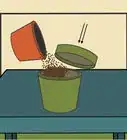
1Fill a pot or planter with well-draining soil. Dill thrives in nutrient-rich soil that drains well and will not form puddles. Select a pot or planter with holes in the bottom (so the soil can drain well), and fill it at least ¾ full with soil. The pot or planter should be deep, at least 10 inches (25 cm), to give the dill’s deep roots enough room to expand.[1]
- You can purchase planting soil at a local plant nursery or hardware store.
- When grown in the outdoors, dill can stand fairly poor soil.
-
2Mix a multi-purpose potting compost into the soil. Compost will give the sprouting dill seeds much-needed nutrition, and help them grow well and produce plenty of leaves. Use a trowel or your hands to mix the compost and soil together in the pot or planter before adding the seeds.[2]
- You can purchase potting compost at a local plant nursery.
Advertisement -
3Plant dill seeds from 3⁄4–1 in (1.9–2.5 cm) deep. Dill seeds should not be planted deeply. Use your finger to press each individual dill seed into the soil in your pot. Then run your fingers or a small hand-held rake through the soil, so that the dill seeds are lightly covered with soil.[3]
-
4Plant multiple seeds 12–15 inches (30–38 cm) from one another. If you’re planning to plant multiple dill seeds, give each one plenty of space so that the stalks and branches of the full-grown plants don’t become entangled. Due to this large distance, you’ll need a large planter if you’d like to grow several dill plants.[4]
- Dill should sprout in 10-14 days. Once the seeds have started to sprout, do not replant the dill plants.
Advertisement


Part 2
Part 2 of 3:Maintaining the Growing Dill
Part 2
-
1Keep the dill plants around 70 °F (21 °C). When grown indoors, dill plants prefer temperatures on the cool side. So, adjust your indoor thermostat so that the temperatures hover around the low 70s.[5]
- Dill plants may wilt and die if left in high temperatures for too long.
-
2Locate the pot so the dill receives 5-6 hours of direct sun each day. Dill thrives in full sunlight. Place the plant in a south-facing window, or on a porch or patio that receives full sun for several hours a day.[6]
- If left for weeks without enough sunlight, the dill will wither.
-
3Insert a wooden stake near the base of the dill plant. As the dill grows, its stalk may not be strong enough to support the plants own weight. Help the plant by placing a stake in the soil near its base once the plant is about 1 foot (0.30 m) tall. Over time, the dill will grow around the stake.[7] Purchase a stake at a local hardware store or plant nursery.
- The stake doesn’t have to be made from any special material. A dowel would suffice, as would any firm piece of wood at least 2 feet (0.61 m) tall.
-
4Water the dill plants at the soil level twice per week. If the soil feels dry, water the plant until water runs into the dish beneath the pot or planter. Water by pouring the water directly onto the soil from a height of 2–3 inches (5.1–7.6 cm). This becomes important once the dill stalk reaches 2 feet (0.61 m), because the leaves could mildew if watered from overhead.[8]
- To see if the dill needs watering, press your finger into the soil: it should be damp, but not muddy or soaking wet.
Advertisement


Part 3
Part 3 of 3:Harvesting Dill
Part 3
-
1
-
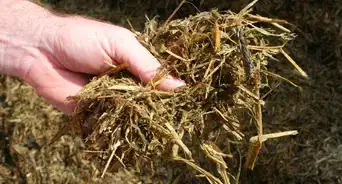
2Snip the dill weed leaves off of the plant. Use a pair of sharp household scissors to cut the leafy, edible part off of the stem.[11] The edible part of the dill plant is the feathery, light leaves. You can harvest as much of the dill at once as you like, since taking a large harvest won’t damage the plant. Once the leaves are harvested, use the scissors to cut the dill leaves up as finely as you like.
- If you don’t have sharp scissors, you can use your thumb and index finger to pinch the leafy parts of the dill off of the stems.
- While dill seeds are edible, they’re used for different culinary purposes than the leaves.
-
3Eat the dill or store it in an airtight container. Unlike many other herbs, fresh dill and dried dill have markedly different tastes.[12] If you prefer the taste of fresh dill, only harvest as much as you’ll eat over the span of a few days. If you plan to store some dill, keep it in an airtight container like a plastic bag. This will maintain the herb’s fresh flavor. Fresh dill will keep for a period of 2 weeks.[13]
- Dried dill is also commonly stored in a small glass jar and kept in the household spice drawer or spice rack.
Advertisement


Community Q&A
-
QuestionIs it easy to grow dill?
 Maggie MoranMaggie Moran is a Professional Gardener in Pennsylvania.
Home & Garden SpecialistYes, it is a very easy plant to reseed itself. It can be started indoors and easily moved outside in about 4-6 weeks, but it is best grown in one place. -
QuestionHow do you cut fresh dill from the plant?Maggie MoranMaggie Moran is a Professional Gardener in Pennsylvania.
Home & Garden SpecialistIt is best to use kitchen shears to cut off the leaves of the plant. After seeding, it is suggested to give it a few weeks to stabilize and grow. -
QuestionIs dill an annual or a perennial?Maggie MoranMaggie Moran is a Professional Gardener in Pennsylvania.
Home & Garden SpecialistIt is a warm season herb, and is a biennial, as a single plant only lives 2 years. -
QuestionWhat can you plant dill with?Maggie MoranMaggie Moran is a Professional Gardener in Pennsylvania.
Home & Garden SpecialistDIll will help asparagus to grow and can also be planted with the various Brassicas plants as well as things like corn, lettuce, and onion. -
QuestionHow many dill seeds do I plant per pot?
 League of HunterCraft (T3K)Community AnswerI usually do 3-5 and end up with 2-4 plants. It also depends on how big the pot is. Just plant and thin them out if you want less than what sprouted.
 -
QuestionAfter I harvest the leafy part of the dill plant, do I cut down the stems?League of HunterCraft (T3K)Community AnswerYou can; as long as the meristem is undamaged, the plant should continue to grow.
Things You’ll Need
- Dill seeds
- Well-draining soil
- Pot or planter
- Multi-purpose compost
- Trowel
- Small rake (optional)
- Stake
- Scissors

References
- ↑ https://agrilifeextension.tamu.edu/browse/featured-solutions/gardening-landscaping/dill/
- ↑ https://www.rhs.org.uk/advice/grow-your-own/herbs/dill
- ↑ https://agrilifeextension.tamu.edu/browse/featured-solutions/gardening-landscaping/dill/
- ↑ https://agrilifeextension.tamu.edu/browse/featured-solutions/gardening-landscaping/dill/
- ↑ https://agrilifeextension.tamu.edu/browse/featured-solutions/gardening-landscaping/dill/
- ↑ https://agrilifeextension.tamu.edu/browse/featured-solutions/gardening-landscaping/dill/
- ↑ https://agrilifeextension.tamu.edu/browse/featured-solutions/gardening-landscaping/dill/
- ↑ https://www.westcoastseeds.com/how-to-grow-guides/grow-dill/
- ↑ https://www.almanac.com/plant/dill
- ↑ https://agrilifeextension.tamu.edu/browse/featured-solutions/gardening-landscaping/dill/
- ↑ https://www.almanac.com/plant/dill
- ↑ https://www.westcoastseeds.com/how-to-grow-guides/grow-dill/
- ↑ https://www.seriouseats.com/2015/04/the-best-way-to-store-fresh-herbs-parsley-cilantro-dill-basil.html
- ↑ https://agrilifeextension.tamu.edu/browse/featured-solutions/gardening-landscaping/dill/
- ↑ https://www.richters.com/show.cgi?page=MagazineRack/Articles/GrowingHerbsIndoors.html
- ↑ https://www.richters.com/show.cgi?page=MagazineRack/Articles/GrowingHerbsIndoors.html
About This Article

Maggie Moran
Home & Garden Specialist
This article was co-authored by Maggie Moran. Maggie Moran is a Professional Gardener in Pennsylvania. This article has been viewed 26,459 times.
Co-authors: 3
Updated: November 3, 2020
Views: 26,459
Categories: Harvest and Storage
Advertisement