wikiHow is a “wiki,” similar to Wikipedia, which means that many of our articles are co-written by multiple authors. To create this article, volunteer authors worked to edit and improve it over time.
There are 7 references cited in this article, which can be found at the bottom of the page.
Learn more...
Coneflowers, also known as Echinacea, are perennial flowers that are native to prairies and meadows in North America. They come in a variety of colors, purple being the most well-known, and are known for attracting pollinators like butterflies, bees, and birds. They’re quite hardy, and don’t need a whole lot of special care to thrive on their own, so they’re great for any experience level in gardening. Looking to grow some? We’ve compiled a list of tips to get you started.
Steps
Method 1
Method 1 of 2:Planting Coneflowers
-
1Plant coneflowers during spring or early summer. Coneflowers are generally in bloom from mid summer all the way through fall. You should start planting before then, depending on the maturity of your flowers: spring or early summer if they already have blooms on the way (i.e. if you bought them grown from a nursery) and spring if they’re still seeds.[1]
-
2Give them a spot in the sun. These flowers thrive in direct sunlight, and are known for being heat and drought resistant. Make sure they’re getting plenty of light to prevent floppy stems and mildew.[2]
-
3Choose a spot with well-drained soil and add a layer of compost. Coneflowers aren’t picky when it comes to soil, but they do best with well-drained (not overly wet) soil that’s rich in organic matter. Loosen up some regular soil with a garden fork, get down to about 12 inches (30 cm)-13 inches (33 cm) deep, and mix in a 2 inches (5.1 cm)-4 inches (10 cm) layer of compost before planting.[3]
-
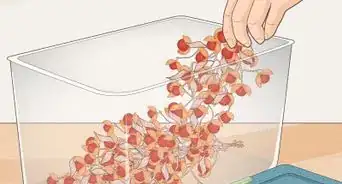
4Sow coneflower seeds less than 1 inch (2.5 cm) underground. If you’re starting coneflowers from seeds, they can be planted pretty close to the surface. However, they need plenty of space to grow, so place seeds 18 inches (46 cm) apart from each other.[4]
- If the space between them seems like a lot, keep in mind that they’re clumping plants, meaning they propagate pretty quickly. Where you plant just one seed will eventually be a cluster of flowers.[5]
-
5Bury transplanted coneflowers up to the top of their roots. Just make sure the root ball is level with the soil’s surface so it’s firmly in the ground. Additionally, the hole’s width should be twice that of its original pot to let the root system spread out. Just like the seeds, these should be placed about 18 inches (46 cm) apart from each other.[6]
-
6Put coneflowers in a 2 gallons (7.6 l)-3 gallons (11 l) pot. Coneflowers are long above ground and even longer below ground. Depending on the species, their root systems can require up to 6 feet (1.8 m)! If you’re planning on putting it in a container, accommodate for the space it needs accordingly.[7]
- Make sure the container has a hole (or holes) for water drainage at the bottom. Remember, coneflowers need well-drained soil.
- The container’s material doesn’t matter as much as its size. Coneflowers can handle heat, so even metal is fine.
-
7Plant them with other prairie plants. If you’re wondering what other flowers and plants you should have surrounding your coneflowers, consider what they grow with in nature. Other meadow perennials, like goldenrods and asters, or even long grasses, could compliment them nicely.[8]


Method 2
Method 2 of 2:Caring for Coneflowers
-
1Water your flowers once a week. Coneflowers thrive in medium to dry soil. 1 inch (2.5 cm) of water a week should suffice for most species, since they’re built for tolerating a bit of drought.[9] Some species, like hybrids, may need a little extra to live up to their fullest potential.[10]
- Water them at their base. Watering top-down onto its leaves can encourage unhealthy fungal growth.[11]
-
2Spray them with neem oil to remove pests. Coneflowers’ spiny stems protect them from deer and other large animals, but insects like aphids can still cause problems. Neem oil, which can be bought as a spray, is an effective and natural insecticide you can lightly spread onto the surface of the flower.[12]
-
3Mulch over the plant’s base when it gets cold. Cover the crown of your flower, or where the stem meets the roots, in a 6 inches (15 cm) layer of chopped leaves. This will help retain the soil’s moisture and improve its fertility, while also discouraging weed growth.[13]
-
4Deadhead your flowers before summer. “Deadheading” is a term for snipping a flower that’s already bloomed so it doesn’t devote energy to setting seeds and instead uses that energy to produce more flowers. This can be done in late winter and early spring, before the next blooming period. Use trimmers to cut it at its base, just above the first leaf, so it regrows its entire body.[14]
- This is optional for perennials like coneflowers, which live for a long time, but can encourage the plant to produce fresher blooms more consistently.






References
- ↑ https://www.almanac.com/plant/coneflowers
- ↑ https://www.gardenista.com/posts/gardening-101-coneflowers-echinaceas-plant-care-growing-guide-perennials/
- ↑ https://www.almanac.com/plant/coneflowers
- ↑ https://gardenerspath.com/plants/flowers/guide-growing-echinacea/
- ↑ https://www.gardenia.net/plant-variety/echinacea-coneflowers
- ↑ https://www.almanac.com/plant/coneflowers
- ↑ https://gardenerspath.com/plants/flowers/grow-coneflowers-containers/
- ↑ https://www.washingtonpost.com/lifestyle/2021/05/27/coneflower-echinacea-how-to-grow/
- ↑ https://gardenerspath.com/plants/flowers/guide-growing-echinacea/
- ↑ https://www.gardenista.com/posts/gardening-101-coneflowers-echinaceas-plant-care-growing-guide-perennials/
- ↑ https://www.almanac.com/plant/coneflowers
- ↑ https://www.almanac.com/plant/coneflowers
- ↑ https://www.almanac.com/plant/coneflowers
- ↑ https://www.gardenista.com/posts/landscaping-101-how-to-deadhead-flowers-annuals-perennials/