wikiHow is a “wiki,” similar to Wikipedia, which means that many of our articles are co-written by multiple authors. To create this article, 46 people, some anonymous, worked to edit and improve it over time.
There are 10 references cited in this article, which can be found at the bottom of the page.
wikiHow marks an article as reader-approved once it receives enough positive feedback. In this case, 92% of readers who voted found the article helpful, earning it our reader-approved status.
This article has been viewed 580,457 times.
Learn more...
If you're looking for an easy-to-grow plant with luscious fruit, look no further than the citrus! Citrus trees are relatively easy to grow, provided that you have a warm enough climate. Even if your conditions are not ideal, there may still be a citrus tree for you. Read on about how to grow an assortment of citrus fruits after the jump.
Steps
-
1Choose a location for your tree. A warm, sunny, southern or western exposure is best. Shelter is a big help, too, if cold is a concern. Choose or create someplace with well-drained soil, and avoid putting a citrus tree directly into a lawn. A nearby reflective wall, fence, or even patio can provide both shelter and a bit of extra warmth, too.[1]
-
2Select and obtain a tree.[2]
- Choose the type of citrus you would like to try growing (oranges, lemons, grapefruit, etc.).
- Ask the nursery about the climate that the particular tree is suitable for.
- Ask about or look up the season for the tree(s) you intend to get. Citrus generally ripens in winter, but different fruits ripen throughout the year, as well.
- If you live somewhere that's a bit colder than a strictly Mediterranean climate, look into cultivars bred for cold resistance.
- Taste the fruit, if you have the opportunity. Not all oranges are alike. If you can taste fruit grown on a tree in your area, perhaps from a neighbor, even better.
- Find out if the fruit produced has many seeds, or not.
- Ask for certification of the health of the tree, or ask someone who's experienced with citrus trees to inspect it. See Warnings.
Advertisement - Choose the type of citrus you would like to try growing (oranges, lemons, grapefruit, etc.).
-
3Choose a size of tree that is appropriate for your setting. Ask at the nursery or look up online how large the mature tree will get.
- Try dwarf citrus trees if you are short on space. You can even grow them in large pots, and they open up the possibility of covering the entire tree in a shelter during the delicate winter months or even bringing the tree indoors. Even though they are small, dwarf citrus trees can produce a very reasonable harvest.[3]
- On the other end of the spectrum, a couple of large lemon trees can form a good-sized hedgerow. It all depends on just how much citrus you want.
-
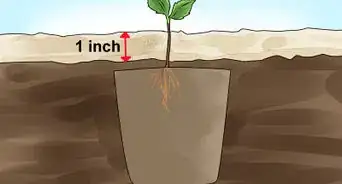
4Dig a large hole. The saying goes that you should dig at least a $60 hole for a $20 tree. As a practical matter, make sure you know where you want to place the tree, then dig a hole that is about three feet (1 meter) in diameter and as deep as the container. Do not bury the root crown, the transition from trunk to roots, as this will cause problems down the road. Plant the tree slightly higher than the surrounding soil to allow for some settling, most container grown nursery stock has high organic matter content that will decompose causing the plant to settle in the planting hole dropping the root crown below grade if not planted slightly high.[4]
- If you have any concerns about drainage, such as in heavy clay soil, fill the hole with water and see how long it takes to drain out. If you have drainage problems (that is, if the water is not gone by the next morning), dig the hole even deeper and plant the tree up higher.
- For a dwarf citrus tree, select a large pot. Try for two feet in diameter or a half-barrel, at least.
- If you have any concerns about drainage, such as in heavy clay soil, fill the hole with water and see how long it takes to drain out. If you have drainage problems (that is, if the water is not gone by the next morning), dig the hole even deeper and plant the tree up higher.
-
5Partially refill the hole with good, well-draining soil. Depending on the quality of what you took out of the hole, you might try a half-and-half mixture of compost and the now-loosened soil. Create a mound of soil in the middle of the hole that supports the root ball with the crown (the base of the tree trunk where the roots begin) slightly above it.
- Mix in some citrus fertilizer with the soil, if you like.
- If you are planting a dwarf citrus in a pot, use straight potting soil and fill it in to a similar level. Place the pot up on blocks and be sure there are plenty of drainage holes in the bottom. Don't let the pot sit directly in a saucer or puddle of water.
- Mix in some citrus fertilizer with the soil, if you like.
-
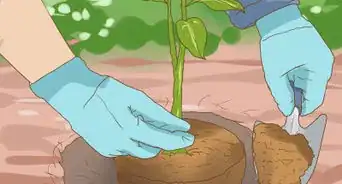
6Remove the tree from its pot and remove any burlap around the roots. Place the tree on the mound of soil. Add or remove soil underneath to adjust the height so that the crown is level with the soil or even slightly above it.
-
7Fill in the remaining hole with a mixture of compost or potting soil and the soil from your garden.
- If you are using a pot, fill with straight potting soil. Leave at least two inches at the top to allow space to water thoroughly.
-
8Do not apply mulch.[5]
- Stay away from organic mulch, as it increases the likelihood of foot rot disease.
- A safe bet is that the roots are at least as wide as the branches, so make the mulch area at least this large. You can even add a rim of mulch around the circumference of the circle to aid in watering.
- Do not mulch right up to the base of the trunk. Leave a little margin so that the crown has breathing room and doesn't stay wet when you water.
-
9Water the tree at least weekly until it is established, unless you get sufficient rain to do the job. Water even mature citrus trees regularly. Citrus trees have relatively shallow, broad root systems. Once established, the trees may tolerate some drought, but they won't produce fruit that's as good.[6]
-
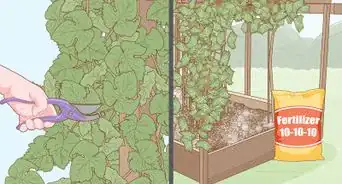
10Fertilize the tree with an appropriate fertilizer. Fertilizers are available in citrus or citrus-and-avocado formulations. Apply them according to package instructions, typically three to four times a year for slow-release types.[7]
-
11Prune citrus trees occasionally. They don't require heavy or regular pruning.[8]
- Remove any "suckers", or shoots growing from the rootstock. Citrus trees are grafted, meaning that a tree with desirable fruit is cut and attached to a sturdier rootstock. You don't want the rootstock taking over.
- Remove any "wild" shoots growing beyond the general shape of the tree. These will often be long, straight, quick-growing branches that don't follow the overall form or shape of the tree.
- Moderately thin the foliage if it grows excessively dense, to promote air circulation and availability of light.
- Generally, train citrus trees as shrubs or hedges. If you'd like to remove a few lower branches to give it more of a tree shape, go ahead, but don't overdo it.
- Remove any "suckers", or shoots growing from the rootstock. Citrus trees are grafted, meaning that a tree with desirable fruit is cut and attached to a sturdier rootstock. You don't want the rootstock taking over.
-
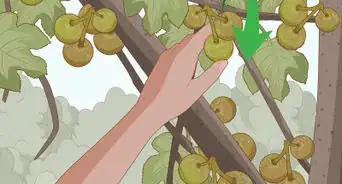
12Harvest fruit when it is fully ripe. Oranges, lemons, and grapefruit should all be completely free of green coloring. They will not ripen off the tree. Limes are generally picked green, so go by size and season. See the external links for more details on limes.[9]Advertisement
Community Q&A
-
QuestionHow long does it take a lime bush to produce fruit?
 Community AnswerTrees growing in tropical climates grow blossoms and yield fruit off and on all year. The yield timing is different for trees growing in Mediterranean climates. More than 300 hours of accumulated temperature below 68 degrees Fahrenheit induces flowering and fruit production. This is called the chill factor. Large numbers of citrus flowers drop from the tree after they open, and an equally large number of young fruits drop from the tree.
 -
QuestionMy miniature lemon tree dropped all of its leaves this winter. Is this normal?
 Community AnswerYes, in winter it is normal for trees to shed their leaves. They will grow back when it is warmer.
 -
QuestionHow much fertilizer should I use for citrus?
 Paradise NurseryCommunity AnswerIt depends on the size of the plant. Purchase citrus specific fertilizer, then read and follow the directions on the label.
 -
QuestionWhich fertilizer should I apply to citrus plants?Community AnswerOrganic, seaweed-based fertilizers work very well and promote leaf/ fruit/ flower growth. You can find various citrus fertilizers on the market, as well. It would be ideal to use a more nitrogen-rich fertilizer in spring/summer, when trees' leaves and stems are actively growing. During late summer/autumn, you can use a more balanced fertilizer and then a more phosphorus/potassium based fertilizer when the tree's energy is directed toward its fruits rather than its leaves.
-
QuestionShould a tree be grafted above or below the soil level?Community AnswerA tree should be grafted above the average soil level, which is about 3-5 feet high. Failure to do so will cause the plant to shrivel, unless it is a small or medium-sized plant.
-
QuestionWhen is the best time to prune citrus trees?
 Community AnswerThe best time to prune citrus trees is early spring. Never do it in autumn!
 -
QuestionI bought a navel orange tree at The Home Depot a week ago. It is still in the pot, and the leaves are falling off. Why is that?
 Community AnswerIf you water too much and the soil is soggy wet, you need to change your water schedule immediately - before the phytophthora kills the tree. Only water when the top inch or two of soil is dry and the leaves feel quite floppy. This could be once every two days in summer or once every three weeks/once a month in winter (depending on the climate). Follow these rules for over/underwatering a tree. Any citrus tree will lose some leaves occasionally (leaves last up to three years). Prevent major temperature/light fluctuations, as these can make leaves fall off. Your tree should replace all lost leaves.
 -
QuestionWill an orange tree in a pot grow larger by putting it in a larger pot?Community AnswerYes, an orange tree will outgrow smaller pots rather quickly so you will have to change pots as it grows bigger.
-
QuestionWhat time of year should I plant my satsuma tree that's in a pot now?Community AnswerProbrably around early spring would be best, but never do it in autumn or winter as that is when your satsuma tree is most likely to be starting to produce that year’s fruit.
-
QuestionHow long do citrus fruits take to reach maturity on a fully grown citrus tree?Community AnswerIt depends on the fruit. An orange tree grafted onto root stock can take 3 years to begin producing. A citrus tree grown from seed can take up to 15 years before it starts producing. Lemon trees can take up to 12 months to bear fruit.
Warnings
- In citrus producing areas and other parts of the US, if there is an "epidemic" of any contagious diseases or pests, the Dept. of Agriculture may come on a person's property, rip out the trees, and haul them away to be burned. That is why it's important to ensure the health of a tree before buying it.Thanks!
- Don't plant your tree near septic tank lines, or the roots may eventually cause issues with clogging.Thanks!
- Use caution when handling the fruit as the citric acid can cause eye-irritation.Thanks!
- WLD (Winter Leaf Drop) is a phenomena that appears when the roots and the leaves work asynchronous. Especially in colder areas the roots work slower because of the "cold" earth, while the leaves are shone by the sun and work properly. An evidence that your plant(s) start to suffer from WLD can be the discoloring of the leaves.[10]Thanks!
- Look out for thorns. Some citrus trees grow long, sharp thorns, and getting citrus juice in the cuts from these thorns is absolutely painful. Look closely, and wear gloves or use a long-handled fruit picker.Thanks!
- Full-sized lemon trees can make a lot of lemons. Think about what you will do with that many before you plant them.Thanks!
- Too much of a good thing, including fertilizer, is no longer a good thing. Fertilize according to package instructions and don't overdo it. Excess fertilizer (either too much or too often) can lead a plant to grow too fast and weaken the plant and leech into ground water or run off into the surrounding environment.Thanks!






References
- ↑ https://www.almanac.com/plant/lemons-oranges
- ↑ https://www.bhg.com.au/growing-lemon-trees-how-to-plant-and-grow-lemons
- ↑ https://gardenerspath.com/plants/fruit-trees/dwarf-citrus-valuable-plant-home-gardening/
- ↑ https://ucanr.edu/sites/VCMG/Planting_and_Care_of_Young_Citrus_Trees/
- ↑ https://aggie-horticulture.tamu.edu/fruit-nut/fact-sheets/citrus/
- ↑ https://cals.arizona.edu/extension/ornamentalhort/landscapemgmt/general/citrusirrigation.pdf
- ↑ https://acis.cals.arizona.edu/docs/default-source/agricultural-ipm-documents/publications/2015/az1671-2015.pdf?sfvrsn=4cecfc9a_4
- ↑ https://extension.arizona.edu/sites/extension.arizona.edu/files/pubs/az1455.pdf
- ↑ http://gardeningsolutions.ifas.ufl.edu/plants/edibles/fruits/citrus.html