This article was co-authored by Patrick Muñoz. Patrick is an internationally recognized Voice & Speech Coach, focusing on public speaking, vocal power, accent and dialects, accent reduction, voiceover, acting and speech therapy. He has worked with clients such as Penelope Cruz, Eva Longoria, and Roselyn Sanchez. He was voted LA's Favorite Voice and Dialect Coach by BACKSTAGE, is the voice and speech coach for Disney and Turner Classic Movies, and is a member of Voice and Speech Trainers Association.
This article has been viewed 9,542 times.
The secret to a successful impromptu speech is to anchor it in your personal experience. Your experience may be different, but it is never "wrong". Even if you're invited to speak on something you don't know well, turn it around and speak from experience. Always "go with what you know".
Steps
-
1Know what an impromptu speech is. By definition, impromptu speeches happen without warning, but the very nature of your initial invitation (before the impromptu invitation) may give you a chance to think ahead. There are three common impromptu speeches: birthdays, toasts, and "vote of thanks".
-
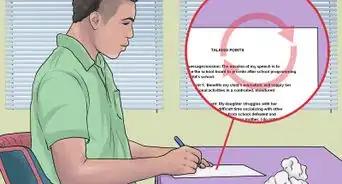
2Be prepared. Even impromptu speeches rarely come with no warning. Even if you only have 2-3 minutes, write 3 points on the back of a napkin, written large, so you can read it while standing. You should feel you can confidently speak on each point [or 'theme'] for at least one minute, from experience.[1] If not, you have picked the wrong three points.Advertisement
-
3Start with the easy and obvious if it makes it easier to start, e.g. "I'm glad we're all gathered here today, even if Gillian did spring this speech thing on me..."
-
4Relate to and connect with your audience.[2] Make it relevant. A builder talking to doctors may seem to have little common ground, until you point out that both professions have to deal with problems and people, e.g. "You know, we have a lot in common. Every day I'm dealing with troublesome inanimate objects which I call carpentry but you call patients." [laughter, pause] "And there is nothing more satisfying than fixing some slippery sucker with a nail gun." The audience has now warmed to your theme!
-
5Remember that you don't have to accept the premise on which you're invited to speak. Or, you might spend 2 minutes exploring it and 2 minutes debunking it.
-
6Avoid making statements, even in jest, which compromise your principles. In a moment a tweet, video or other medium can send your statement viral. A reputation takes years to earn and milliseconds to burn.
-
7Use humour in proportion to your skill, Better a short and heartfelt speech than one laced with tasteless jokes that fall flat.
-
8Use your three points, or an ending, moral or exhortation (also known as a "call to action") to draw together the threads of what you have said. Return to acknowledge the audience, organisation, or key person/s at the event.[3] If you have contrasted your experience with that of the audience, allow yourself to come of "just-so" slightly worse, as this humility will endear you to your audience. You want to finish with a bang, not a whimper and sometimes speeches have a "natural stop point" even if this leaves some things unsaid.Advertisement


Community Q&A
-
QuestionHow can I come across as energetic?
 Community AnswerPretend you are speaking to your best friends about the best thing that could've possibly happened to you. Be passionate. If your speech is about something you are not passionate about, fake it. Body language is key. Use hand movements, move around, and smile.
 -
QuestionHow do I elucidate my thesis without obfuscating my substance?
 DonaganTop AnswererUse common words in short sentences.
 -
QuestionI'm going to present an impromptu speech in a competition, what should I do in the five minutes of preparing?DonaganTop AnswererSearch your memory for any experience you may have with the topic of the speech, even if it's only incidental. If you're allowed to speak with others, ask if they have any such experience.











References
About This Article