This article was co-authored by wikiHow Staff. Our trained team of editors and researchers validate articles for accuracy and comprehensiveness. wikiHow's Content Management Team carefully monitors the work from our editorial staff to ensure that each article is backed by trusted research and meets our high quality standards.
There are 7 references cited in this article, which can be found at the bottom of the page.
This article has been viewed 1,597 times.
Learn more...
As an extra safety measure, the U.S. Congress passed the REAL ID Act in 2005. This requires anyone boarding a plane within the United States or entering a U.S. government facility after October 20th, 2020 to show a REAL ID-compliant form of identification.[1] A REAL ID is similar to an enhanced license in that it requires more documentation to obtain and, in most states, it has a special symbol on it (a black or gold star in the corner). You can obtain a REAL ID in-person from your state’s Department of Motor Vehicles (DMV).
Steps
Part 1
Part 1 of 2:Gathering the Necessary Documents
-
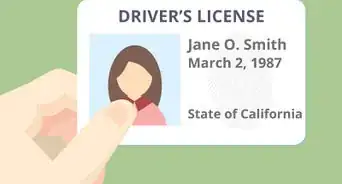
1Locate your driver’s license, birth certificate, or passport. One of these documents is required to show your name and date of birth. Make sure that the form of identification you choose includes your full name (first, middle, and last). This is how the name will show up on your REAL ID.[2]
- In some cases, you may be required to provide more than 1 of these items, so check with your DMV.
-
2Provide proof of your legal name if you have changed it. If your name is different from the name on your driver’s license, birth certificate, or passport, you will need to provide an additional form of documentation. You can use a marriage license or court order to show that your legal name has changed.[3]
- Make sure that your first, middle, and last name appear correctly on the document you use.
Advertisement -
3Find proof of your social security number or ineligibility to have one. You may use your social security card or a W-2 that includes your full social security number on it. If you are ineligible for a social security card, then you may also bring a letter from the Social Security Administration.[4]
- If you lost your social security card, get a replacement before applying for your REAL ID. You will need to contact the Social Security Administration to do this.
-
4Obtain proof of your USA citizenship or lawful status. You can use your birth certificate to prove that you are a U.S. citizen.[5] If you are not a U.S. citizen, then you will need to provide an alternate form of proof of lawful permanent or temporary residency. Other valid forms of proof of citizenship or lawful status include:[6]
- Valid, unexpired U.S. Passport
- U.S. Certificate of Citizenship
- Certificate of Naturalization
- A valid foreign passport with an unexpired U.S. visa and I-94 stamp
- Unexpired Employment Authorization Document (I-766) and USCIS form I-797
- Unexpired Permanent Resident Card
-
5Collect 2 utility bills to prove you are a resident of your state. To show that you are a legal resident of the state in which you are applying for a REAL ID, you will need to provide 2 utility bills that have your name and address on them. Make sure that your name and address appear correctly on the bills.[7]
- For example, you could bring your electric, gas, or water bill along with you to satisfy this requirement.
Tip: Keep in mind that requirements for the REAL ID vary from state to state, so you might have to provide more or less documentation depending on your state’s rules.[8]
Advertisement


Part 2
Part 2 of 2:Applying for a REAL ID
-
1Get a REAL ID to access government facilities and nuclear power plants or to fly commercially. Although the U.S. government is encouraging everyone to get a REAL ID, it is not a requirement. The only people who will need a REAL ID are those who need access to government facilities, military bases, or nuclear power plants, and those who plan to take commercial flights. Be sure to obtain your REAL ID by October 20, 2020 if you do need one. However, you do not need a REAL ID if you only want to:[9]
- Drive a car or other vehicle
- Vote or get registered to vote
- Enter government buildings that don’t require a REAL ID, such as museums
- Apply for federal benefits and other resources
- Access healthcare services, law enforcement services, and to participate in constitutionally protected activities
- Participate in law enforcement proceedings and investigations
-
2Take all of the required documents to your local DMV. Make sure that you have all of the required documents together when you go to apply for a REAL ID. The employees at the DMV will need to see the original documents, so you cannot just make copies and bring them.[10]
- Place the documents into a large envelope to keep them together.
-
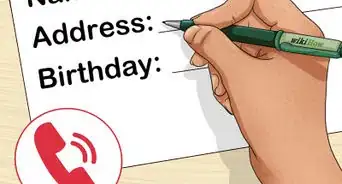
3Fill out the required form at the DMV. When you visit the DMV, get the required form and fill it out according to its instructions. Each state's DMV will have a different form for the ID, so you will have to check with yours to find out what that is.[11]
- Note that you cannot apply for your first REAL ID online, but you will be able to renew your ID online later on.
Tip: Expect to have your photo taken when you apply for the REAL ID. A new photo is required to ensure that your image is up to date.[12]
-
4Pay the required fees for the ID. The REAL ID does not cost any more or less than a regular state ID or driver’s license. The fee varies by state, so check with yours to find out what you will have to pay. Bring cash, a check, or a debit card to pay the fee when you submit your application.[13]
- For example, in North Carolina, the fee ranges from $13 to $20 depending on the type of license.[14]
Advertisement













References
- ↑ https://www.tsa.gov/real-id
- ↑ https://dmv.ny.gov/driver-license/federal-real-id
- ↑ https://www.michigan.gov/sos/0,4670,7-127-1627_81569---,00.html
- ↑ https://dmv.ny.gov/driver-license/federal-real-id
- ↑ https://dmv.ny.gov/driver-license/federal-real-id
- ↑ https://www.dmv.virginia.gov/webdoc/pdf/dmv141.pdf
- ↑ https://dmv.ny.gov/driver-license/federal-real-id
- ↑ https://www.tsa.gov/real-id
- ↑ https://dmv.ny.gov/driver-license/federal-real-id
- ↑ https://www.ncdot.gov/dmv/license-id/nc-real-id/Pages/default.aspx
- ↑ https://www.ncdot.gov/dmv/license-id/nc-real-id/Pages/default.aspx
- ↑ https://www.ncdot.gov/dmv/license-id/nc-real-id/Pages/default.aspx
- ↑ https://www.ncdot.gov/dmv/license-id/nc-real-id/Pages/default.aspx
- ↑ https://www.ncdot.gov/dmv/license-id/driver-licenses/Pages/licenses-fees.aspx
About This Article