This article was co-authored by Steve Downs and by wikiHow staff writer, Hannah Madden. Steve Downs is a Live Honey Bee Removal Specialist, Honey bee Preservationist, and the Owner of Beecasso Live Bee Removal Inc, a licensed bee removal and relocation business based in the Los Angeles, California metro area. Steve has over 20 years of humane bee capturing and bee removal experience for both commercial and residential locations. Working with beekeepers, agriculturalists, and bee hobbyists, Steve sets up bee hives throughout the Los Angeles area and promotes the survival of bees. He has a passion for honeybee preservation and has created his own Beecasso sanctuary where rescued bee hives are relocated and preserved.
There are 7 references cited in this article, which can be found at the bottom of the page.
Wood bees, or carpenter bees, are valuable pollinators, but they can also cause a lot of damage to wooden structures. If you have wood bees in your area, you might be wondering how you can get rid of them without using pesticides or insecticides in your home. Fortunately, there are a lot of natural ways you can get rid of small infestations and deter the bees from coming back next year.
Steps
Method 1
Method 1 of 12:Use loud noises.
-
1Wood bees are sensitive to noise. Point a radio or speakers at the nest and play music as loud as you can for at least a day. Eventually, most of the bees will fly out, and they’ll probably relocate somewhere else. Try to keep playing loud noise for a few more days to ensure the bees don't come back.[1]
- You can also tap the wood with something hard repeatedly to make a loud noise and drive them out.

Method 2
Method 2 of 12:Use almond oil in and around wood.
-
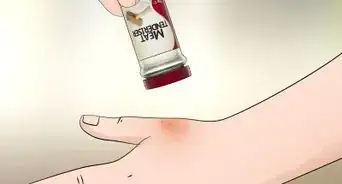
1Bees don’t like the smell of almond oil.[2] Grab a bottle of almond essential oil and use an eyedropper to dab some on and around the wood where the bees live. If you want to treat an entire length of wood, fill a spray bottle with water and add about 10 drops of almond essential oil. Use the mixture to spritz the entire area and coat the whole length of wood.[3]
- Essential oils are generally safe, but they can cause irritation if you come into direct contact with them. Always dilute them before using them, and try not to get them on your bare skin.

Method 3
Method 3 of 12:Provide a new home for the bees.
-
1This is a good way to get rid of wood bees without killing them. Wood bees are important pollinators, so consider setting up a different area for them to live so they're out of your hair but still free to do their thing.[4] Find a spot in a sunny location that’s protected from the rain, then place a small bundle of softwood there in a pile. You can encourage the bees to move to this habitat by drilling 1⁄2 in (1.3 cm) diameter holes into the end of each log.[5]
- Softwood includes pine, fir, and spruce.
- Keep the bundle dry to prevent damage or rot.
- Do this method in conjunction with a natural repellent, like almond oil. That way, the bees will have an incentive to look for a different habitat.

Method 4
Method 4 of 12:Vacuum bees out of holes in the wood.
-
1Wood bees aren’t very strong, so you can physically remove them yourself. Grab your vacuum and put the hose attachment on the end. Stick the nozzle onto the holes in the wood, then turn the vacuum on. Once you’ve sucked out as many bees as you can, empty the vacuum into a bucket and drown the bees in water or relocate them to a wood pile where you don’t mind them living.[6]
- Try doing this during the evening hours when the bees are less active.
- The vacuum method works well on newer nests, but it won’t be very effective on larger, more established ones.

Method 5
Method 5 of 12:Spray diesel or petrol into the holes.
-
1Petrol and diesel are effective at killing bees. Keep in mind that gasoline is flammable, so ensure that the wood bee’s nest isn’t near any open flames. Point the gas can nozzle into the hole, then pour the diesel or petrol into it. As you keep pouring, you’ll see dead bee bodies get flushed out of the wood.[7]
- Wear a mask, gloves, and goggles to stay safe.
- When you’re done, rinse the wood and the ground with water to dilute the gasoline so it can’t catch on fire.

Method 6
Method 6 of 12:Kill bees naturally with diatomaceous earth.
-
1This powdery substance contains fossils, called diatoms, that kill insects. The diatoms naturally dry out insects and kill them without using any sort of insecticide. Pick up a bag of diatomaceous earth from your local hardware store and put on gloves. Carefully sprinkle the powder into the holes made by the bees; once they come into contact with it, they’ll die.[8]
- If you have a large wood bee infestation, you may have to use diatomaceous earth more than once. Keep using it once a day until all the bees are dead.

Method 7
Method 7 of 12:Plug holes with steel wool and metal screens.
-
1Wood bees won’t be able to burrow through steel wool and metal screens. If you notice holes made by bees in your wood, grab a ball of steel wool and shove small pieces into each hole. Then, attach a metal screen in front of the holes with nails or screws so the bees can’t get in (or out). If you block off the route to their nest, the bees will eventually die inside the wood or find somewhere else to live.[9]
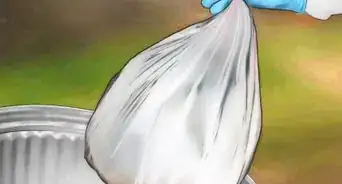
- Tape a large trash bag over a chimney entrance to prevent bees from getting into your chimney.[10]
- You can also do this after the wood bees have moved on from their nest in late summer. That way, they won’t be able to come back and make a nest in the same spot again.

Method 8
Method 8 of 12:Inject holes with boric acid.
-
1Boric acid is a natural salt that kills bees. Wear a mask and put on gloves and safety goggles as you work. Grab a tub of boric acid and sprinkle it into the holes made by the bees. When the bees come into contact with the boric acid, they will die. Keep doing this once a day until you don’t notice any bees anymore.[11]
- Boric acid is a sodium borate salt, similar to table salt.
- If you have small children or animals in the house, keep them away from the boric acid, as it can be toxic.

Method 9
Method 9 of 12:Trap bees with a bee trap.
-
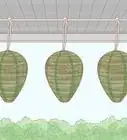
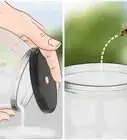
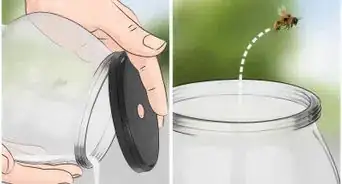
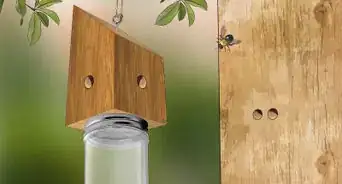
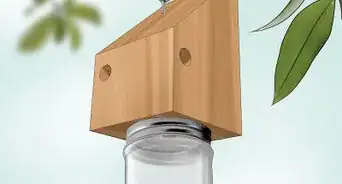
1You can make a bee trap yourself or buy one from a hardware store. Set up the bee trap near where the nest is, then wait for the bees to fall in. Once the bees fall into the trap, they will die because they can’t access food or water. When the trap is full, you can empty the dead bees out into the garbage.[12]
- Bee traps work for small infestations, but they don’t do much against larger wood bee colonies.

Method 10
Method 10 of 12:Paint any exposed wood.
-
1Bees have a hard time getting through paint. While stain isn’t very effective against wood bees, painted wood provides a nice, thick barrier against burrowing insects. If you have any exposed wood on your structure, consider painting it to prevent bees from entering it in the early summer time.[13]

Method 11
Method 11 of 12:Use pressure-treated wood when building large structures.
-
1Burrowing insects have a tough time getting through pressure-treated wood. If you’re building a new structure on your property and you have the choice, consider using pressure-treated lumber, or wood that’s gone through an intense amount of pressure to force water and preservatives deep into the grain. It will provide protection from wood bees and termites.[14]
- You can find pressure-treated wood at most hardware stores.

Method 12
Method 12 of 12:Fill and seal any holes in the wood.
-
1Take a look at your structure and find any small holes or cracks. If you don’t have wood bees in your wood yet, you can use caulk or putty to fill and seal the holes before the bees come. However, keep in mind that if the bees are already in the wood, putty and caulk is not strong enough to keep them out (or in).[15]
- If the bees are already in your wood, fill the holes with steel wool instead.

Community Q&A
-
QuestionHow can you make a bee trap without harming bees?
 Steve DownsSteve Downs is a Live Honey Bee Removal Specialist, Honey bee Preservationist, and the Owner of Beecasso Live Bee Removal Inc, a licensed bee removal and relocation business based in the Los Angeles, California metro area. Steve has over 20 years of humane bee capturing and bee removal experience for both commercial and residential locations. Working with beekeepers, agriculturalists, and bee hobbyists, Steve sets up bee hives throughout the Los Angeles area and promotes the survival of bees. He has a passion for honeybee preservation and has created his own Beecasso sanctuary where rescued bee hives are relocated and preserved.
Live Bee Removal SpecialistYou can use a cardboard or wooden box of your liking. Set it in an area out of harm's way. Make a small opening somewhere in the box so that bees can enter. Lightly apply a few drops of lemon grass oil during spring time, and hopefully you will capture a swarm. -
QuestionHow do you get a bee out of your house?Steve DownsSteve Downs is a Live Honey Bee Removal Specialist, Honey bee Preservationist, and the Owner of Beecasso Live Bee Removal Inc, a licensed bee removal and relocation business based in the Los Angeles, California metro area. Steve has over 20 years of humane bee capturing and bee removal experience for both commercial and residential locations. Working with beekeepers, agriculturalists, and bee hobbyists, Steve sets up bee hives throughout the Los Angeles area and promotes the survival of bees. He has a passion for honeybee preservation and has created his own Beecasso sanctuary where rescued bee hives are relocated and preserved.
Live Bee Removal SpecialistThe easiest way to remove bees flying around in your home is to open up the windows or a door, as bees are attracted to the outside light and will probably fly out on their own.
References
- ↑ https://www.homeremedyhacks.com/13-home-remedies-get-rid-carpenter-bees/
- ↑ Steve Downs. Live Bee Removal Specialist. Expert Interview. 23 February 2020.
- ↑ https://www.beyondpesticides.org/assets/media/documents/alternatives/factsheets/CARPENTER%20BEE%20CONTROL.pdf
- ↑ Steve Downs. Live Bee Removal Specialist. Expert Interview. 23 February 2020.
- ↑ https://www.uaex.edu/farm-ranch/pest-management/insect/carpenter-bee-control.aspx
- ↑ https://www.homeremedyhacks.com/13-home-remedies-get-rid-carpenter-bees/
- ↑ https://www.homeremedyhacks.com/13-home-remedies-get-rid-carpenter-bees/
- ↑ https://agrilife.org/aes/files/2014/06/Carpenter-Bees.pdf
- ↑ https://www.beyondpesticides.org/assets/media/documents/alternatives/factsheets/CARPENTER%20BEE%20CONTROL.pdf
- ↑ Steve Downs. Live Bee Removal Specialist. Expert Interview. 23 February 2020.
- ↑ https://portal.ct.gov/CAES/Fact-Sheets/Entomology/Carpenter-Bees
- ↑ https://entomology.ca.uky.edu/ef611
- ↑ https://www.uaex.edu/farm-ranch/pest-management/insect/carpenter-bee-control.aspx
- ↑ https://www.uaex.edu/farm-ranch/pest-management/insect/carpenter-bee-control.aspx
- ↑ https://www.beyondpesticides.org/assets/media/documents/alternatives/factsheets/CARPENTER%20BEE%20CONTROL.pdf
About This Article