This article was written by Steve Downs and by wikiHow staff writer, Hannah Madden. Steve Downs is a Live Honey Bee Removal Specialist, Honey bee Preservationist, and the Owner of Beecasso Live Bee Removal Inc, a licensed bee removal and relocation business based in the Los Angeles, California metro area. Steve has over 20 years of humane bee capturing and bee removal experience for both commercial and residential locations. Working with beekeepers, agriculturalists, and bee hobbyists, Steve sets up bee hives throughout the Los Angeles area and promotes the survival of bees. He has a passion for honeybee preservation and has created his own Beecasso sanctuary where rescued bee hives are relocated and preserved.
There are 10 references cited in this article, which can be found at the bottom of the page.
If you see round, hairy bees with black and yellow stripes flying around your yard, then you probably have a bumble bee nest somewhere nearby. Unlike other bees, bumble bees actually make their nests in the ground, which is why you might see them crawling in and out of the dirt around your home. Bumble bees are important pollinators, and their population is already threatened, so killing them isn’t ideal. That’s why we’ve provided a few non-lethal ways you can get rid of the bumble bee nest in the ground without killing the hive. And, if those methods don’t work, we’ve also provided a few options you can use to kill the bees and get rid of them for good.
This article is based off an interview with our live honey bee removal specialist and preservationist, Steve Downs, owner of Beecasso Live Bee Removal Inc. Check out the full interview here.
Steps
Method 1
Method 1 of 11:Cover the nesting holes.
-
1If the bees can’t get back in, they may find somewhere else to nest. Grab a few bricks or large stones and place them on top of the small holes that the bees use to crawl inside their nest. Leave the objects there for a few days so that the bees will (hopefully) find a new spot to make their own. Once you stop noticing bees, you can remove the bricks or stones from your yard to reveal a bee-free space.[1]
- If you’re worried about getting stung (bumble bees aren't super aggressive, but they will sting if they feel threatened), place the objects over the nest at night when the bees are less active.
Advertisement

Method 2
Method 2 of 11:Water your lawn.
-
1Bees are attracted to thin, dry soil. If you notice that the bees in your yard are just starting to build their nest, water the area for about 3 to 4 days, making sure to soak the ground completely every time. Hopefully, this will deter the bees enough that they’ll move out of the nest and fly off somewhere else.[2]
- Try not to spray the bees with water directly, since this can agitate them and make them aggressive. Instead, wait until the evening time when the bees aren’t active so there’s no danger of getting stung.

Method 3
Method 3 of 11:Sprinkle cinnamon into the holes of the nest.
-
1Cinnamon is a great natural bee repellent. If you can find the holes where the bees are entering the nest, grab some ground cinnamon and mix a little bit with water.[3] Spray the nesting holes generously with your mixture for a couple of days until you don’t notice any bees flying in and out anymore.
- Don’t spray your mixture directly on a bee, since that could agitate it (and make it angry). Instead, wait until you don’t see any bees around, and then go in with your cinnamon and water.
Advertisement

Method 4
Method 4 of 11:Spray a vinegar mixture around the nest.
-
1Bees also dislike the smell of vinegar.[4] Pour some white vinegar or apple cider vinegar into a spray bottle and spritz the holes around the nest generously. Keep doing this for a couple of days until you don’t see any bees flying around your yard anymore.[5]
- If you aren’t a fan of the smell of vinegar either, don’t worry—as it dries, the smell will fade, and after a few days, it shouldn’t be an issue anymore.

Method 5
Method 5 of 11:Repel the bees with an orange or almond oil spray.
-
1These strong scents have been proven to drive bees away.[6] Either sprinkle a few drops of the oil around the nest directly onto the ground, or dilute the oil in water and spritz the holes leading into the nest. You can also apply this mixture to plants to help deter the bees from landing in your garden.[7]
- Essential oils are mostly safe, but they can cause skin irritation. If you plan on using essential oils, don’t get them on your hands, and call poison control if you accidentally ingest any.[8]
- If you have any pets, keep them away from the area after using essential oils. Certain oils (including citrus oils) are toxic to dogs and cats, and even skin contact can make them sick.[9]
Advertisement

Method 6
Method 6 of 11:Trap bees with a cardboard or wooden box.
-
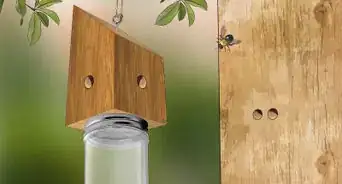
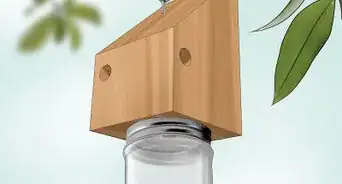
1Then, you can relocate the bees elsewhere. Grab a cardboard or wooden box and make a small opening in one of the sides. Add a few drops of lemon grass oil, then put the box somewhere near the nest that’s out of harm’s way. Wait for about a day, then check the box (carefully!) to see how many bees are inside.[10]
- Once you’ve collected a lot of bees (usually, there are 40 to 50 in a swarm), you can call a beekeeper to come and take the hive.
- Trapping bees works best in the springtime, since that’s when they’re most active.

Method 7
Method 7 of 11:Leave the nest alone until summer if you can.
-
1Once fall starts rolling in, the bees will fly away from the nest on their own. If the bees in your yard aren’t a huge problem (or they’re kind of far away from your home), you can simply leave them be for a few months. Once the bees fly away, cover up the nesting area with a tarp to deter the bees from coming back again next season.[11]
- Nesting season usually only spans the springtime, so you can remove your tarp once summer rolls around.
Advertisement

Method 8
Method 8 of 11:Get the nest removed by a beekeeper.
-
1Some beekeepers will remove bumble bee nests and take the hive with them. Experts don’t recommend trying to move a hive on your own, especially one in the ground, since it can be tough to do without getting stung. Try searching up your local beekeeper association and calling someone close by to see if they need any bees. They’ll be able to come out fully suited up and do their best to remove the hive without killing any bees.[12]
- Some beekeepers may charge a small fee for this, but a lot of them will do it for free.

Method 9
Method 9 of 11:Spray soapy water into the holes.
-
1This is a non-toxic way to get rid of bees, but it is lethal. If you’re out of options and you really want to get rid of the bees in your yard, mix equal parts dish soap and water in a spray bottle and then spray the mixture down into the holes where the bees are. After a couple of minutes, the soap and water mixture will kill any bees it comes into contact with.[13]
- After you spray your mixture, seal the hole with a brick or a rock to make sure the bees can’t crawl out of the nest.
Advertisement


Method 10
Method 10 of 11:Treat the nest with insecticide as a last resort.
-
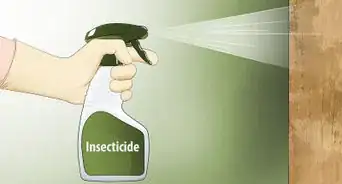
1Insecticides will kill the bees, which isn’t ideal. However, if you’re truly fed up with dealing with the bees (or they’ve stung you multiple times), head to the hardware store and pick up a bottle of insecticide. Read the directions on the bottle carefully, and wear gloves and safety goggles whenever you spray. Try to only spray the insecticides in the nesting area to avoid killing any other insects in your yard.[14]
- Insecticides are dangerous, and they can be toxic. Keep any pets and small children out of the area if you plan to use insecticides.

Method 11
Method 11 of 11:Prevent new nests with mulch.
-
1Mulch makes it hard for bees to burrow underground. If you don’t want the bees coming back next season, wait until late summer or early fall and add a thin layer of mulch to the nesting area. Bees are also attracted to thin, sparse soil, so try to grow thick grass in the areas that you don’t want any bees.[15]
- You can also try removing plants and trees that attract bees (basically anything that flowers).[16]
Advertisement

References
- ↑ https://bpca.org.uk/pest-aware/bee-control-how-to-get-rid-of-bees-bpca-a-z-of-pests/189185
- ↑ https://ipm.ces.ncsu.edu/2014/03/pest-alert-ground-bees-active-but-do-not-threaten-people-or-yards/
- ↑ Steve Downs. Live Bee Removal Specialist. Expert Interview. 23 February 2020.
- ↑ Steve Downs. Live Bee Removal Specialist. Expert Interview. 23 February 2020.
- ↑ https://gardencollage.com/wander/gardens-parks/home-gardeners-guide-safe-bee-friendly-pesticides/
- ↑ Steve Downs. Live Bee Removal Specialist. Expert Interview. 23 February 2020.
- ↑ https://gardencollage.com/wander/gardens-parks/home-gardeners-guide-safe-bee-friendly-pesticides/
- ↑ https://www.healthywa.wa.gov.au/Articles/A_E/Essential-oils
- ↑ https://www.aspca.org/news/latest-home-trend-harmful-your-pets-what-you-need-know
- ↑ Steve Downs. Live Bee Removal Specialist. Expert Interview. 22 February 2021.
- ↑ https://bpca.org.uk/pest-aware/bee-control-how-to-get-rid-of-bees-bpca-a-z-of-pests/189185
- ↑ https://extension.umn.edu/yard-and-garden-insects/wasps-and-bees#treating-or-removing-honey-bee-and-bumble-bee-nests-1465461
- ↑ David Williams. Beekeeper & Bee Removal Specialist. Expert Interview. 13 February 2020.
- ↑ https://extension.umn.edu/yard-and-garden-insects/wasps-and-bees#treating-or-removing-honey-bee-and-bumble-bee-nests-1465461
- ↑ https://ohioline.osu.edu/factsheet/HYG-2143-10
- ↑ Steve Downs. Live Bee Removal Specialist. Expert Interview. 23 February 2020.
- ↑ David Williams. Beekeeper & Bee Removal Specialist. Expert Interview. 13 February 2020.
About This Article